The Japan Times - En garde! Wasps use penis spikes to ward off predators

EUR -
AED 4.323663
AFN 75.347698
ALL 95.528884
AMD 433.357851
ANG 2.107244
AOA 1080.76821
ARS 1633.856661
AUD 1.622053
AWG 2.120625
AZN 1.998435
BAM 1.95745
BBD 2.371979
BDT 144.501779
BGN 1.963868
BHD 0.444762
BIF 3505.049681
BMD 1.177307
BND 1.490912
BOB 8.13772
BRL 5.783991
BSD 1.177682
BTN 111.001246
BWP 15.768021
BYN 3.328106
BYR 23075.220654
BZD 2.368556
CAD 1.60434
CDF 2726.643841
CHF 0.915594
CLF 0.026771
CLP 1053.619683
CNY 8.018934
CNH 8.004864
COP 4375.579851
CRC 540.246115
CUC 1.177307
CUP 31.19864
CVE 110.358004
CZK 24.307746
DJF 209.713173
DKK 7.473711
DOP 70.036942
DZD 155.656005
EGP 62.059278
ERN 17.659608
ETB 183.885946
FJD 2.567817
FKP 0.865876
GBP 0.864232
GEL 3.154767
GGP 0.865876
GHS 13.24894
GIP 0.865876
GMD 86.554381
GNF 10335.710425
GTQ 8.992349
GYD 246.393463
HKD 9.220446
HNL 31.307986
HRK 7.535707
HTG 154.245405
HUF 355.876999
IDR 20367.943937
ILS 3.423391
IMP 0.865876
INR 110.813802
IQD 1542.754293
IRR 1545804.322744
ISK 143.820085
JEP 0.865876
JMD 185.496327
JOD 0.834676
JPY 184.107546
KES 152.049068
KGS 102.920785
KHR 4723.900821
KMF 493.292187
KPW 1059.5893
KRW 1707.760614
KWD 0.362316
KYD 0.98141
KZT 545.383409
LAK 25844.34129
LBP 105461.686315
LKR 379.218313
LRD 216.108454
LSL 19.214893
LTL 3.476282
LVL 0.712141
LYD 7.449278
MAD 10.794097
MDL 20.261731
MGA 4890.03801
MKD 61.637784
MMK 2472.158404
MNT 4215.283897
MOP 9.499044
MRU 47.11971
MUR 55.003406
MVR 18.195334
MWK 2042.086278
MXN 20.25245
MYR 4.602768
MZN 75.241442
NAD 19.21473
NGN 1599.277482
NIO 43.336522
NOK 10.868907
NPR 177.604659
NZD 1.968697
OMR 0.452674
PAB 1.177672
PEN 4.079238
PGK 5.125319
PHP 71.048724
PKR 328.138038
PLN 4.227757
PYG 7208.074609
QAR 4.292718
RON 5.266061
RSD 117.394022
RUB 87.91019
RWF 1726.5257
SAR 4.424583
SBD 9.441335
SCR 16.221677
SDG 707.017566
SEK 10.825925
SGD 1.490041
SHP 0.878979
SLE 29.020987
SLL 24687.538318
SOS 673.055784
SRD 44.044242
STD 24367.881574
STN 24.520456
SVC 10.304684
SYP 130.149312
SZL 19.208617
THB 37.833955
TJS 11.005488
TMT 4.126462
TND 3.416079
TOP 2.834673
TRY 53.266239
TTD 7.966579
TWD 36.95391
TZS 3054.738898
UAH 51.56956
UGX 4404.674629
USD 1.177307
UYU 47.089685
UZS 14271.026915
VES 580.996894
VND 30974.951806
VUV 139.032561
WST 3.192283
XAF 656.499112
XAG 0.01452
XAU 0.000248
XCD 3.181731
XCG 2.122426
XDR 0.817538
XOF 656.510274
XPF 119.331742
YER 280.934968
ZAR 19.142485
ZMK 10597.173903
ZMW 22.434526
ZWL 379.09243
  • RIO

    -0.4400

    105.07

    -0.42%

  • BCE

    0.2450

    24.475

    +1%

  • NGG

    -0.9400

    86.91

    -1.08%

  • CMSC

    0.0000

    23.01

    0%

  • BCC

    -0.0300

    74.21

    -0.04%

  • JRI

    -0.0300

    13.14

    -0.23%

  • GSK

    0.0700

    50.6

    +0.14%

  • RYCEF

    -0.1700

    17.33

    -0.98%

  • VOD

    -0.2250

    15.905

    -1.41%

  • BTI

    -1.1700

    58.39

    -2%

  • BP

    -1.1050

    43.525

    -2.54%

  • RELX

    -1.7500

    34

    -5.15%

  • CMSD

    0.0000

    23.42

    0%

  • AZN

    -2.5600

    182.36

    -1.4%

  • RBGPF

    0.0000

    63.18

    0%

En garde! Wasps use penis spikes to ward off predators
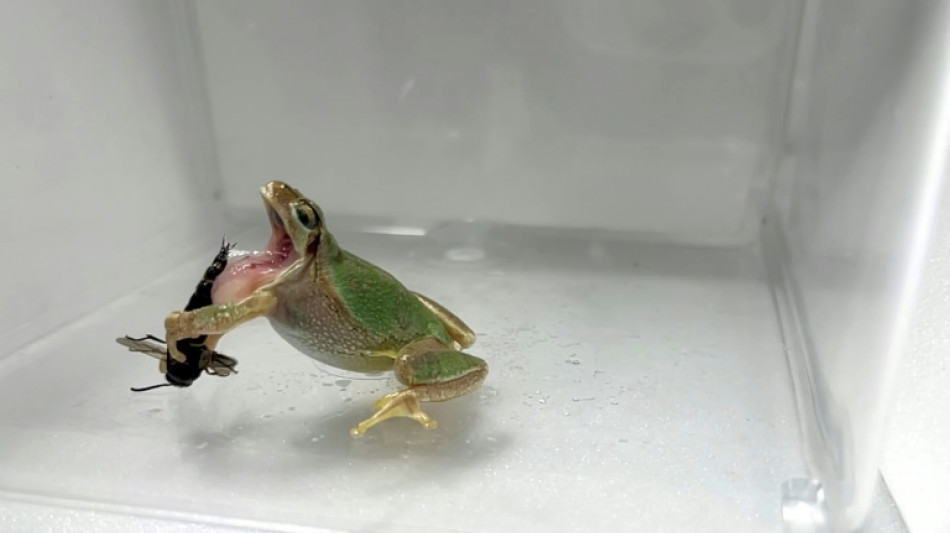
En garde! Wasps use penis spikes to ward off predators / Photo: Shinji SUGIURA - Kobe University/AFP

En garde! Wasps use penis spikes to ward off predators

An accidental sting has helped Japanese scientists prove some male wasps have a rather unusual predator defence weapon: penis spikes.

Text size:

While wasps are known for their prickly attacks, only females have a real sting in their tails. Their male counterparts generally evade predators by mimicking the fairer sex.

Scientists had theorised that some male wasps might have other defence mechanisms, including perhaps deploying their genital spikes.

"However, the evidence was lacking," explained Shinji Sugiura, an ecologist at Japan's Kobe University.

Sugiura studies animal anti-predator defences but it was only by chance that he investigated the unusual male wasp mechanism, after his graduate student and co-author reported being stung by a mason wasp.

"I tried to be stung after hearing her experience," Sugiura told AFP.

"Because I had believed male wasps as harmless, I was very surprised to experience the pain."

Female wasps sting via an ovipositor, a tube-like protrusion that deposits eggs but can also deliver a venomous riposte.

Male wasps lack the organ but are equipped with two large spikes that sit either side of their penis.

To test the effectiveness of this defence, Sugiura's team offered up male mason wasps to two different kinds of frogs to see how the spikes were deployed.

"Male wasps were frequently observed to pierce the mouth or other parts of frogs with their genitalia while being attacked," Sugiura reported in research published Tuesday in the Current Biology journal.

The attacks are documented in a video that shows an unfortunate frog trying repeatedly to chomp down on a wasp, before using its front feet to pull the stinging insect out of its mouth.

Pond frogs happily ate all the males, as well as stinging females, but over a third of tree frogs rejected the male wasps after being stung.

When the experiment was repeated with the genital spikes removed from the wasps, the tree frogs no longer held back and ate them without hesitation.

"The difference was statistically significant. Even a small difference of survival could cause the evolution of anti-predator devices in insects," Sugiura said.

There has been little research on insect genitalia outside of its role in reproduction, according to Sugiura, though the wasp defence mechanism is not entirely without precedent.

Previous research has found, for example, that some species of hawkmoth use their genitalia to emit ultrasound that jams bat sonar.

Sugiura is no stranger to uncovering some of the weirdest ways animals evade their predators.

He has documented how some beetles can escape after being swallowed, by following the digestive tract to its logical conclusion and escaping from the anus.

And he has shown that other insects can make any unfortunate toad that has eaten them vomit them back up.

He now hopes to expand his current research to determine whether other wasp families have the same genital spike defence mechanism.

Y.Kato--JT