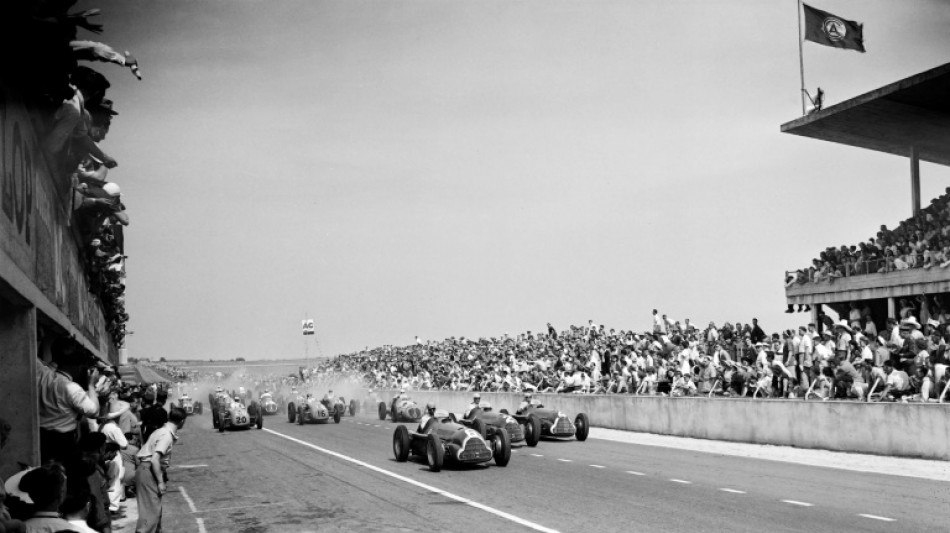
Six things about the first F1 world championship of 1950 / Photo: - - AFP/File

This year marks the 75th anniversary of the very first Formula One world championship in 1950 which featured seven races and was won by the Italian Giuseppe Farina.
AFP Sport picks out six things to know about that first summer of speed.
- Origins -
Grand Prix racing dates back much further than 1950, almost to the moment that the first automobiles appeared on the road. In fact the first recorded race took place in 1894 when Count Jules-Albert de Dion won the 126km Paris–Rouen rally at an average speed of 19kph (12mph).
The first closed-circuit race came in 1903 in Athy, Ireland and the first race to carry the label of Grand Prix is thought to have been at Le Mans in 1906 - although some vouch for Pau in 1901.
A manufacturers' championship took place in the 1920s but it was only after World War Two and the emergence of the FIA as the new governing body that the new competition would begin.
- Programme -
The previous three years had seen a variety of one-off Formula One races with no overall competition. That changed with the 1950 championship which comprised six races in Europe - Britain, Monaco, Switzerland, Belgium, France and Italy - and one in the US.
The Indianapolis race was effectively a stand-alone as it took place one week after Monaco and none of the European racers took part.
The European races involved four works teams - Alfa Romeo, Ferrari, Maserati, and Talbot-Lago - and 26 privateers. Mercedes only joined the championship in 1954.
- Champion Farina -
History remembers well the exploits of Juan Manuel Fangio for his five world titles but this inaugural season belonged to his Alfa Romeo teammate, the Italian Giuseppe 'Nino' Farina.
They won three races each but Turin-born Farina's fourth place in Belgium gave him the championship with 30 points to Fangio's 27.
He won the first race in front of an estimated 200,000 spectators at Silverstone on May 13 and secured the title with victory in Monza on September 3.
At 43 he remains the second-oldest champion, behind only Fangio who was 47 when he took his final title in 1957.
Farina was also the first champion to die when he was killed in a road accident on his way to the 1966 French Grand Prix where he was due to perform as driving double for Yves Montand in the film 'Grand Prix'.
- Monaco pile-up -
Although not as fast as today, the early cars were far more dangerous, the first serious pile-up happening on the opening lap in the second race at Monaco, when a wave flooded the track at Tabac Corner.
Farina, who was second at the time, spun and crashed. Leader Fangio drove clear but eight more drivers crashed and retired, albeit unhurt.
On the second lap, Jose Froilan Gonzalez crashed his already-damaged Maserati which caught fire. Only seven of the 19 starters completed the race.
Gonzalez recovered from his burns, going on to win the 1951 British Grand Prix and the 1954 Le Mans, but others competing in the 1950 season were not as fortunate as the 'Pampas Bull'.
- Dangerous games -
Less than two months after driving a Maserati 4CL at Silverstone, Joe Fry was killed at the Blandford hill climb while Raymond Sommer, who was fourth in Monaco, died when his car overturned during a race at the Circuit de Cadours - just one week after he placed eighth in the Formula One season-closer in Monza.
Another five of the class of 1950 - Alberto Ascari, Louis Rosier, Guy Mairesse, Peter Whitehead and Harry Schell - would lose their lives in racing accidents while David Murray perished in a road accident in the Canary Isles in 1973.
Ascari is the only Italian to win the title for Ferrari and he remains the only driver along with Michael Schumacher to deliver back-to-back world titles for 'Il Cavallino'.
- The Prince -
Formula One has attracted its share of wealth and glamour, such as Johnny (the Earl of) Dumfries but few can match the royal bloodline of His Highness Prince Birabongse Bhanudej who finished eighth in the 1950 championship after taking part in four races.
B. Bira, as he was known on the track, started auto racing in a Riley Imp in England in 1935, adoping the pale blue and yellow racing colours of Siam.
That's right, Siam. His paternal grandfather was King Mongkut, loosely portrayed by Yul Brunner in the movie 'The King and I'.
Aged 36 and driving a powerful Maserati 4CLT/48, he finished fifth in Monaco and fourth at Bremgarten in Switzerland.
Other characters in that first season included Belgian Jazz trumpeter Jonny Claes and Monegasque Louis Chiron, who was a driver for Marshals Petain and Foch of the French army during the First World War.
Born in 1899, Chiron would become the oldest driver ever to have started an F1 race when he came sixth in Monaco in 1955 at the age of 55.
Luigi Fagiola, meanwhile, was the only driver born in the 19th century to win a Grand Prix when he took the chequered flag in France in 1951 at the age of 53.
M.Saito--JT