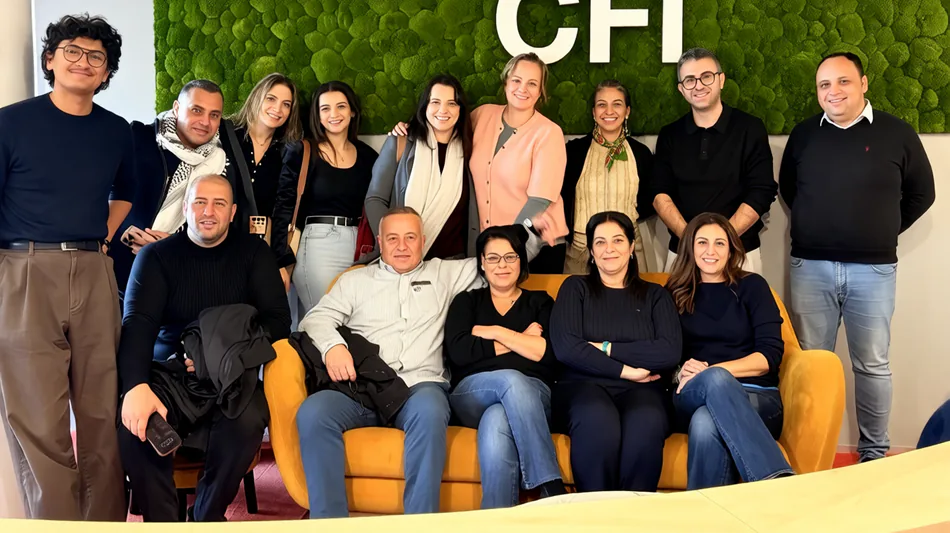
Palestinian Media Delegation Concludes Brussels and Paris Visit, Calls for Greater Support for Press Freedom

A Palestinian media delegation has concluded its participation in an international media conference organized by the French media development agency CFI in Paris, following a visit to Brussels where they met with EU officials. The group highlighted challenges facing independent journalism and called for stronger support for press freedom.
A Palestinian media delegation has concluded its participation in an international media conference organized by the French media development agency CFI in Paris, following a visit to Brussels where journalists held a series of meetings with European Union officials. The discussions focused on challenges facing the media sector and strategies to strengthen independent journalism.
Emmanuelle Talon, CFI’s director general, stated that the conference centered on the future of media and information, addressing major challenges confronting the sector. Approximately 300 journalists and media specialists from 60 countries participated in the event, which was held at La Communale in Saint-Ouen-sur-Seine.
Talon expressed gratitude to speakers and partner organizations for their commitment, including France’s Ministry for Europe and Foreign Affairs, France Médias Monde, the European Union, the French National Research Institute for Sustainable Development (IRD), the Centre for Media and Information Education (CLEMI), the École publique de journalisme de Tours (EPJT), Factoscope, the Institut français, and Les Surligneurs.
The Palestinian delegation was received by Alexandre Chatel, CFI’s project manager in Palestine, Shorouq Al-Asaad, the agency’s coordinator in Palestine, and other CFI team members. The group included representatives from several independent Palestinian media organizations: Palestine News Network (PNN), represented by Editor-in-Chief Monjed Jadu; Wattan Media Network, represented by Dr. Moammar Orabi; Nisaa FM Radio, represented by director Maysoun Odeh; Roya TV in Palestine, represented by director Mounia Al-Dweik; Masader Foundation and Radio, represented by director Anis Sarabita; Injaz Palestine, represented by director Munther Zahran; Kashif Observatory, represented by director Reham Abu Aita; Nisaa Camera website, represented by director Tala Al-Sharif; and journalist Mohammed Daraghmeh, director of Al Sharq TV’s Palestine bureau.
Maria Badraneh, Institutional Development Coordinator of Yura, also participated alongside representatives of Palestinian media outlets serving Palestinian citizens of Israel, including Kholoud Mokalled, Samah Bsoul, and Maryam Farah.
Conference sessions examined methods to uphold human rights, build alliances, and strengthen the media sector through discussions aimed at understanding information-related challenges and developing collective responses. Participants discussed the impact of disinformation on human rights and explored ways to enhance cooperation among civil society organizations, media outlets, institutions, and the private sector to defend information integrity.
Workshops addressed emerging actors in media development across Africa, including mapping exercises. Other sessions focused on climate disinformation and how journalists can improve reporting to support effective action amid the spread of misleading climate narratives. Discussions explored countermeasures for climate disinformation and ways to make environmental journalism a stronger driver of public and civic engagement.
Participants considered practical solutions to climate-related disinformation and ways to strengthen the media’s role in public debate.
Henrik Ahrnas, director of the Qareeb media development project, presented its achievements following implementation by CFI with funding from the French Development Agency (AFD). The project supported media development in four Arab countries: Palestine, Lebanon, Jordan, and Iraq. Ahrnas highlighted the project's main achievements through figures and results, describing its impact over the years. Participants and beneficiaries from the four countries expressed appreciation to the project director and CFI for an initiative they said had made an important contribution to strengthening independent media.
On the sidelines of the CFI conference, the 2026 Factoscope Awards — the Francophone Awards for Fact-Checking and Media Literacy — were presented to recognize initiatives tackling disinformation. In the category for specialized fact-checking media, Centrafrique Check from the Central African Republic, represented by Brittany Ngalingbo, won the award for fact-checking political statements. SciencesCheck from Mali received the award for debunking rumors.
Eleza RDC from the Democratic Republic of Congo, represented by Joël Alimasi, won the award for restoring audiovisual content to its proper context. The award for debunking fake news specifically targeting women went to Youth for Health and Development of Africa (YOHEDA) from Cameroon, represented by Andrea Fines Tchuinkam Mukeladji.
In the civil society category, the French initiative Réseaux Sauvages, represented by Anaïs Thérond, received the award for the best citizen-led initiative against disinformation. The French initiative Presto Santé Vax, represented by Professor Patricia Amé, won the award for the best university initiative in the same field.
Alongside its participation in the CFI conference, the Palestinian delegation visited several French media institutions, including CFI's headquarters, Radio France Internationale (RFI), and Monte Carlo Doualiya. The visits provided delegates an opportunity to learn about the institutions' working methods, editorial teams, and operational structures, while hearing about their professional experience and strategies adopted to respond to rapid technological changes in the international media landscape.
Before traveling to Paris, the delegation visited Brussels, where it met officials from various European Union departments and institutions to discuss opportunities for strengthening independent media. During these meetings, Palestinian journalists provided EU officials with a detailed account of conditions facing Palestinian media workers, including what they described as Israeli targeting of journalists in Gaza and attacks, harassment, and restrictions affecting journalists in the West Bank.
They raised cases of journalists being detained, threatened, and subjected to various forms of pressure by Israeli forces and settlers, as well as physical and digital targeting directed at Palestinian media. Members of the delegation called on the European Union to take a stronger stance in support of press freedom and apply consistent standards in defending journalists, pointing to what they described as the EU's support for journalists in Ukraine and its silence over violations against Palestinian journalists.
They urged the bloc to reconsider political and technical conditions imposed on media organizations seeking support and called for stronger backing for Palestinian journalism and accountability for those responsible for violations against journalists. The delegation stressed that protecting journalists and defending media freedom should be grounded in consistent principles, regardless of where violations take place.
T.Ueda--JT