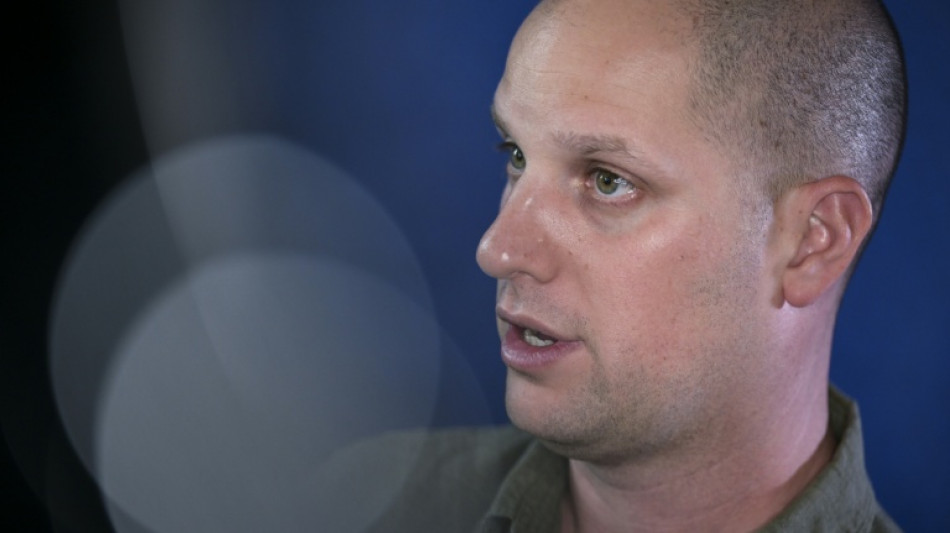
Panic, anger, tears: Evan Gershkovich's uneasy journey after Russian jail / Photo: Oliver Contreras - AFP

US journalist Evan Gershkovich spent nearly 500 days in a tiny Russian jail cell. When he was finally set free two years ago as part of an extraordinary multi-country prisoner swap, it took him almost as long to heal.
In an exclusive interview with AFP in Washington on Wednesday, Gershkovich recounted his ordeal after being arrested by Russia's security agency and charged with espionage, a journey he documented in his memoir "This Cursed Beautiful Land," which came out this week.
His release brought a flood of emotions he had kept buried in prison.
"Panic attacks, freezing in crowds of people, quick temper," Gershkovich, 34, said. "I went through prison in this sort of stoic way of thinking I have to keep my emotions in check, but clearly that all got pent up, and so it all started coming out after I got out."
Having not once allowed himself to cry in prison, he now wept regularly and was having nightmares of still being behind bars. There was an even more unsettling feeling: a desire to go back to his prison life, to which he had gotten so used.
"In the initial weeks, I had this really strange pang of wanting to go back. Because it was something I understood," Gershkovich recalled.
The son of Jewish emigres from the Soviet Union, Gershkovich grew up in suburban New Jersey speaking Russian with his parents and sister, eating Russian food and going by the Russian equivalent of his name, Vanya.
He arrived in Russia in 2017 eager to get his start in journalism and worked for AFP in Moscow before moving to the Journal. He remained one of the few journalists who continued to report inside the country after Russia's full-scale invasion of Ukraine in 2022.
He was arrested in March 2023 in the industrial city of Yekaterinburg in the Ural Mountains as he was reporting a story on Russia's military production when a half-dozen security officers from Russia's Federal Security Service, known as the FSB, burst into the restaurant where he was sitting and put him in handcuffs. The source he was meeting turned out to be an FSB agent tasked with entrapping him.
"Immediately it was immense fear, it was sort of like animalistic fear," Gershkovich said.
"They, you know, put the hood back over my head and pummel my midsection," Gershkovich recounted. "I think they were just trying to give me a signal like... 'You're under our control now.'"
Gershkovich says that aside from being roughed up during his arrest, he was not subjected to physical or psychological abuse endured by thousands of other inmates in Russian prisons, including Ukrainians arrested in territories occupied by Russia.
"They chose to not break me as a person, torture me, deprive me of food and hot water," Gershkovich said, adding the agents were clearly aiming for prisoner swap.
K.Yoshida--JT