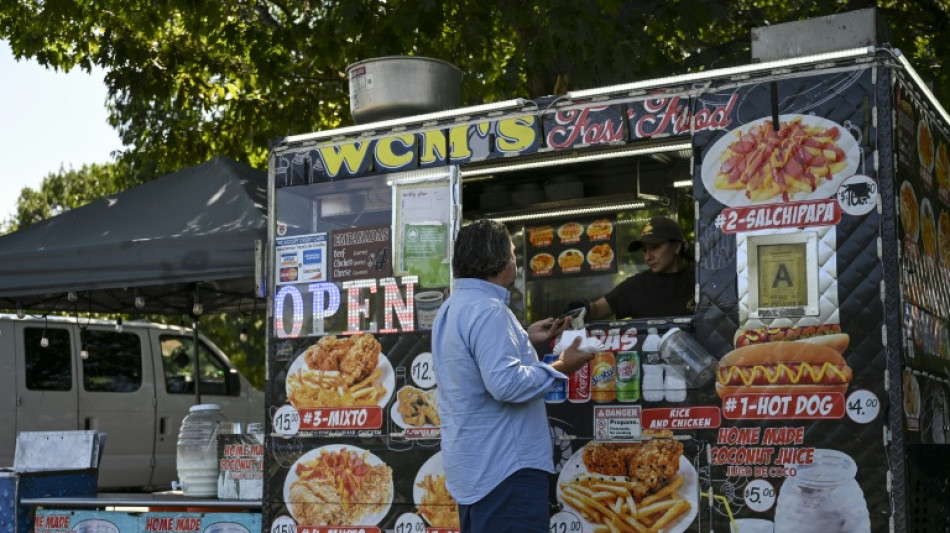
New York's noisy food carts go electric in clean air trial / Photo: ANGELA WEISS - AFP

Walk around New York and you'll likely hear the chugging of petrol generators powering the city's tens of thousands of food carts. But not William Arevalo's.
His truck, selling hot dogs, empanadas and fried shrimp, runs on rechargeable batteries as part of a city pilot aimed at cutting harmful noise and air pollution by harnessing electric energy.
"I can't believe it. Now we don't have noise and all our equipment is still working," Arevalo, 59, told AFP from his food cart parked under the shade of trees in a Queens park.
Arevalo is one of 10 street vendors testing whether they can ditch petrol generators to reduce noise, planet-warming emissions and health risks posed by exhaust fumes.
It's a mammoth task: The vast majority of the city's 20,500 licensed food carts -- selling pretzels, peanuts and ice cream -- rely on generators to power stoves, freezers and ventilators.
Shifting all of them to electric power would be the same as taking around 30,000 cars off the road annually, according to the city council, but costs and infrastructure challenges lie ahead.
Arevalo, who is originally from Ecuador and whose family has run the food truck for over 20 years, has noticed several benefits after swapping out his petrol generator.
"All the smoke from the generator used to come inside the truck. It's really bad for our health. And sometimes when I was with a customer, I couldn't hear them because of the generator noise," he said.
"Now it's 100 percent better," Arevalo added from inside the cart, where several two-dollar bills are taped to a wall -- for good luck, he explained.
And on a hot July day, he said the batteries were far more reliable than fuel generators that can overheat and cut out during summer.
- 'Surprised' -
At the back of Arevalo's cart -- decorated all over with colorful menu pictures of chicken wings and coconut juice -- is an inverter that holds up to six, foot-long batteries.
He said those provide enough power to keep fries frozen and fans whirring as long as they are switched out every five hours or so.
The six-month pilot started in July and uses the same batteries as many electric bicycles. PopWheels, a New York startup, supplies and charges them at nearby fire-resistant lockers.
Similar trials have been short-lived in the past.
In 2013, New York hooked up some Manhattan street carts to the city's power grid -- it cut emissions and noise but there was no way to scale up.
And a pilot by the Street Vendor Project nonprofit deployed similar batteries to food trucks, but a lack of charging infrastructure proved an issue.
This time will be different, the council hopes, as it envisions a subscription-based model whereby vendors pay a fee to access batteries and charging stations.
"We think it's going to be cost competitive, either less than what vendors pay right now or about the same as what vendors pay on gas," said Isabela Brown, senior policy advisor at the mayor's climate office.
For vendors "the main cost... will be to have an inverter system installed. We're looking at financial solutions, loans, other things the city can provide," she added.
Inverter systems can cost thousands of dollars -- not dissimilar to petrol generators depending on the size -- but proponents say running costs are lower in the long run.
For now, Arevalo is delighted to be flaunting his electric street cart to fellow vendors who rely on petrol generators.
"I show my friends and they're surprised. Everything is working, it's really all working," he smiled.
S.Yamamoto--JT