Ultra-reclusive Turkmenistan slowly opens up to tourists / Photo: STRINGER - AFP

From a gas crater dubbed the "Gateway to Hell" to the shimmering marble buildings of its capital, Turkmenistan is tentatively opening up to tourists after decades of isolation.
One of the world's most reclusive countries, the former Soviet republic adopted strict visa requirements after gaining independence in 1991 and closely monitors travellers.
While this policy remains largely in place, tour agencies in the Central Asian nation have noticed a recent decrease in visa rejections and this year authorities announced plans to expand the tourism sector.
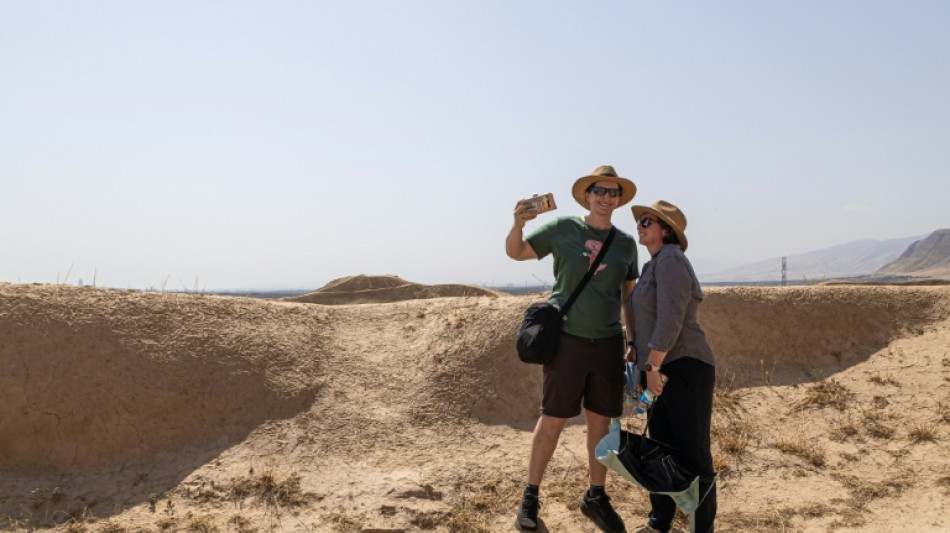
At the archaeological ruins of Nisa, an ancient fortress near the capital, Ashgabat, AFP spotted a Western tour group taking advantage of this tentative thaw.
"I wanted to see what the mystery was about," said Nick Frey, a 28-year-old US tourist admiring the fortress.
"I think the uniqueness is really what stood out."
Turkmenistan declared itself "permanently neutral" under its post-independence leader Saparmurat Niyazov, a policy that he used to justify extreme constraints on contact with the outside world.
For 15 years, the former Communist official shaped the capital in his image, ordering it to be rebuilt as a marble citadel complete with a towering gold statue of himself.
Since Niyazov's death in 2006, successive presidents -- Gurbanguly Berdymukhamedov and his son Serdar -- have kept the system in place, along with the cults of personality and grand architecture.
Ashgabat has the highest density of white marble buildings in the world, according to Guinness World Records.
- 'World's weirdest country' -
Turkmenistan's odd architecture and reclusiveness has made it a magnet for content creators on social media, some of whom have dubbed it the "world's weirdest country".
"The first thing I noticed was the whiteness of everything," said Liza Zorn, a German tourist who visited Ashgabat.
"It was the first time in my life I saw white traffic lights."
Among the sights she came to see was the "Gateway to Hell", a gas crater that has been burning for half a century and is one of the more internationally known tourist spots in the desert-covered country.
Before arriving, all holidaymakers must prove their tourist credentials and their itinerary is strictly mapped out.
"You have to have your plans organised by a tour agency like ours and everything has to be approved," said Effie Frank, a supervisor at the Saiga Tours travel agency.
In recent years her agency has not been refused any letters of invitation, essential for obtaining a visa.
"It does seem like it's getting a bit easier to come to Turkmenistan," she said.
After visiting Nisa, the 20 or so tourists with her group returned to Ashgabat for Carpet Day -- a national holiday honouring Turkmen rug artisans -- before visiting yurts and tasting local produce.
Carpets are one of the three most important national symbols, along with the Akhal-Teke horse and Alabai dog.
- 'We are ready' -
President Serdar Berdymukhamedov, who runs the country in tandem with his father, appears to be warming to the new visitors.
"The country's tourism industry is increasingly expanding," he said earlier this year, adding that he wanted to develop international cooperation.
The industry is still in its infancy.
"Firstly, there needs to be political will. Secondly, a simplified visa policy. And thirdly, well-developed infrastructure," a Western diplomat in Ashgabat told AFP on condition of anonymity.
These three elements are not yet fully in place.
While luxury hotels are springing up in Ashgabat and Avaza, the main seaside resort on the Caspian Sea, the rest of the country is poorly equipped for visitors.
Turkmenistan still relies almost exclusively on gas revenues to power its economy.
The country -- which closed its state tourism authority during the Covid pandemic -- does not regularly publish data on the number of arrivals.
But Azat, an employee at a local travel firm, was enthusiastic.
"Tourists visiting this country could, with multiple-entry visas, continue their tour along the Great Silk Road," he told AFP.
He also proposed collaborating with Uzbekistan, as there are many archaeological sites close to the border that are inaccessible to foreigners.
"We are ready to welcome large numbers of tourists from neighbouring countries," he said.
A law passed last year to introduce electronic visas is yet to be implemented.
Y.Watanabe--JT