Latin America's resurgent right notches another win in Colombia / Photo: Juan BARRETO - AFP

Populist leaders are sweeping into power across Latin America, with Colombian voters the latest to embrace hardline right-wing politics -- but will the trend last?
With the big exceptions of Brazil and Mexico, it is tough to find a presidential palace in Latin America not occupied by a tough-talking or charismatic rightwinger.
The right has won a string of elections from Argentina to Honduras. Still, experts see little evidence for a region-wide ideological shift -- rather a favorable playing field for outsider candidates.
What unites the victors, according to far-right politics expert Lisa Zanotti, is their ability to tap into grievance, build a strong personal brand and forge ad hoc coalitions.
El Salvador's Nayib Bukele -- who has jailed almost two percent of the population -- may have provided the blueprint.
Offering seemingly simple solutions to crime, economic stagnation and a discredited political elite, he is astronomically popular at home and often tops polls across the region.
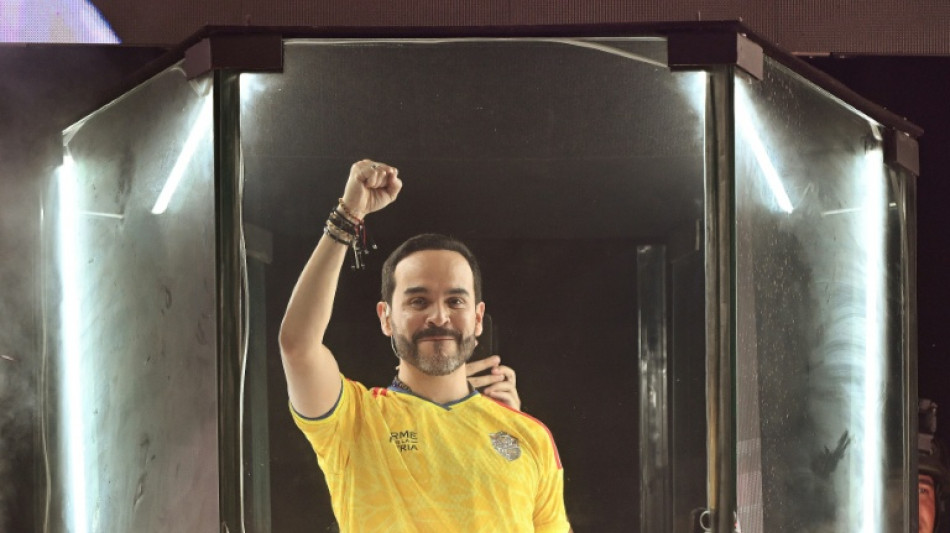
His outsider model was adopted wholesale, including by the similarly coiffed Abelardo de la Espriella, whom a few Colombian commentators have jokingly dubbed the "Temu Bukele."
Latin America's presidential systems can facilitate this trend of outsider candidates, according to Zanotti, a researcher at Budapest's CEU Democracy Institute and Santiago's Ultra-Lab.
"Presidential elections allow political entrepreneurs to bypass weak or discredited parties and construct a direct relationship with voters," she said.
- Winning formula-
"In the 2000s we saw 'pink tide' governments in Latin America" with the left winning many elections," said Anthony Pereira of Tulane University, who sees populism as an evolving tradition in Latin America.
The left won through populist cash transfers, raising minimum wages, helping people go from under-the-table jobs to formal ones with actual contracts, and granting access to credit and education -- all paid for by rising commodity prices.
"The number of people living in poverty went down" he said. Then came the commodities crash and "the optimism of the 2010s turned to disappointment and resentment."
At the same time, "organized crime grew stronger and ran entire neighborhoods -- and prisons. Voters started to respond more enthusiastically to politicians who claimed to be anti-establishment," he said.
De la Espriella appealed not just to anti-left voters, but to a burgeoning middle class frustrated by growing crime -- a leading issue for voters in every recent Latin American election.
While the left has struggled to formulate a response, the right has promised quick answers -- from airstrikes to megajails.
- Crime wave -
Much of the world still thinks of Latin American organized crime in terms of cut-throat cocaine cartels and cavalier capos like Pablo Escobar.
In reality, from Ecuador to Brazil, these groups -- while still violent -- have become multi-million and even multi-billion-dollar conglomerates.
Instead of simply shipping cocaine to the United States, they now permeate Latin American life -- demanding protection money from Peruvian bus drivers, or taking over gold mines in Venezuela's jungles.
"The extortion is too much. Shops are closing because people can't survive like this," said Sandra Gutierrez, a 60-year-old Colombian voter. "The crime is unbearable."
According to the latest Latinobarometro poll, 75 percent of Latin Americans surveyed in more than a dozen countries said crime had risen in the last year.
About a third said they or their family members had been personally affected by crime in the same period.
- Uncle Sam -
Hard-right governments in the United States, Russia, Israel and Europe have also worked hard to export their model, or find Latin American leaders who share their worldview.
President Donald Trump in particular has tried hard to put his thumb on the scale of several Latin American votes.
In Colombia, he threatened billions of dollars in military aid if De la Espriella's "radical left Marxist" rival won.
The result was Colombia's leftist President Gustavo Petro saw his approval ratings rise. In Sunday's election Petro's protege got 1.5 million more votes than Petro did four years ago.
Brazil's leftist leader Luiz Inacio Lula da Silva also saw his poll numbers rise when Trump threatened sanctions and tried to back his likely rightwing rival in this October's election.
- Becoming incumbent -
But in office, some of the new rightwing leaders are already seeing the difficulties in meeting expectations.
Bolivia's Rodrigo Paz has faced rolling protests that have caused widespread shortages. Ecuador's Daniel Noboa initially brought down murder rates, which have since rebounded to record highs.
Chile's Jose Antonio Kast has seen his popularity plummet in his first 100 days in office. Now Colombian commentators are wondering whether De la Espriella will suffer a similar fate.
"He campaigned in black and white, sharpening differences," said researcher Juan Alvarez at the Caro y Cuervo Institute.
"Governing is done in shades of gray. What his grey-mode of government will look like, we still don't know."
Y.Kato--JT