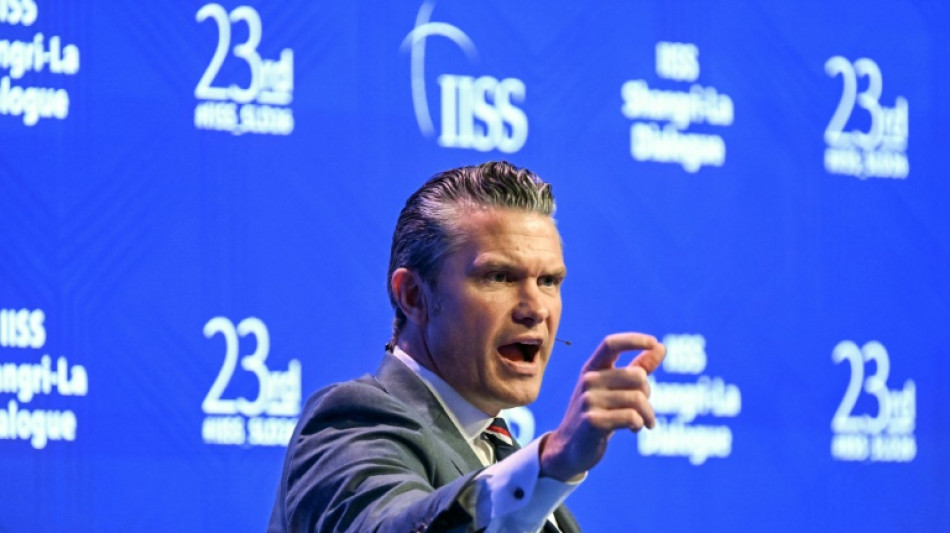
Pentagon chief says US seeks 'stable equilibrium' with China in Asia / Photo: JAM STA ROSA - AFP

Pentagon chief Pete Hegseth struck a measured tone towards China at a major defence forum on Saturday, noting "rightful alarm" over Beijing's military build-up but saying the United States sought a "stable equilibrium" in Asia.
Hegseth's headline speech at Singapore's Shangri-La Dialogue, which brings together top defence officials and experts from around 45 countries, contrasted with his strongly confrontational remarks on China at last year's gathering.
Unlike Beijing, which has sent a panel of military experts and scholars instead of defence minister Dong Jun for the second year running, Hegseth is leading a bumper US delegation to the event that provides chances for both open debate and behind-closed-doors diplomacy.
"When we look across the region today, there is rightful alarm regarding China's historic military build-up and the expansion of its military activities in the region and beyond," Hegseth said.
Washington does not seek "needless confrontation in the region", but rather "a genuinely stable equilibrium (in Asia) that works for Americans as well as our allies", he said.
That means "a favourable but durable balance of power in which no state, including China, can impose its hegemony and hold the security or prosperity of our nation and our allies in question", he added.
He said the United States sought "respectful" and "good-faith" engagement with Beijing, adding: "I wish my counterpart was here at this conference, but I look forward to other options when we can cross paths."
Trump visited China this month, talking up "fantastic" trade deals but giving few details and later suggesting Washington could use its arms sales to self-ruled Taiwan as a bargaining chip with Beijing.
There had been "no change" in Washington's stance towards Taiwan, but "any decision about future Taiwan arms sales... will rest with" US President Donald Trump, Hegseth said.
- Vibe shift -
The remarks contrasted sharply with last year's event, when Hegseth painted China as a potentially "imminent" threat to security and outlined a swaggering vision of muscular American deterrence.
That day, he also took potshots at Beijing's absent minister, saying: "We are here this morning, and somebody else isn't."
Hegseth's speech reflected the "quite happy, quite positive" atmosphere of Trump's China visit, said Oh Ei Sun, senior fellow at the Singapore Institute of International Affairs.
But he saw no "deliberate rapprochement", saying the address "simply reflects how this (US) administration views superpower competition... we have to beef up our own capability, and we have to make sure our allies are also working hard and putting up the money".
Instead of Dong, China has sent experts and scholars from its army's academic institutions, led by Major General Meng Xiangqing of the National Defense University.
Analysts have said Dong's no-show reflects Beijing's confidence as an established power with little inclination to answer publicly for its assertive moves in the region.
But some argue that China is also running the risk of having no senior policymaker present if two major security issues come up: reopening the Strait of Hormuz, and Beijing's claim to Taiwan.
Hegseth again urged US allies to spend more on their own defence, singling out South Korea, Japan, Australia and the Philippines for praise while threatening consequences for nations that "free-ride on the generosity of the American taxpayer".
"Those days are over. Allies who refuse to step up and carry their own weight for our collective defense will face a clear shift in how we do business."
- Iran threat -
Hegseth's remarks came as a peace deal between the United States and Iran to end their war remained elusive.
A White House official told AFP on Friday that Trump, who is weighing a final decision on a potential accord, would only commit if Iran met all his conditions.
But Iran has said "no final agreement" is in place, and its state media has rebutted parts of Trump's characterisation of the deal.
Hegseth said Washington was "more than capable" of restarting the war if it wanted.
The head of the Pentagon is also due to meet his British and Australian counterparts as part of the AUKUS security alliance.
Australian media outlets have reported, citing unnamed sources, that the AUKUS nations are expected to announce a major project, perhaps involving uncrewed underwater vehicles.
H.Takahashi--JT