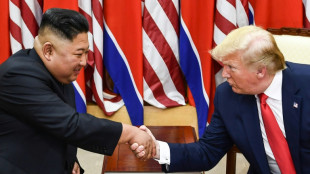
Trump links normalizing ties with Israel to Iran peace deal / Photo: ATTA KENARE - AFP

US President Donald Trump on Monday said Saudi Arabia and other Gulf nations must normalize ties with Israel as part of efforts to reach a deal with Iran, adding fresh uncertainty into protracted peace negotiations.
Progress over a deal to end the conflict that broke out in late February has slowed as both sides talked down the prospect of an imminent agreement, with Tehran saying they were not close to signing and Trump warning he was in no hurry.
In another hurdle for any deal, the US leader said it should be mandatory for Qatar, Pakistan, Egypt, Turkey and Jordan to sign up to the Abraham Accords, a set of agreements brokered in 2020 with nations historically hostile to Israel.
"After all the work done by the United States to try and pull this very complex puzzle together, it should be mandatory that all of these Countries, at a minimum, simultaneously, sign onto the Abraham Accords," he wrote in a lengthy social media post.
"Those Countries discussed are Saudi Arabia, The United Arab Emirates (already a Member!), Qatar, Pakistan, Turkiye, Egypt, Jordan, and Bahrain (already a Member!)"
Trump said he had spoken to the leaders of those countries on Saturday about efforts to end the war with Iran. Bahrain and the UAE have already signed the accords, along with Morocco and Sudan.
US and Iranian forces have observed a ceasefire since April 8 while diplomats push for a negotiated settlement, although Iran has maintained controls on Gulf shipping through the Strait of Hormuz and the US Navy has sought to blockade Iran's ports.
Trump said earlier on Monday that a deal with Iran would either be "great and meaningful" or there would be "no deal."
But while the accords were welcomed by some as a foreign policy success, they remain deeply unpopular among the public in many parts of the Middle East, not least because they do not tackle the Israeli-Palestinian conflict.
The issue is fraught as countries like Gulf heavyweights Saudi Arabia and Qatar have said they will never normalize ties with Israel unless an independent Palestinian state is created.
Anna Jacobs of the Arab Gulf States Institute in Washington said Trump's latest demand added to the disaster that has been the war on all fronts for Gulf nations.
"The national security of the Gulf states has been threatened more than ever before because of President Trump's reckless decisions, and he expects Arab states to thank him and to normalize relations with Israel, which they will not do at this stage," she said.
"These expectations and assumptions from this US administration shows how little they understand the Middle East."
- 'Going crazy' -
Trump's maximalist demand came after top US diplomat Marco Rubio suggested a deal could be reached within the day, causing world oil prices to tumble based on renewed optimism about an agreement.
"We thought we might have some news last night, maybe today," Secretary of State Rubio told reporters during a visit to New Delhi, referring to hopes for a deal.
"We have what I think is a pretty solid thing on the table in terms of their ability to open up the straits, get the straits open."
But Iran's foreign ministry spokesman Esmaeil Baqaei poured cold water on hopes for a quick final settlement.
"It is correct to say that we have reached a conclusion on a large portion of the issues under discussion," he told a weekly news briefing.
"But to say that this means the signing of an agreement is imminent -- no one can make such a claim."
In Iran's capital Tehran, residents who spoke to Paris-based journalists said they were losing patience at the lack of diplomatic progress.
"We're going crazy. Imagine getting hopeful ten times a day, and disappointed a hundred times a day," said Amir, 40.
"We're all frustrated."
- 'Critical moment' -
Israeli Prime Minister Benjamin Netanyahu said on Sunday that he and Trump had agreed that "any final agreement with Iran must eliminate the nuclear threat entirely."
Iranian officials have stressed that, despite the long-standing US demand for an end to its uranium enrichment, talks on the issue of the Islamic republic's nuclear programme have been deferred until after an initial agreement.
Meanwhile, Pakistan's Prime Minister Shehbaz Sharif -- whose government is spearheading efforts to mediate a negotiated agreement between the United States and Iran -- met China's President Xi Jinping in Beijing.
Speaking to Chinese leaders, Sharif said "the world is passing through a critical moment," Pakistan's state-run PTV channel showed.
"Things are moving in the right direction. I would like to thank China's support to promote peace."
H.Takahashi--JT