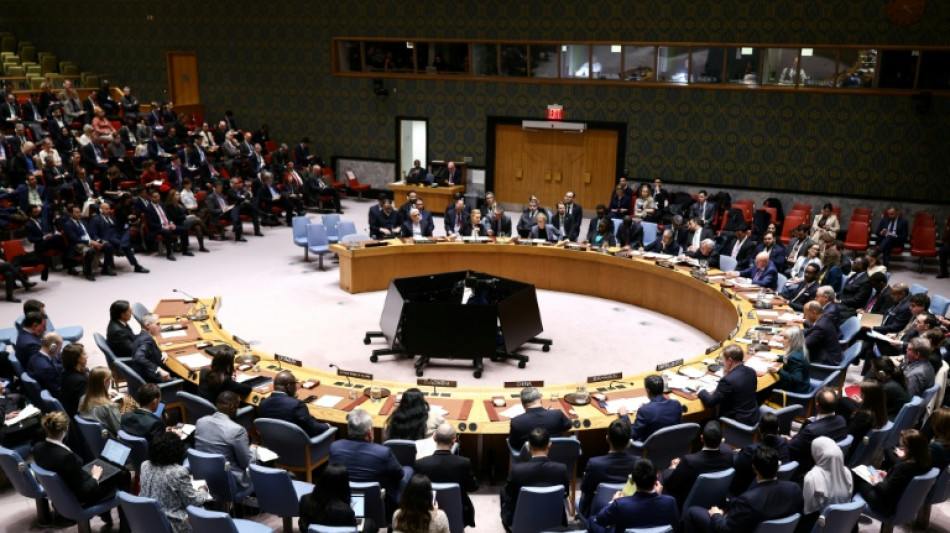
UN Security Council vote expected on Hormuz resolution / Photo: CHARLY TRIBALLEAU - AFP

The UN Security Council is expected to vote Tuesday on a watered-down resolution calling for the unblocking of the Strait of Hormuz -- far from the sponsoring Gulf countries' initial goal of obtaining clearance to free it by force.
The vote is expected at 11:00 am (0300 GMT), though the outcome is not certain. The text in question has been diluted in recent days in the hope of avoiding rejection.
A draft seen by AFP on Monday no longer mentions authorization to use force -- even defensively.
The vote comes just hours before Donald Trump's 8:00 pm (midnight GMT) deadline for Iran to make a deal or face the US military destroying its power plants and bridges.
Bahrain, with the backing of the United States and other oil-exporting Gulf countries, launched negotiations two weeks ago on a draft that would have given a clear UN mandate to any state wishing to use force to unblock the strait.
Iran has imposed an effective blockade on the critical waterway since the United States and Israel launched the war on February 28, sending ripple effects throughout the global economy.
"We cannot accept economic terrorism affecting our region and the world, the whole world is being affected by the developments," Jamal Alrowaiei, Bahrain's ambassador to the UN, said last week.
But objections from several veto-holding permanent members -- including France, Russia and China -- have forced the text to be watered down and the vote delayed multiple times.
French opposition appeared to be lifted by the addition of wording that meant any action would need to be "defensive."
The Security Council adopted a strong resolution against Tehran in mid-March, condemning its blocking of the strait.
The Council must now "swiftly develop the necessary defensive response" to the situation, French Ambassador Jerome Bonnafont said on Thursday.
- Veto? -
However, Russia, a long-standing ally of Iran, as well as China could still veto the text. For this reason, a vote scheduled for last Friday was delayed.
The latest draft reviewed by AFP "strongly encourages states...to coordinate efforts, defensive in nature, commensurate to the circumstances, to contribute to ensuring the safety and security of navigation, including through the escort of merchant and commercial vessels," rather than explicitly authorizing force.
It also "demands," that Iran "immediately cease all attacks against merchant and commercial vessels and any attempt to impede transit passage or freedom of navigation in the Strait of Hormuz."
Additionally, it calls for the end to attacks on civilian water, oil, and gas infrastructure.
"Bahrain and its backers would secure a clear diplomatic rejection of Iran's obstruction of the Strait, even if they fell short of obtaining authorization for the use of force," Daniel Forti, the head of UN affairs at the International Crisis Group, told AFP.
"Meanwhile, China and Russia would succeed in preventing the Council from endorsing a potentially escalatory military response, even if the text sidesteps the roles of the US and Israel in the conflict."
UN Security Council mandates authorizing member states to use force are rare.
During the 1990 Gulf War, a vote allowed a US-led coalition to intervene in Iraq after it invaded Kuwait.
In 2011, NATO obtained the green light to intervene in Libya when Russia abstained from a vote. Moscow later fumed that this had led to the fall of Libyan leader Colonel Muammar Gaddafi.
K.Inoue--JT