The Japan Times - Kenya, Uganda double down on rail extension burdened by Chinese debt

EUR -
AED 4.313234
AFN 75.750435
ALL 95.578696
AMD 433.594907
ANG 2.102159
AOA 1078.160336
ARS 1638.971773
AUD 1.625109
AWG 2.11404
AZN 1.999672
BAM 1.958437
BBD 2.373175
BDT 144.574668
BGN 1.95913
BHD 0.444976
BIF 3506.83234
BMD 1.174466
BND 1.49167
BOB 8.141894
BRL 5.790702
BSD 1.178287
BTN 111.063856
BWP 15.776243
BYN 3.329855
BYR 23019.541599
BZD 2.369771
CAD 1.603364
CDF 2720.064631
CHF 0.915033
CLF 0.026588
CLP 1046.41439
CNY 7.992303
CNH 7.987329
COP 4391.212453
CRC 540.500166
CUC 1.174466
CUP 31.12336
CVE 110.414612
CZK 24.310747
DJF 209.820735
DKK 7.472819
DOP 70.07077
DZD 155.423039
EGP 61.917074
ERN 17.616996
ETB 183.972419
FJD 2.568381
FKP 0.863023
GBP 0.864883
GEL 3.147732
GGP 0.863023
GHS 13.255849
GIP 0.863023
GMD 85.736074
GNF 10340.659465
GTQ 8.997345
GYD 246.52194
HKD 9.192848
HNL 31.323911
HRK 7.539253
HTG 154.323854
HUF 355.902081
IDR 20401.597252
ILS 3.418737
IMP 0.863023
INR 110.912846
IQD 1543.578414
IRR 1541956.947453
ISK 143.801193
JEP 0.863023
JMD 185.589895
JOD 0.832657
JPY 184.144002
KES 151.682245
KGS 102.672444
KHR 4726.162529
KMF 492.10156
KPW 1056.962147
KRW 1724.486599
KWD 0.361498
KYD 0.981922
KZT 545.674746
LAK 25857.596849
LBP 105154.351013
LKR 379.417652
LRD 216.227592
LSL 19.224422
LTL 3.467894
LVL 0.710423
LYD 7.452972
MAD 10.799449
MDL 20.272124
MGA 4892.316697
MKD 61.676845
MMK 2465.917641
MNT 4203.300853
MOP 9.503997
MRU 47.141268
MUR 54.988565
MVR 18.15135
MWK 2043.037861
MXN 20.275107
MYR 4.603321
MZN 75.050158
NAD 19.224586
NGN 1599.599736
NIO 43.357827
NOK 10.917372
NPR 177.688178
NZD 1.973409
OMR 0.451583
PAB 1.178287
PEN 4.081295
PGK 5.127664
PHP 71.115081
PKR 328.303558
PLN 4.229206
PYG 7211.649015
QAR 4.294993
RON 5.262191
RSD 117.382025
RUB 87.677284
RWF 1727.425963
SAR 4.439687
SBD 9.433617
SCR 16.55833
SDG 705.267211
SEK 10.875383
SGD 1.489822
SHP 0.876858
SLE 28.892668
SLL 24627.968842
SOS 673.406736
SRD 43.961469
STD 24309.083409
STN 24.531883
SVC 10.309882
SYP 129.83015
SZL 19.218878
THB 37.847764
TJS 11.011555
TMT 4.122377
TND 3.417889
TOP 2.827833
TRY 53.276327
TTD 7.970733
TWD 36.867679
TZS 3063.471122
UAH 51.592714
UGX 4406.933896
USD 1.174466
UYU 47.115446
UZS 14278.225498
VES 582.780873
VND 30901.385664
VUV 138.617742
WST 3.175865
XAF 656.805031
XAG 0.014574
XAU 0.000249
XCD 3.174054
XCG 2.123559
XDR 0.816855
XOF 656.841431
XPF 119.331742
YER 280.225528
ZAR 19.270765
ZMK 10571.61339
ZMW 22.446032
ZWL 378.177704
  • CMSC

    -0.0400

    22.97

    -0.17%

  • BCC

    -1.4800

    72.76

    -2.03%

  • JRI

    -0.0200

    13.15

    -0.15%

  • AZN

    -2.4000

    182.52

    -1.31%

  • BCE

    0.3400

    24.57

    +1.38%

  • NGG

    -1.9400

    85.91

    -2.26%

  • CMSD

    0.0000

    23.42

    0%

  • GSK

    -0.0300

    50.5

    -0.06%

  • RBGPF

    0.0000

    63.18

    0%

  • RIO

    -2.4000

    103.11

    -2.33%

  • BTI

    -1.4800

    58.08

    -2.55%

  • BP

    -0.8200

    43.81

    -1.87%

  • RELX

    -1.5900

    34.16

    -4.65%

  • RYCEF

    -0.0500

    17.45

    -0.29%

  • VOD

    -0.4400

    15.69

    -2.8%

Kenya, Uganda double down on rail extension burdened by Chinese debt
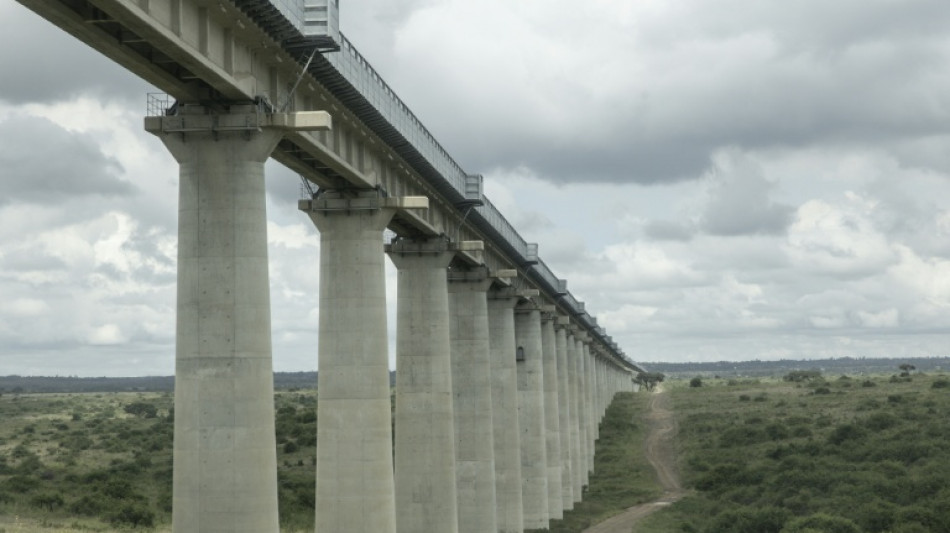
Kenya, Uganda double down on rail extension burdened by Chinese debt / Photo: SIMON MAINA - AFP/File

Kenya, Uganda double down on rail extension burdened by Chinese debt

The presidents of Kenya and Uganda met near their shared border Saturday to mark the multi-billion-dollar, long-delayed extension of a Chinese-built railway that has left Kenya heavily in debt.

Text size:

The Standard Gauge Railway, built from 2013 to 2019, connects the Kenyan port of Mombasa to its capital Nairobi, and on to the lake town of Naivasha, but China refused further lending before it could be extended to Uganda as planned.

Kenya now spends roughly $1 billion a year servicing Chinese debt, most of it borrowed to build the railway.

That is far more than the line generates in revenue -- around $165 million last year -- even if passenger and cargo numbers have been growing strongly over the past year.

A report by Kenya's auditor general last year found more than $260 million had been wasted just on penalties and interest from late debt payments.

Yet despite the controversy over the cost, Kenya has been keen to finish the line.

Kenyan President William Ruto said the rail link will "define generations", speaking at a ceremony in grand pomp and circumstance with his Ugandan counterpart Yoweri Museveni in Kisumu, near the Kenya-Uganda border.

Ruto argued the line would slash logistics costs that "undermine competitiveness" in east Africa.

If the ambitious building schedule is to be believed, the line is due to reach Kisumu by June 2027. The next phase will then take the line to Malaba, a town on the border.

"Cargo takes an average of 80 hours to move from Mombasa to Malaba and more than 100 hours to reach Kampala," the Ugandan capital, Ruto said.

"We cannot build prosperity on inefficiency."

- 'Irrational and wasteful' -

Museveni said the line would reduce the inefficiencies in his own country's infrastructure.

"The railway is part of the rationalisation of our transport system, especially on the Uganda side, which is irrational and wasteful," the veteran leader told the ceremony.

Later, he posted on X that "by shifting bulk cargo from roads to rail and pipelines, we reduce transport costs, protect infrastructure and improve efficiency".

Ruto broke ground on the next phase in Narok County on Thursday, arguing that it will create jobs and reduce road congestion.

"We have thought through this project (and)... its finance," he insisted.

Treasury estimates say the overall cost will be more than 500 billion shillings ($3.9 billion), according to Kenya's Business Daily.

Kenya is not taking more cash from Chinese banks this time -- instead borrowing against future cargo taxes -- though it is partnering with Chinese transport firms to build the new phase.

China lent Kenya $9.7 billion between 2000 and 2019, according to the Chinese Loans to Africa Database by Boston University, with around half of that going to the railway.

It stopped lending from 2020 to 2023 as Kenya struggled to make repayments, at a time when China revised its broader lending strategy in Africa.

Kenya considers the railway extension crucial for strengthening trade through east and central Africa, hoping to reach landlocked countries such as Uganda, Rwanda, South Sudan and the mineral-rich Democratic Republic of Congo.

M.Ito--JT