Job threats, rogue bots: five hot issues in AI / Photo: Arun SANKAR - AFP

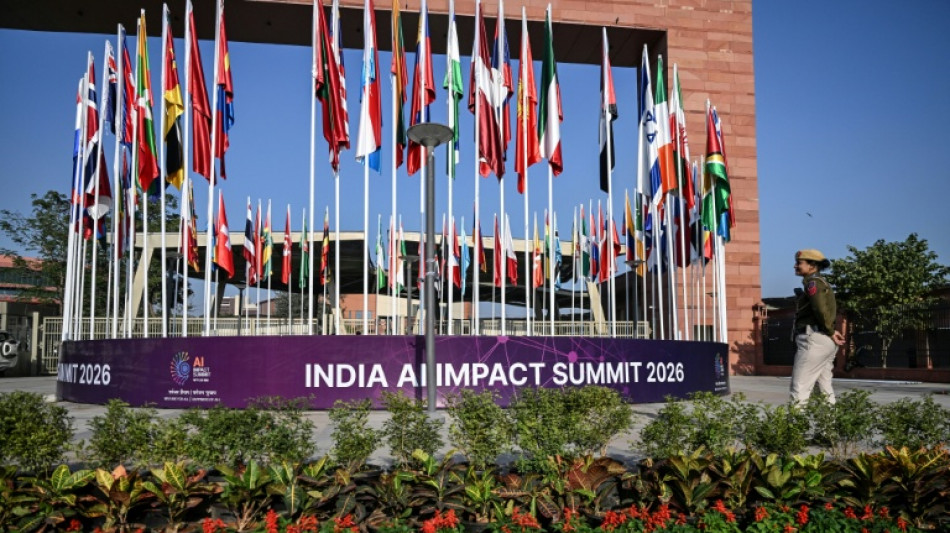
As artificial intelligence evolves at a blistering pace, world leaders and thousands of other delegates will discuss how to handle the technology at the AI Impact Summit, which opens Monday in New Delhi.
Here are five big issues on the agenda:
- Job loss fears -
Generative AI threatens to disrupt myriad industries, from software development and factory work to music and the movies.
India -- with its large customer service and tech support sectors -- could be vulnerable, and shares in the country's outsourcing firms have plunged in recent days, partly due to advances in AI assistant tools.
"Automation, intelligent systems, and data-driven processes are increasingly taking over routine and repetitive tasks, reshaping traditional job structures," the summit's "human capital" working group says.
"While these developments can drive efficiency and innovation, they also risk displacing segments of the workforce," widening socio-economic divides, it warns.
- Bad robots -
The Delhi summit is the fourth in a series of international AI meetings. The first in 2023 was called the AI Safety Summit, and preventing real-world harm is still a key goal.
In the United States, families of people who have taken their own lives have sued OpenAI, accusing ChatGPT of having contributed to the suicides. The company says it has made efforts to strengthen its safeguards.
Elon Musk's Grok AI tool also recently sparked global outrage and bans in several countries over its ability to create sexualised deepfakes depicting real people, including children, in skimpy clothing.
Other concerns range from copyright violations to scammers using AI tools to produce perfectly spelled phishing emails.
- Energy demands -
Tech giants are spending hundreds of billions of dollars on AI infrastructure, building data centres packed with cutting-edge microchips, and also, in some cases, nuclear plants to power them.
The International Energy Agency projects that electricity consumption from data centres will double by 2030, fuelled by the AI boom.
In 2024, data centres accounted for an estimated 1.5 percent of global electricity consumption, it says.
Alongside concerns over planet-warming carbon emissions are worries about water use to cool the data centre servers, which can lead to shortages on hot days.
- Moves to regulate -
In South Korea, a wide-ranging law regulating artificial intelligence took effect in January, requiring companies to tell users when products use generative AI.
Many countries are planning similar moves, despite a warning from US Vice President JD Vance last year against "excessive regulation" that could stifle innovation.
The European Union's Artificial Intelligence Act allows regulators to ban AI systems deemed to pose "unacceptable risks" to society.
That could include identifying people in real time in public spaces or evaluating criminal risk based on biometric data alone.
- 'Everyone dies' -
More existential fears have also been expressed by AI insiders who believe the technology is marching towards so-called "Artificial General Intelligence", when machines' abilities match those of humans.
OpenAI and rival startup Anthropic have seen public resignations of staff members who have spoken out about the ethical implications of their technology.
Anthropic warned last week that its latest chatbot models could be nudged towards "knowingly supporting -- in small ways -- efforts toward chemical weapon development and other heinous crimes".
Researcher Eliezer Yudkowsky, author of the 2025 book "If Anyone Builds It, Everyone Dies: Why Superhuman AI Would Kill Us All" has also compared AI to the development of nuclear weapons.
H.Nakamura--JT