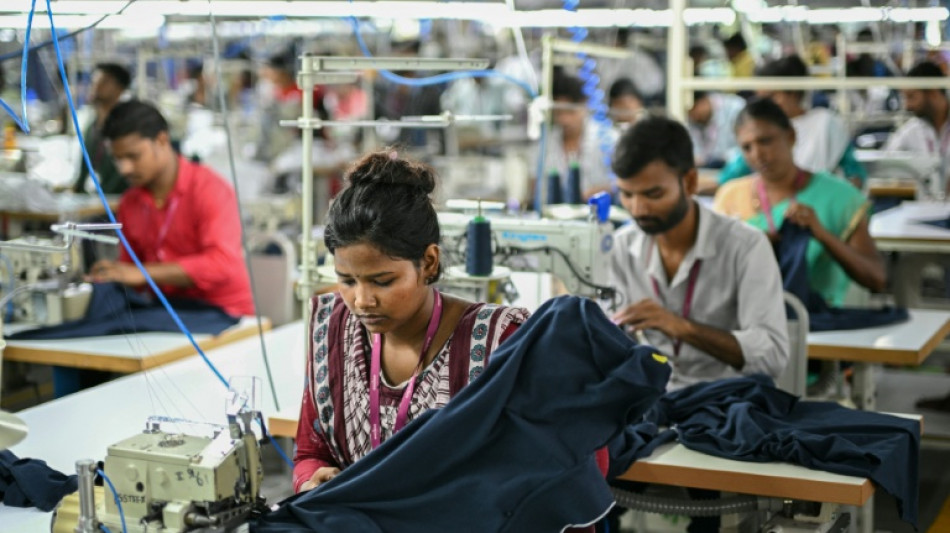
India eyes new markets with US trade deal limbo / Photo: R. Satish BABU - AFP/File

India is aggressively seeking trade deals to open markets for exporters and soften the blow of steep US tariffs, as efforts to secure an agreement with Washington remain elusive.
Relations between Washington and New Delhi plummeted in August after President Donald Trump raised tariffs to 50 percent, a blow that threatens job losses and hurts India's ambition of becoming a manufacturing and export powerhouse.
That pressure, experts say, has pushed New Delhi into a rapid diversification drive beyond its biggest market.
India signed or operationalised four trade agreements last year, including a major pact with Britain -- the fastest pace of dealmaking it has seen in years -- and is now eyeing fresh deals.
Negotiations are underway with the European Union, the Eurasian Economic Union, Mexico, Chile and the South American Mercosur trade bloc, either for new deals or to expand existing agreements.
If successful, India would have trade arrangements with "almost every major economy", said Ajay Srivastava, from the New Delhi-based Global Trade Research Initiative (GTRI).
Srivastava said 2025 was "one of the most active years" for trade agreements, which he said aimed to "spread risk" rather than to pivot from Washington.
- 'Expand its destinations' -
Washington's punishing tariffs aimed at stopping India's purchases of Russian oil -- which it says finances Moscow's invasion of Ukraine -- have driven New Delhi's desire to grow other markets.
"The strategy was a reaction, as I read it, to what Trump did," trade economist Biswajit Dhar told AFP. "This has now become an imperative for India to actually expand its destinations."
Major deals will help labour-intensive sectors hurt by tariffs.
India's apparel export promotion council projects that the UK trade deal could help double garment exports to Britain over the next three years.
The gains from a potential EU agreement could be even bigger.
European Commission President Ursula von der Leyen, expected to visit New Delhi later in January, has said it would be the "largest deal of this kind anywhere in the world".
Although the two sides missed a deadline to conclude talks by the end of 2025 -- reportedly over disputes related to steel and auto exports -- Indian negotiators remain optimistic.
German Chancellor Friedrich Merz will visit India and meet Prime Minister Narendra Modi on Monday, holding talks on "intensifying cooperation in trade and investment", Modi's office said in a statement.
Smaller agreements also matter.
Trade between Oman and India totalled less than $11 billion last financial year, but a December deal with Muscat offers "a gateway to the broader Middle East and Africa markets", and a template for a wider "Gulf engagement strategy", analysts at Nomura suggested.
And while a free trade agreement (FTA) with New Zealand added little to Indian export growth, it secured $20 billion in foreign investment, increased visa access and showed Washington that New Delhi is willing to compromise.
"The New Zealand FTA makes concessions on agricultural produce like apples, even though farmers here may have concerns," said an Indian commerce ministry official, who declined to be identified.
"Who says we can't be flexible?"
- 'Eggs in one basket' -
India's goods exports rose a surprising 19 percent in November 2025, reversing an October decline.
While the surge was helped by electronics shipments -- still exempt from US tariffs -- marine product exports also posted gains.
"Diversification has certainly happened," KN Raghavan, of the Seafood Exporter Association of India said.
"We have increased exports to the EU and China," he said, adding they were the top markets after the United States.
But exporters caution that alternative markets cannot fully replace the United States, with Raghavan saying a US deal is "paramount".
That remains in limbo.
India's imports of Russian oil fell sharply in December to 1.2 million barrels per day from 1.8 million per day in November, according to Kpler trade data.
It is unclear if that will be enough for Trump.
Pankaj Chadha, chairman of the Engineering Export Promotion Council, said diversification had become a necessity to lessen dependence on the "biggest and the most lucrative" market.
"It's better not to put all your eggs in one basket," he said.
S.Fujimoto--JT