The Japan Times - 600-year-old pinot noir grape found in medieval French toilet

EUR -
AED 4.089192
AFN 72.375297
ALL 90.522135
AMD 403.960011
ANG 1.992858
AOA 1022.158315
ARS 1721.026204
AUD 1.622555
AWG 2.004232
AZN 1.896276
BAM 1.949815
BBD 2.252143
BDT 139.432002
BGN 1.946144
BHD 0.421903
BIF 3345.395827
BMD 1.113462
BND 1.429654
BOB 13.263287
BRL 6.211445
BSD 1.118367
BTN 105.10238
BWP 15.342766
BYN 3.348417
BYR 21823.857856
BZD 2.249176
CAD 1.584629
CDF 2577.664591
CHF 0.923589
CLF 0.027839
CLP 1095.680494
CNY 7.427182
CNH 7.425395
COP 3684.47961
CRC 505.844995
CUC 1.113462
CUP 26.84037
CVE 109.927568
CZK 24.381701
DJF 199.118389
DKK 7.475084
DOP 67.831481
DZD 152.094503
EGP 59.632022
ERN 16.701932
ETB 179.434408
FJD 2.519208
FKP 0.83586
GBP 0.836605
GEL 2.8909
GGP 0.83586
GHS 13.095801
GIP 0.83586
GMD 82.395958
GNF 9907.543483
GTQ 8.545768
GYD 234.340672
HKD 8.735945
HNL 30.063268
HRK 7.537036
HTG 146.586749
HUF 365.29322
IDR 20242.407585
ILS 3.533294
IMP 0.83586
INR 104.319432
IQD 1695.380662
IRR 2122342.339778
ISK 136.788751
JEP 0.83586
JMD 177.493575
JOD 0.789402
JPY 177.191876
KES 144.72809
KGS 97.371816
KHR 4561.020051
KMF 492.150581
KPW 1002.115879
KRW 1485.881747
KWD 0.346409
KYD 0.931931
KZT 499.292895
LAK 25171.941393
LBP 100144.948857
LKR 371.665803
LRD 190.11472
LSL 18.333846
LTL 3.287764
LVL 0.673522
LYD 7.168994
MAD 10.909213
MDL 20.095683
MGA 5110.791458
MKD 61.532684
MMK 2337.98716
MNT 4012.309549
MOP 9.036082
MRU 45.114315
MUR 52.522235
MVR 17.145125
MWK 1939.229956
MXN 20.722015
MYR 4.535686
MZN 71.160941
NAD 18.334257
NGN 1498.887566
NIO 40.91944
NOK 10.621132
NPR 168.163054
NZD 1.993353
OMR 0.428136
PAB 1.118367
PEN 3.811298
PGK 5.008631
PHP 70.414184
PKR 309.295093
PLN 4.403453
PYG 6902.757521
QAR 4.076686
RON 5.344281
RSD 117.600504
RUB 92.249092
RWF 1654.606189
SAR 4.183295
SBD 9.008741
SCR 15.35965
SDG 669.749634
SEK 11.049609
SGD 1.42779
SHP 0.834335
SLE 25.503035
SLL 23348.749147
SOS 639.13239
SRD 41.806022
STD 23046.418134
STN 24.424807
SVC 9.785874
SYP 14477.234335
SZL 18.339705
THB 37.488059
TJS 10.27756
TMT 3.897117
TND 3.340082
TOP 2.680949
TRY 55.931898
TTD 7.58465
TWD 36.590149
TZS 2948.514585
UAH 50.865607
UGX 4562.993512
USD 1.113462
UYU 45.250693
UZS 13391.53277
VES 1002.662073
VND 28565.314355
VUV 133.411902
WST 3.103285
XAF 655.957
XAG 0.021085
XAU 0.000275170461
XCD 3.009187
XCG 2.015495
XDR 0.787276
XOF 655.957
XPF 119.331742
YER 263.331712
ZAR 18.432803
ZMK 10022.446406
ZMW 22.782589
ZWL 358.534353
SSP 6397.282577
MXV 2.32832
  • RYCEF

    0.1000

    19.81

    +0.5%

  • VOD

    -0.2500

    16.33

    -1.53%

  • CMSC

    -0.2800

    20.12

    -1.39%

  • RBGPF

    -2.0000

    65

    -3.08%

  • RIO

    -0.2500

    94.16

    -0.27%

  • BTI

    -1.2000

    54.85

    -2.19%

  • NGG

    -0.3000

    74.94

    -0.4%

  • GSK

    -0.3500

    49.35

    -0.71%

  • BCE

    -0.4200

    20.14

    -2.09%

  • CMSD

    -0.3400

    19.93

    -1.71%

  • BP

    -0.9100

    43.52

    -2.09%

  • RELX

    0.1700

    33.24

    +0.51%

  • BCC

    -0.6200

    75.97

    -0.82%

  • AZN

    -1.9400

    164.21

    -1.18%

  • JRI

    0.0000

    10.77

    0%

600-year-old pinot noir grape found in medieval French toilet
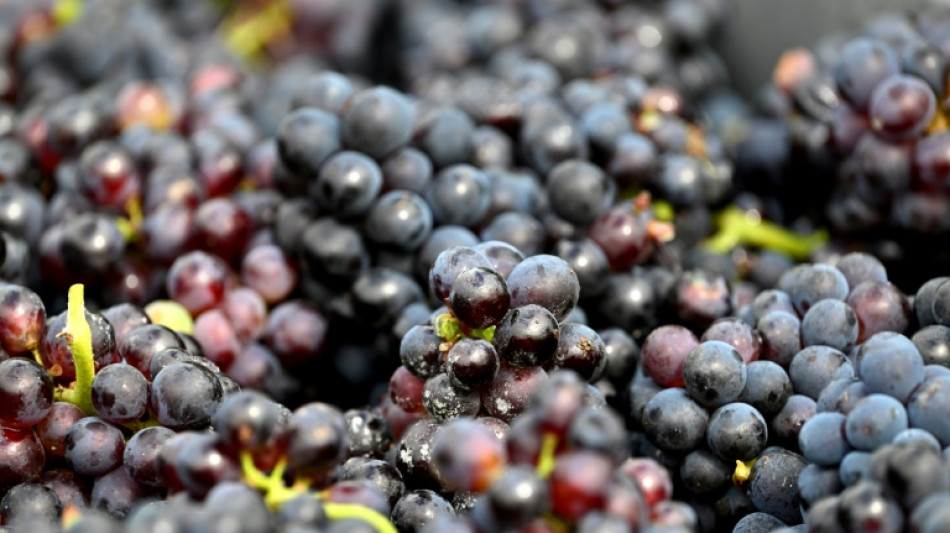
600-year-old pinot noir grape found in medieval French toilet / Photo: FRANCOIS NASCIMBENI - AFP/File

600-year-old pinot noir grape found in medieval French toilet

A 600-year-old grape seed discovered in the toilets of a medieval French hospital is genetically identical to the grapes still being used to make pinot noir wine, scientists said Tuesday.

Text size:

The seed reveals that people in France have been cultivating this immensely popular variety of grape since at least the 1400s, the scientists said in a new study.

It is not possible to say whether the fruit was "eaten like table grapes or whether people made wine from it at the time", study co-author Laurent Bouby told AFP.

But the research provides a link between modern France -- one of the world's largest wine-producing and -consuming countries -- and its distant wine-loving past.

Another study co-author, Ludovic Orlando, pointed out that the Hundred Years' War between England and France finally wrapped up in the mid-1400s.

And the brief life of France's patron saint, Joan of Arc, was also in the 15th century.

"She could have eaten the same grapes as us," the paleogeneticist at the University of Toulouse told AFP.

The seed was found in a toilet in a 15th-century hospital in Valenciennes in northern France. At the time, toilets were sometimes used as rubbish bins, the researchers explained.

The study, which was published in the journal Nature Communications, involved sequencing the genome of 54 grape seeds dating from the Bronze Age -- from around 2,300 BC -- to the Middle Ages.

It confirms that generations of winegrowers had been using what are today called "clonal propagation" techniques, such as preserving cuttings of particular grape varieties for 600 years, the researchers said.

Ancient texts had offered indications this was happening, "but outside of paleogenomics, it is very difficult to characterise this technique", said Bouby of the Institute of Evolutionary Science of Montpellier.

But the new research found evidence this technique was being used in many areas as far back as the Iron Age, around 625–500 BC.

- Aged like fine wine -

The oldest grapes analysed in the study were from wild vines in the French region of Nimes dated to around 2,000 BC.

Domesticated vines then started to appear between 625 and 500 BC in France's southern Var region.

This lines up with when colonising Greeks were believed to have introduced viticulture -- cultivating grapevines -- to France, after founding the city of Marseille.

Orlando said it was already known that wine was traded at the time by the Greeks and the Etruscans, because of wine jugs called amphora that lasted through the centuries.

But the DNA of the grape seeds, particularly those from the ancient Roman period, revealed long-distance exchanges of domesticated grape varieties from places including Spain, the Balkans, the Caucasus and the Middle East.

It also showed there was plenty of genetic mixing of domesticated grape varieties and local wild vines during the Roman period, particularly in northern France.

In the future, "it would be very interesting to work closely with historians who have access to texts describing certain winegrowing techniques" to find out more, Orlando said.

Pinot noir, which is often associated with France's Burgundy region, is the fourth most widely grown grape in the world, according to the study.

T.Ueda--JT