Myanmar's long march of military rule / Photo: STR - AFP/File

Myanmar's military has ruled the country for most of its post-independence history, presenting itself as the only force capable of guarding the fractious Southeast Asian nation from rupture and ruin.
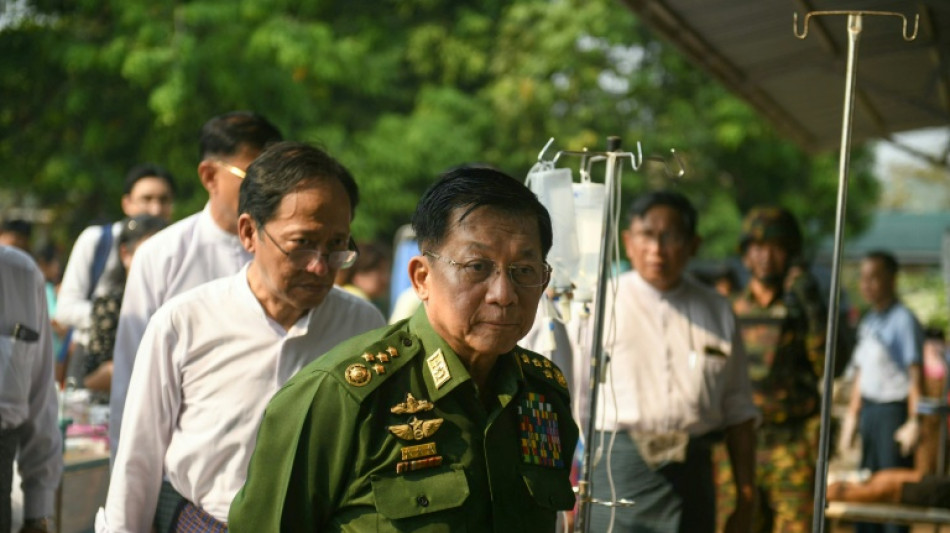
A decade-long democratic thaw saw martial rulers loosen their grip and Nobel Peace Prize laureate Aung San Suu Kyi lead, before a junta snatched back power in a 2021 coup triggering a ferocious civil war.
The military has organised elections starting Sunday but the vote is being shunned at home and abroad, and the generals have pledged to preserve their role in politics.
Here is a brief history of military rule in Myanmar:
- Founding force -
Myanmar, formerly known as Burma, won its independence in 1948 as Britain dissolved its empire after World War II.
The autonomy struggle was led by Aung San, the father of Aung San Suu Kyi. He first fought with the invading Japanese to oust Britain, before swapping sides as the tide of war changed and currying favour with London for the cause of independence.
The fledgling democracy had a thriving press and cinema scene, and promising economic potential as the world's leading rice exporter.
But as the civilian government battled rebellions and internal divisions, it handed power to the military in 1958 for a two-year caretaker spell.
- 'Bamboo curtain' -
Elections followed, but the voluntary relinquishing of power had emboldened the military to make a takeover by force in 1962.
Aung San's wartime comrade Ne Win, who had taken the helm of the armed forces after the leader's assassination in murky circumstances, swooped in in a putsch he justified as protection against Myanmar's disintegration.
He later said the military "took over power against its cherished beliefs", promising to "transfer power to the people in due course".
But he ruled for 26 years, enforcing a nominally socialist one-party state that pulled a "bamboo curtain" around Myanmar making it a hermit nation, crashing the economy and crushing dissent.
- Protests, coup, protests -
Massive student-led pro-democracy protests that began on August 8, 1988 forced Ne Win to step down.
But a rebranded leadership swiftly staged a fresh coup, crushing demonstrations in a bloody crackdown that saw more than 3,000 people killed and many more spirited away to prison.
Than Shwe became the top general, facing his own uprising in 2007 when the "Saffron Revolution" led by robed monks took up the pro-democracy mantle.
He, too, used military might to quell the resistance.
The 1988 protests were a proving ground for activists, some still challenging military rule today. At the forefront was Suu Kyi, who won the Nobel Peace Prize in 1991 during one of many stints in detention.
- Military makes the rules -
Than Shwe retired in 2011, handing power to a civilian government, which was however led by an ex-general and reined in by a military-drafted constitution privileging the armed forces with a central role in parliament and cabinet.
Critics initially dismissed it as military rule wearing a civilian sash, but president Thein Sein proved a cautious reformist.
He released Suu Kyi, who surged to electoral victory in 2015 and assumed a leadership position carved out to sidestep military-drafted rules that barred her from the presidency.
The democratic figurehead opened the country up, often sparring with military chief Min Aung Hlaing.
- Civil war -
Her second landslide in 2020 polls proved a step too far, and Min Aung Hlaing snatched back power, making unsubstantiated allegations of voter fraud, re-jailing Suu Kyi and dissolving her party.
The coup triggered a full-blown civil war as long-active ethnic minority armies were joined on the battlefield by pro-democracy partisans.
The junta is touting the upcoming phased elections as a step towards reconciliation.
But Suu Kyi remains under junta lock and key, generals are managing the vote, rebels are set to block it from territory they control, and international monitors have dismissed it as a pretext for continuing military rule.
Results are expected around the end of January 2026.
K.Nakajima--JT