In Simandou mountains, Guinea prepares to cash in on iron ore / Photo: PATRICK MEINHARDT - AFP

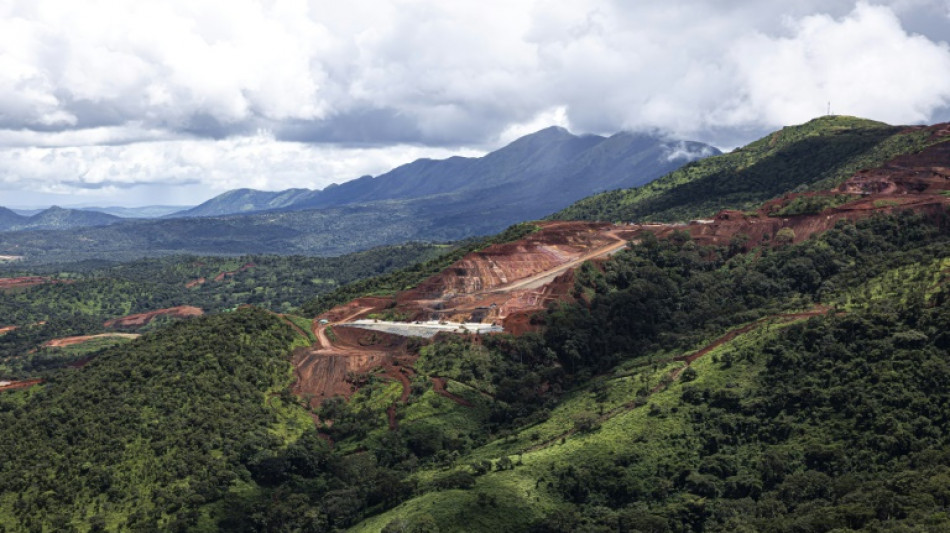
At the foot of the Simandou mountains in southeast Guinea's lush tropical forest, thousands of workers, trucks and excavators are digging up the hills.
The verdant paradise is home to a gigantic mining project that promises to propel the poor west African country into the ranks of the world's largest iron exporters -- raising economic hopes but also concern for local populations.
In just a few weeks, Guinea will export its first shipments of iron ore from Simandou, officially launching production decades after the discovery of high-grade iron deposits.
"It wasn't too long ago where this was virgin forest," Chris Aitchison, managing director of SimFer, one of the operators of the site, told AFP, praising what he said had been a "monumental task" at multiple levels.
The project will ideally provide a stream of much-needed revenue for the country and has already resulted in construction of infrastructure that could diversify the economy: industrial partners have spent approximately $20 billion building more than 650 kilometres (400 miles) of railway and a massive port.
- Logistical challenge -
The logistical challenges building the mines were immense but so is the potential windfall from the site, which contains several billion tonnes of high-quality ore.
The price of iron ore, which is used for making steel, has skyrocketed since the early 2000s, fuelled by a boom in Chinese construction.
Ever since Anglo-Australian mining giant Rio Tinto confirmed the Simandou deposits in the mid-1990s, the site has been at the centre of a swirl of legal battles, political turmoil and corruption scandals.
Guinea's junta government, run by strongman Mamady Doumbouya who came to power in a 2021 coup, boasts of having finally pushed the project over the finish line.
Of the four Simandou mining deposits, two are being developed by Chinese-Singaporean group Winning Consortium Simandou (WCS) and the other two by SimFer, a consortium owned by Rio Tinto and Chinese giant Chinalco.
An AFP team travelled to the SimFer site, on the southern end of the Simandou range, a few weeks before the start of production scheduled for November 11.
On the slopes of Mount Oueleba, with an altitude of 1,300 metres (4,265 feet), excavators devoured the mountainside, creating piles of black ore.
Thousands of people work day and night at the gigantic mine site, which is 55 kilometres long.
Although mining activity has already begun, it will take another 2.5 years for infrastructure to be completed and for SimFer to reach its annual production rate of 60 million tonnes.
- Water pollution -
SimFer says it is doing everything possible to limit its environmental impact on the local population in compliance with international standards.
Its efforts include a training centre for students, a seed bank of local flora or gradually rehabilitating mined land.
It also moved its operations to the east side of the mountain to preserve a chimpanzee population, costing it hundreds of millions of dollars, it said.
Despite the initiatives, the mine is impacting local communities: According to a report by the organisation Advocates for Community Alternatives (ACA), construction activities have caused soil and water pollution near the mines, along the railway and near the port.
Sediment runoff from construction was the main form of pollution observed.
Water pollution is "a big issue for us", Aitchison said, adding that the company was spending "a lot of time building sediment traps".
Ore will be transported on a 36-hour journey from Simandou to the Morebaya port complex at the mouth of a river, where SimFer and Winning will export 120 million tonnes of ore per year when production reaches its peak.
- Community impacts -
Among the estuary area's many palm trees sits SimFer's port terminal, where thousands of employees work ahead of its scheduled completion in September 2026.
A few kilometres away, the village of Touguiyire stands in contrast to the economic prosperity of the port.
A pirogue canoe returned from fishing and its haul was meagre. A few women sorted through the small fish on the pier while men mended their nets.
Since the arrival of dredging boats for the port, the fish have disappeared and with them an entire way of life, locals say.
"Before, the pirogues would return with 10 buckets of fish," Aissata Cisse, a 54-year-old vendor said. "Now they come back with only two."
Fishermen must now go farther out into open waters in pirogues that are not always seaworthy.
According to local representative Bissiry Camara, three men recently died while fishing on the high seas.
The small village once had about 60 pirogues and its approximately 3,000 inhabitants relied on a bountiful catch. Now only three pirogues are operational, according to fishermen.
"The lives of the fishermen are completely threatened," said Alkaly Bangoura, a member of a monitoring committee for the Simandou project in the Forecariah prefecture where Touguiyire is located.
In an attempt to compensate, Winning and SimFer have distributed food as well as equipment for fishing further out, such as motors.
Due to a lack of income, however, the fishermen can no longer maintain their pirogues and remain stranded on shore.
"We hoped for a better future with Simandou, but now it's disillusionment", Bangoura said.
- Opacity -
Meanwhile, authorities vaunt the mine as a major boost for the economy -- the country's economic development plan is even called Simandou 2040.
Billboards in the capital Conakry promoting Simandou were used widely by the junta during its recent campaign promoting a new constitution that would allow its leader to stay in power.
The state, which holds a 15-percent stake in the railway line, is counting on it to open up entire areas and believes it should help develop agriculture in remote but highly fertile regions.
"A new economy will emerge," Prime Minister Amadou Oury Bah told AFP during an interview, pointing to the train's ability to diversify the country's output.
Despite Guinea's considerable natural resources, including vast reserves of bauxite used to make aluminium, its economy struggles and the population benefits very little from the mining industry.
"There have already been other mining projects that have raised a lot of hope... but with very limited results," said Oumar Totiya Barry, executive director of the independent organisation Guinean Observatory of Mines and Metals.
According to him, the project's ability to open up the country is doubtful. "When you look at the Simandou railway's route, it passes very far from all of Guinea's major cities," he said.
One major unknown is the content of the 2022 agreement negotiated between the state and the companies, despite the Guinean mining code's requirement to publish such contracts.
Traditionally, miners receive tax breaks in exchange for their large investments, but neither the government, SimFer nor Winning would comment when contacted by AFP.
Prime Minister Bah, however, is promising transparency.
Once production begins "there is no reason why things should not be made available to the public", he said.
K.Inoue--JT