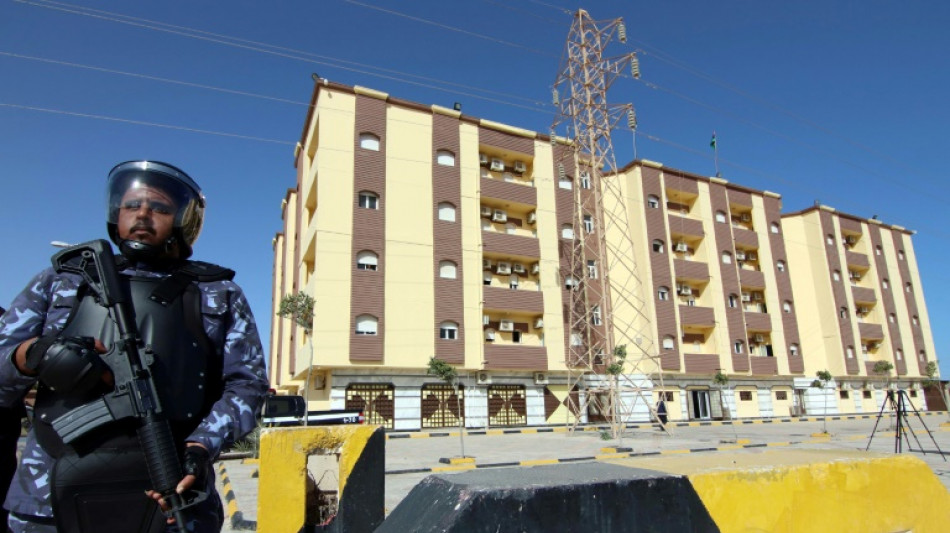
Libyan protesters storm parliament building in Tobruk / Photo: Mohammed El SHAIKHY - AFP/File

Protesters stormed Libya's parliament building in the eastern city of Tobruk on Friday, demonstrating against deteriorating living conditions and political deadlock, Libyan media reported.
Several television channels said that protesters had managed to penetrate the building and committed acts of vandalism, while media outlets showed images of thick columns of black smoke coming from its perimeter as angry young demonstrators burned tyres.
Other media reports said part of the building had been burned.
The parliament building was empty, as Friday falls on the weekend in Libya.
Libya's parliament, or House of Representatives, has been based in Tobruk, hundreds of kilometres (miles) east of the capital Tripoli, since an east-west schism in 2014 following the revolt that toppled dictator Moamer Kadhafi three years earlier.
A rival body, formally known as the High Council of State, is based in Tripoli.
Images Friday showed that a protester driving a bulldozer had managed to smash through part of a gate, allowing other demonstrators to enter more easily, while cars of officials were set on fire.
Later, protesters began to break through the building's walls with construction equipment.
Others, some brandishing the green flags of the Kadhafi regime, threw office documents into the air.
While recognising "the right of citizens to demonstrate peacefully", parliament condemned "acts of vandalism and the burning" of its headquarters.
The interim prime minister of the Tripoli-based government, Abdulhamid Dbeibah, said on Twitter that he would add his voice to those of the protesters and called for the holding of elections.
Libya has endured several days of power cuts, worsened by the blockade of several oil facilities against the backdrop of political rivalries.
"We want the lights to work," protesters chanted.
- Talks fail to resolve stalemate -
Two governments have been vying for power for months: one based in Tripoli, led by Dbeibah, and another headed by former interior minister Fathi Bashagha, appointed by the parliament and supported by eastern-based strongman Khalifa Haftar.
"I call on my parliamentary colleagues as well as members of the High Council of State to collectively resign to respect the will of the Libyan people and preserve Libya's stability," lawmaker Ziad Dgheim, was quoted as saying by Libyan channel Al-Ahrar on Friday.
Lawmaker Balkheir Alshaab said: "We must recognise our failure and immediately withdraw from the political scene."
Presidential and parliamentary elections, originally set for December last year, were meant to cap a UN-led peace process following the end of the last major round of violence in 2020.
But the vote never took place due to several contentious candidacies and deep disagreements over the polls' legal basis between rival power centres in the east and west.
The United Nations said Thursday that talks between the rival Libyan institutions aimed at breaking the deadlock had failed to resolve key differences.
Parliament speaker Aguila Saleh and High Council of State president Khaled al-Mishri met at the UN in Geneva for three days of talks to discuss a draft constitutional framework for elections.
While some progress was made, it was not enough to move forward towards elections, with the two sides still at odds over who can stand in presidential elections, said the UN's top Libya envoy Stephanie Williams, who facilitated the talks.
- 'Escalating quickly' -
The prospect of elections appears as distant as ever since the HoR, elected in 2014, appointed Bashagha, arguing that Dbeibah's mandate had expired.
After Bashagha failed to enter Tripoli in an armed standoff in May, the rival administration has taken up office further east in Sirte, Kadhafi's hometown.
Recent weeks have seen repeated skirmishes between armed groups in Tripoli, prompting fears of a return to full-scale conflict.
Protests took place in other Libyan cities on Friday including Tripoli, where protesters held images of Dbeibah and Bashagha crossed out.
"Popular protests have erupted across Libya in exasperation at a collapsing quality of life, the entire political class who manufactured it, and the UN who indulged them over delivering promised change," tweeted analyst Tarek Megerisi of the European Council on Foreign Relations.
"Things are escalating quickly and the response will define Libya's summer," he added.
Libya's National Oil Corporation said Monday that a blockade at oil installations in the central coastal region of Sirte meant it may declare force majeur, a measure freeing it of contractual obligations due to circumstances beyond its control.
A blockade of two major oil export terminals and several oilfields began in April.
Eastern-based strongman Haftar's forces control major oil facilities.
A drop in gas production contributed to chronic power cuts, which can last around 12 hours a day.
K.Yamaguchi--JT