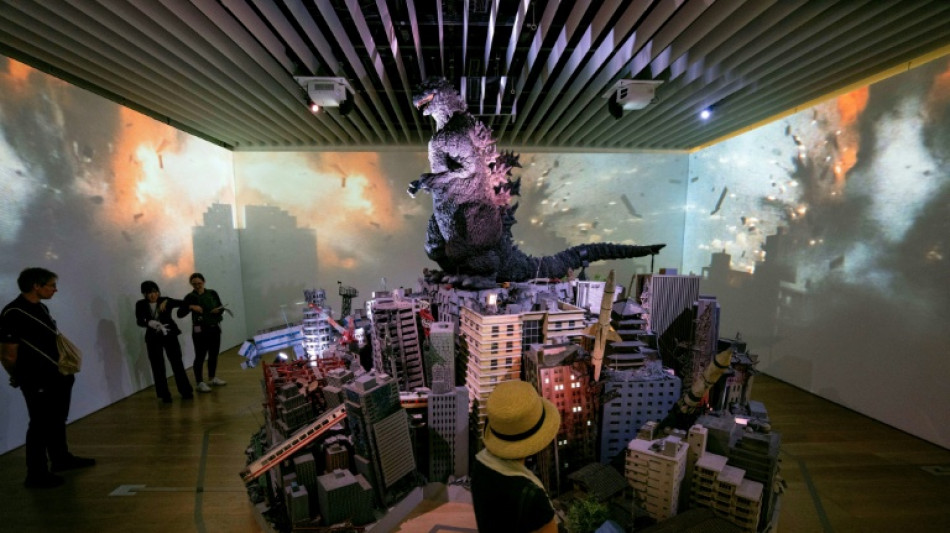
Mighty Atom: how the A-bombs shaped Japanese arts / Photo: Kazuhiro NOGI - AFP

From Godzilla's fiery atomic breath to post-apocalyptic anime and harrowing depictions of radiation sickness, the influence of the nuclear bombings of Hiroshima and Nagasaki runs deep in Japanese popular culture.
In the 80 years since the World War II attacks, stories of destruction and mutation have been fused with fears around natural disasters and, more recently, the Fukushima crisis.
Classic manga and anime series "Astro Boy" is called "Mighty Atom" in Japanese, while city-levelling explosions loom large in other titles such as "Akira", "Neon Genesis Evangelion" and "Attack on Titan".
"Living through tremendous pain" and overcoming trauma is a recurrent theme in Japan's cultural output "that global audiences have found fascinating", said William Tsutsui, a history professor at Ottawa University.
The US nuclear bombing of Hiroshima on August 6, 1945 left around 140,000 people dead. It was followed days later by the bombing of Nagasaki that killed around 74,000 people.
Some poetry "portrays the sheer terror of the atomic bomb at the moment it was dropped", but many novels and artworks address the topic indirectly, said author Yoko Tawada.
"It's very difficult for the experience of the atomic bomb, which had never existed in history before, to find a place in the human heart as a memory," she told AFP.
Tawada's 2014 book "The Emissary" focuses on the aftermath of an unspecified terrible event.
She was inspired by connections between the atomic bombs, the 2011 Fukushima nuclear disaster and "Minamata disease" -- mass mercury poisoning caused by industrial pollution in southwest Japan from the 1950s.
The story "is less of a warning, and more a message to say: things may get bad, but we'll find a way to survive", Tawada said.
- Godzilla's skin -
Narratives reflecting Japan's complex relationship with nuclear technologies abound, but the most famous example is Godzilla, a prehistoric creature awakened by US hydrogen bomb testing in the Pacific.
"We need monsters to give a face and form to abstract fears," said professor Tsutsui, author of the book "Godzilla on My Mind".
"In the 1950s, Godzilla fulfilled that role for the Japanese -- with atomic energy, with radiation, with memories of the A-bombs."
Many people who watched Godzilla rampage through Tokyo in the original 1954 film left theatres in tears, he said.
And "it's said that the special effects people working on Godzilla modelled the monster's heavily furrowed skin after the keloid scars on the survivors of Hiroshima and Nagasaki."
In the nearly 40 Godzilla movies released since, nuclear themes are present but often given less prominence, partly to appease American audiences, Tsutsui said.
Even so, the series remains hugely popular, with 2016 megahit "Shin Godzilla" seen as a critique of Japan's response to the tsunami-triggered Fukushima disaster.
- 'Black Rain' -
"Black Rain", a 1965 novel by Masuji Ibuse about radiation sickness and discrimination, is one of Japan's best-known novels about the Hiroshima bombing.
But the fact Ibuse was not an A-bomb survivor is part of a "big debate about who is permitted to write these stories", said Victoria Young of the University of Cambridge.
"How we talk about or create literature out of real life is always going to be difficult," she said.
"Are you allowed to write about it if you didn't directly experience it?"
Nobel-winning author Kenzaburo Oe collected survivor accounts in "Hiroshima Notes", essays written on visits to the city in the 1960s.
"He's confronting reality, but tries to approach it from a personal angle" including his relationship with his disabled son, said Tawada, who has lived in Germany for four decades after growing up in Japan.
"The anti-war education I received sometimes gave the impression that Japan was solely a victim" in World War II, she said.
"When it comes to the bombings, Japan was a victim -- no doubt" but "it's important to look at the bigger picture" including Japan's wartime atrocities, she said.
As a child, illustrations of the nuclear bombings in contemporary picture books reminded her of depictions of hell in historical Japanese art.
This "made me consider whether human civilisation itself harboured inherent dangers", making atomic weapons feel less like "developments in technology, and more like something latent within humanity".
H.Nakamura--JT