The Japan Times - Trawling Iraq's threatened marshes to collect plastic waste

EUR -
AED 4.048391
AFN 71.653298
ALL 90.75031
AMD 397.442438
ANG 1.973657
AOA 1011.961176
ARS 1704.383624
AUD 1.623037
AWG 1.984237
AZN 1.856101
BAM 1.951037
BBD 2.220878
BDT 137.48047
BGN 1.954992
BHD 0.417001
BIF 3319.211342
BMD 1.102354
BND 1.423305
BOB 12.873396
BRL 6.246263
BSD 1.102608
BTN 104.113356
BWP 15.450053
BYN 3.311511
BYR 21606.133827
BZD 2.223108
CAD 1.571157
CDF 2551.948763
CHF 0.923203
CLF 0.028076
CLP 1104.973776
CNY 7.354629
CNH 7.355428
COP 3659.781435
CRC 495.301692
CUC 1.102354
CUP 26.528091
CVE 110.400862
CZK 24.405338
DJF 196.830673
DKK 7.476492
DOP 67.24023
DZD 151.259517
EGP 58.978202
ERN 16.535307
ETB 181.42142
FJD 2.507138
FKP 0.83436
GBP 0.833065
GEL 2.855395
GGP 0.83436
GHS 12.925107
GIP 0.83436
GMD 81.574323
GNF 9793.033462
GTQ 8.429306
GYD 230.683681
HKD 8.648739
HNL 29.723102
HRK 7.531242
HTG 144.950495
HUF 364.886804
IDR 20101.861877
ILS 3.545941
IMP 0.83436
INR 103.891879
IQD 1675.705726
IRR 2109615.737539
ISK 136.614616
JEP 0.83436
JMD 174.650597
JOD 0.781559
JPY 176.084434
KES 143.361332
KGS 96.384849
KHR 4497.603336
KMF 492.752448
KPW 992.118776
KRW 1472.176938
KWD 0.34335
KYD 0.921103
KZT 492.691684
LAK 24881.085017
LBP 98983.338221
LKR 367.641256
LRD 187.910642
LSL 18.686464
LTL 3.254964
LVL 0.666803
LYD 7.125024
MAD 10.953937
MDL 20.078069
MGA 5022.01716
MKD 61.54521
MMK 2315.245513
MNT 3974.716094
MOP 8.933131
MRU 44.703153
MUR 52.493964
MVR 16.998872
MWK 1916.706549
MXN 20.443137
MYR 4.504325
MZN 70.438049
NAD 18.686464
NGN 1481.089143
NIO 40.680139
NOK 11.20832
NPR 166.581569
NZD 1.994348
OMR 0.424511
PAB 1.102608
PEN 3.761013
PGK 5.044017
PHP 70.506587
PKR 305.654544
PLN 4.404526
PYG 6843.293114
QAR 4.017253
RON 5.348508
RSD 117.465767
RUB 91.306912
RWF 1635.305588
SAR 4.217285
SBD 8.926527
SCR 15.295052
SDG 663.067957
SEK 11.094899
SGD 1.419062
SHP 0.830054
SLE 25.408839
SLL 23115.81135
SOS 631.702158
SRD 41.327132
STD 22816.497327
STN 24.500084
SVC 9.672033
SYP 14332.804046
SZL 18.681064
THB 37.34223
TJS 10.196735
TMT 3.858238
TND 3.316427
TOP 2.654204
TRY 55.485652
TTD 7.503026
TWD 36.257957
TZS 2926.910001
UAH 50.255172
UGX 4553.882371
USD 1.102354
UYU 44.690894
UZS 13292.045418
VES 1006.31588
VND 28358.601825
VUV 132.635307
WST 3.09826
XAF 655.957
XAG 0.022553
XAU 0.000284217645
XCD 2.979166
XCG 1.992107
XDR 0.779421
XOF 655.957
XPF 119.331742
YER 260.761859
ZAR 18.51405
ZMK 9922.506973
ZMW 22.599077
ZWL 354.957463
SSP 6553.913348
MXV 2.295791
  • RYCEF

    0.1000

    19.81

    +0.5%

  • VOD

    -0.2500

    16.33

    -1.53%

  • CMSC

    -0.2800

    20.12

    -1.39%

  • RBGPF

    -2.0000

    65

    -3.08%

  • RIO

    -0.2500

    94.16

    -0.27%

  • BTI

    -1.2000

    54.85

    -2.19%

  • NGG

    -0.3000

    74.94

    -0.4%

  • GSK

    -0.3500

    49.35

    -0.71%

  • BCE

    -0.4200

    20.14

    -2.09%

  • CMSD

    -0.3400

    19.93

    -1.71%

  • BP

    -0.9100

    43.52

    -2.09%

  • RELX

    0.1700

    33.24

    +0.51%

  • BCC

    -0.6200

    75.97

    -0.82%

  • AZN

    -1.9400

    164.21

    -1.18%

  • JRI

    0.0000

    10.77

    0%

Trawling Iraq's threatened marshes to collect plastic waste
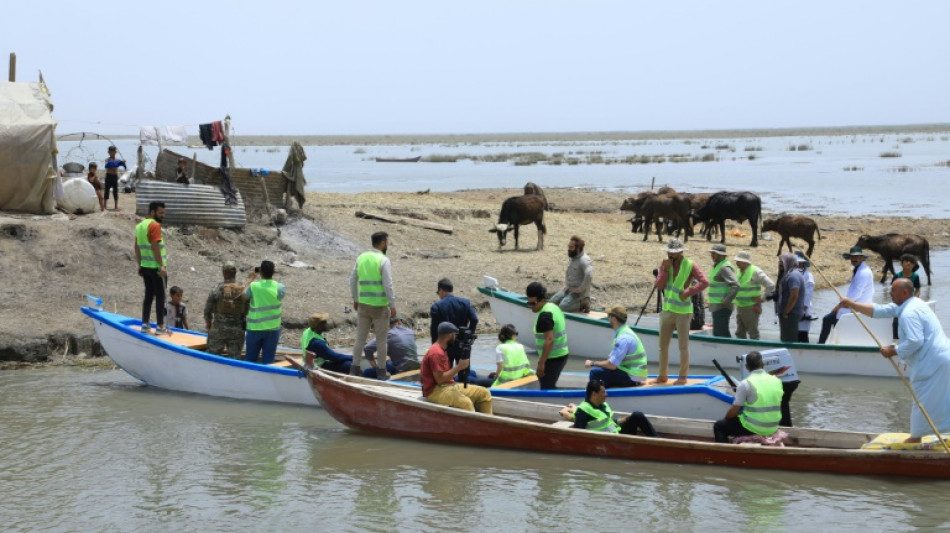
Trawling Iraq's threatened marshes to collect plastic waste / Photo: Asaad NIAZI - AFP

Trawling Iraq's threatened marshes to collect plastic waste

Iraq's vast swamplands are the reputed home of the biblical Garden of Eden, but the waterways are drying out and becoming so clogged with waste their very existence is at risk, activists warn.

Text size:

"For 6,000 or 7,000 years the inhabitants have protected the marshes," said Raad al-Assadi, director of Chibayish Organisation for Ecotourism, who this week began work on a boat to try to clear some of the worst areas of trash.

"But we have reached a stage where the marshes are threatened with extinction."

The swamps, nestled between the Tigris and Euphrates rivers, are one of the world's largest inland deltas.

The wetlands barely survived the wrath of dictator Saddam Hussein, who ordered they be drained in 1991 as punishment for communities protecting insurgents and to hunt them down.

But after Saddam was toppled, Iraq pledged to preserve the ecosystem and provide functional services to the marshland communities, and they were inscribed as a UNESCO World Heritage site in 2016 both for their biodiversity and their ancient history.

Tourists have returned, but one of the main visible sources of pollution in the area are visitors who throw away their "plastic waste", said Assadi.

- 'Respect our land' -

After decades of brutal war, Iraq lacks structures for the collection and disposal of waste, and 70 percent of its industrial waste is dumped directly into rivers or the sea, according to data compiled by the United Nations and academics.

A team of 10 joins the boat, cruising the maze of narrow waterways to collect the piles of plastic bottles filling the channels, and erecting signs urging people to "respect our land", and not to litter.

But it is far from the only threat: Iraq's host of environmental problems, including drought and desertification, threaten access to water and livelihoods across the country.

The UN classifies Iraq "as the fifth most vulnerable country in the world" to climate change, having already witnessed record low rainfall and high temperatures in recent years.

The water level of the marsh is falling, a phenomenon accentuated by repeated droughts and by the dams built upstream of the two rivers, among Iraq's upstream neighbours, Turkey and Iran.

"There is a threat to this ecosystem, which has significant biodiversity", said French ambassador Eric Chevallier, at the launch Thursday of the French-funded boat project.

Chevallier called for "much greater mobilisation, Iraqi and international, to meet all the challenges" that a heating planet is causing.

A string of sandstorms in recent weeks have blanketed Iraq, with thousands needing medical care due to respiratory problems.

The Middle East has always been battered by dust and sandstorms, but they have become more frequent and intense in recent years.

The trend has been associated with overuse of river water, more dams, overgrazing and deforestation.

The rubbish collectors are not the only unusual team in the marshes: earlier this year, the Iraqi Green Climate Organization launched a veterinary ambulance to help farmers treat their water buffalo.

Y.Ishikawa--JT