The Japan Times - With bulging in-tray, Ishiba becomes Japan PM

EUR -
AED 4.097816
AFN 72.527946
ALL 90.712998
AMD 404.811747
ANG 1.99706
AOA 1024.313507
ARS 1724.662178
AUD 1.623096
AWG 2.008458
AZN 1.91877
BAM 1.953926
BBD 2.256892
BDT 139.72599
BGN 1.950247
BHD 0.422793
BIF 3352.449481
BMD 1.11581
BND 1.432668
BOB 13.291252
BRL 6.230345
BSD 1.120725
BTN 105.323984
BWP 15.375116
BYN 3.355477
BYR 21869.872723
BZD 2.253918
CAD 1.585326
CDF 2583.100203
CHF 0.922108
CLF 0.0279
CLP 1098.064116
CNY 7.442842
CNH 7.446837
COP 3690.831133
CRC 506.911552
CUC 1.11581
CUP 26.896962
CVE 110.159347
CZK 24.353609
DJF 199.538223
DKK 7.475346
DOP 67.974501
DZD 152.322563
EGP 59.441086
ERN 16.737147
ETB 179.813105
FJD 2.521675
FKP 0.837623
GBP 0.836361
GEL 2.900602
GGP 0.837623
GHS 13.123413
GIP 0.837623
GMD 82.569707
GNF 9928.433203
GTQ 8.563787
GYD 234.834771
HKD 8.754365
HNL 30.127233
HRK 7.552928
HTG 146.895822
HUF 364.308582
IDR 20253.064275
ILS 3.538138
IMP 0.837623
INR 104.639586
IQD 1698.955315
IRR 2126817.227366
ISK 136.806464
JEP 0.837623
JMD 177.867814
JOD 0.7911
JPY 177.20958
KES 144.999439
KGS 97.577343
KHR 4570.636808
KMF 493.187739
KPW 1004.228806
KRW 1489.840304
KWD 0.347051
KYD 0.933896
KZT 500.345637
LAK 25225.015582
LBP 100356.101099
LKR 372.449448
LRD 190.51557
LSL 18.372503
LTL 3.294696
LVL 0.674942
LYD 7.18411
MAD 10.932215
MDL 20.138054
MGA 5121.567239
MKD 61.529349
MMK 2342.916727
MNT 4020.769368
MOP 9.055134
MRU 45.209437
MUR 52.587814
MVR 17.179495
MWK 1943.318757
MXN 20.739588
MYR 4.546978
MZN 71.31144
NAD 18.372914
NGN 1501.914249
NIO 41.006083
NOK 10.604989
NPR 168.517621
NZD 1.990159
OMR 0.428949
PAB 1.120725
PEN 3.819334
PGK 5.019192
PHP 70.494669
PKR 309.947231
PLN 4.396012
PYG 6917.311752
QAR 4.085282
RON 5.343504
RSD 117.623643
RUB 92.835034
RWF 1658.09487
SAR 4.192115
SBD 9.027735
SCR 15.61324
SDG 671.145774
SEK 11.024313
SGD 1.430513
SHP 0.836094
SLE 25.547314
SLL 23397.979196
SOS 640.479979
SRD 41.894194
STD 23095.010728
STN 24.476306
SVC 9.806507
SYP 14507.759094
SZL 18.378373
THB 37.519083
TJS 10.29923
TMT 3.905334
TND 3.347703
TOP 2.686602
TRY 56.050138
TTD 7.600642
TWD 36.644646
TZS 2951.791192
UAH 50.972855
UGX 4572.61443
USD 1.11581
UYU 45.346102
UZS 13419.768365
VES 1004.776153
VND 28606.016684
VUV 133.693197
WST 3.109828
XAF 655.957
XAG 0.021063
XAU 0.000275061032
XCD 3.015532
XCG 2.019745
XDR 0.788935
XOF 655.957
XPF 119.331742
YER 263.891149
ZAR 18.441943
ZMK 10043.624196
ZMW 22.830625
ZWL 359.290311
SSP 6410.771031
MXV 2.330291
  • RYCEF

    0.1000

    19.81

    +0.5%

  • VOD

    -0.2500

    16.33

    -1.53%

  • CMSC

    -0.2800

    20.12

    -1.39%

  • RBGPF

    -2.0000

    65

    -3.08%

  • RIO

    -0.2500

    94.16

    -0.27%

  • BTI

    -1.2000

    54.85

    -2.19%

  • NGG

    -0.3000

    74.94

    -0.4%

  • GSK

    -0.3500

    49.35

    -0.71%

  • BCE

    -0.4200

    20.14

    -2.09%

  • CMSD

    -0.3400

    19.93

    -1.71%

  • BP

    -0.9100

    43.52

    -2.09%

  • RELX

    0.1700

    33.24

    +0.51%

  • BCC

    -0.6200

    75.97

    -0.82%

  • AZN

    -1.9400

    164.21

    -1.18%

  • JRI

    0.0000

    10.77

    0%

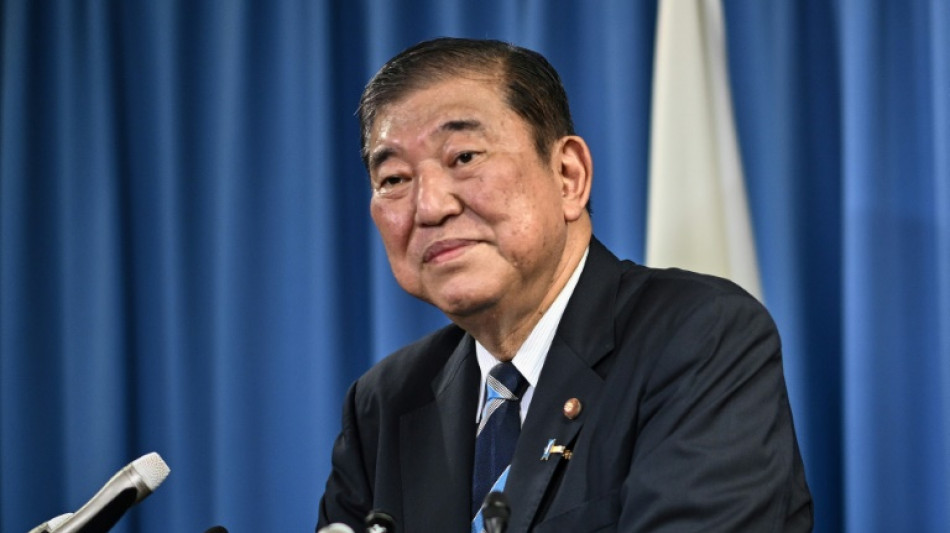
With bulging in-tray, Ishiba becomes Japan PM
With bulging in-tray, Ishiba becomes Japan PM / Photo: Philip FONG - AFP

With bulging in-tray, Ishiba becomes Japan PM

Shigeru Ishiba became Japanese prime minister on Tuesday, seeking to restore the ruling party's popularity and tackle a demographic crisis, a lacklustre economy and fears over China's military build-up.

Text size:

Ishiba, 67, says he intends to call a general election for October 27. He won a tight race on Friday to lead the Liberal Democratic Party (LDP), which has governed almost constantly for decades.

Japan's parliament, where the LDP has a majority, approved Ishiba's appointment on Tuesday afternoon, and he was expected to announce his cabinet later in the day.

Former chief cabinet secretary Katsunobu Kato was tipped to become finance minister, while Gen Nakatani will take defence and Takeshi Iwaya foreign affairs, local media said.

Ishiba, who has held at least three previous ministerial posts, is a self-confessed defence "geek" who tried and failed four times before to become LDP leader.

He finally succeeded this time because, while a divisive figure within the party, he is -- unlike predecessor Fumio Kishida -- relatively popular among voters, analysts said.

Ishiba's win "indicates that the LDP sought an experienced leader with broad voter appeal to steer the party in the next national election," said Yuko Nakano of the Center for Strategic and International Studies.

"If the ruling coalition secures a fresh mandate (in the election), Ishiba will have the opportunity to reshape the party's internal dynamics and restore public confidence, while addressing Japan's broader challenges, including economic stagnation felt by many voters and regional security concerns," she said.

- Tumbling stocks -

Markets, however, have reacted negatively, with the Nikkei plunging almost five percent on Monday. On Tuesday, the index recovered some ground and closed up 1.9 percent.

Ishiba's backing of interest rate hikes by the Bank of Japan has sent the yen higher, while the prospect of corporate tax hikes has worried investors.

One major area of government spending is the military.

Kishida undertook to double defence spending and boost ties with the United States and other countries rattled by China's rise and the behaviour of Russia and North Korea.

Last week, a Japanese warship sailed through the Taiwan Strait for the first time. A week earlier, a Chinese aircraft carrier steamed between two Japanese islands near Taiwan.

Japan has also scrambled fighter jets on multiple occasions in recent weeks to respond to activity by Russian and Chinese aircraft, including in its airspace.

Ishiba, who visited Taiwan in August, backs the creation in the region of a military alliance along the lines of NATO with its tenet of collective defence.

"Replacing Russia with China and Ukraine with Taiwan, the absence of a collective self-defence system like NATO in Asia means that wars are likely to break out because there is no obligation for mutual defence," Ishiba said in a recent policy paper.

S.Yamada--JT



