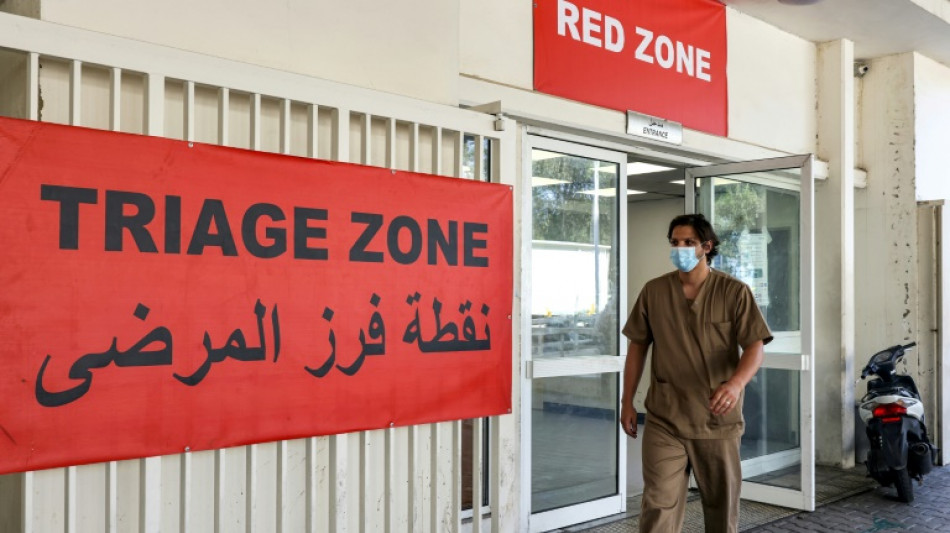
Bracing for war: Lebanese hospitals ready emergency plans / Photo: ANWAR AMRO - AFP

In Lebanon's biggest public hospital, nurses are busy honing their life-saving skills as the spectre of all-out war looms, 10 months into intensifying clashes between Hezbollah and Israel over the Gaza war.
"We are in a state of readying for war," nurse Basima Khashfi said as she gave emergency training to young nurses and other staff at the hospital in Beirut.
"We are currently training employees -- not just nurses, but also administrative and security staff.
"With our current capabilities, we're almost prepared" in case of a wider war, she told AFP.
Lebanon has been setting in motion public health emergency plans since hostilities began, relying mostly on donor funds after five years of gruelling economic crisis.
The threat of full-blown war grew after Iran and Lebanon's Hezbollah movement vowed to avenge the killings last month, blamed on Israel, of Hamas political leader Ismail Haniyeh in Tehran and top Hezbollah commander Fuad Shukr in south Beirut.
"We're training to handle mass casualty incidents and to prepare for disasters or war," said Lamis Dayekh, a 37-year-old nurse undergoing training. "If war breaks out, we'll give everything we have."
- 'Red zone' -
The cross-border violence has killed nearly 600 people in Lebanon, mostly Hezbollah fighters but including at least 131 civilians, according to an AFP tally.
On the Israeli side, including in the annexed Golan Heights, 23 soldiers and 26 civilians have been killed, army figures show.
In a building next to the hospital, where the emergency operations centre is located, health ministry officials are busy typing away, making calls and monitoring news of the war in Gaza and south Lebanon on large television screens.
"This is not our first war and we have been ready every time," said Wahida Ghalayini, who heads the centre, active since hostilties began in October.
She cited a massive 2020 Beirut port explosion, Hezbollah and Israel's 2006 conflict and Lebanon's 1975-1990 civil war.
The health ministry's plan includes a helpline for those already displaced by war, an assessment of hospital needs, disaster training for staff and a mental health module.
The emergency room coordinates with rescue teams and hospitals in Lebanon's south.
The plan prioritises hospitals based on their location. The "red zone", at high risk of Israeli strikes, comprises Hezbollah's strongholds in the country's south, east and Beirut's southern suburbs.
But despite Lebanon's long history of civil unrest and disasters, the public health sector now faces an economic crisis that has drained state coffers, forcing it to rely on aid.
- 'Learn' from Gaza -
"We need lots of medical supplies, fuel, oxygen... the Lebanese state has a financial and economic problem," said Ghalayini.
The state electricity provider barely produces power, so residents rely on expensive private generators and solar panels.
Most medical facilities depend on solar power during the day, she said, pointing to panels atop the adjacent hospital's roof and parking lot.
Lebanese Health Minister Firass Abiad said the country had enough drugs and medical supplies to last at least four months in case of a wider war.
"Efforts to increase readiness follow the (Israeli) enemy entity's threat of expanding its aggression," Abiad said in a statement.
Last month's strike that killed a top Hezbollah commander targeted a densely packed residential area, killing five civilians and wounding scores more.
It tested the readiness of Beirut hospitals in the high-risk Hezbollah stronghold, Ghalayini told AFP.
As Israel threatens full-scale war, Lebanon is also looking to health workers in Gaza for emergency planning strategies, she said.
"We are observing the Gaza emergency centre... to learn from them," she said, pointing at television footage of bloodied patients at a hospital in Gaza, where the death toll has sparked mounting concerns.
For 25-year-old nurse Mohamed Hakla, the prospect of war is frightening but "our job is to help others. I will not deprive people of this (help) because of fear".
S.Yamamoto--JT