UK general election: what happens next? / Photo: JUSTIN TALLIS - AFP

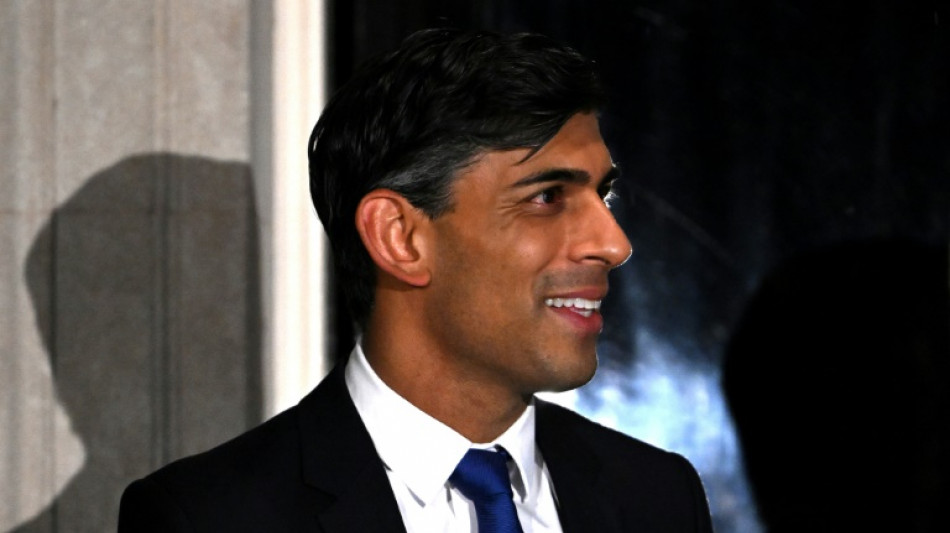
UK Prime Minister Rishi Sunak has called a general election for July 4, teeing up a battle between his ruling Conservatives and the main opposition Labour party.
Here's what you need to know before the country goes to the polls.
- What has happened? -
Sunak said he had spoken to King Charles III earlier on Wednesday to request the dissolution of parliament.
The prime minister, the leader of the biggest party in parliament, then followed tradition by announcing the election to the nation from outside Number 10 Downing Street.
"Now is the moment for Britain to choose its future, to decide whether we want to build on the progress we have made or risk going back to square one with no plan and no certainty," he said.
- What happens next? -
Parliament will tie up some legislative loose-ends before prorogation -- ending its current session -- on Friday May 24, with formal dissolution on May 30, Downing Street said.
Five weeks of campaigning then officially begin. Current members of parliament (MPs) lose their status and become candidates if they are running for office again.
The government enters a "pre-election period" -- previously called "purdah" -- which restricts what it can do before the next government is elected.
- How is the election decided? -
England, Scotland, Wales and Northern Ireland -- collectively the United Kingdom of Great Britain and Northern Ireland -- are split into 650 parliamentary constituencies or seats.
Registered voters aged over 18 in each constituency are permitted to cast their ballot for one candidate, either in person at a polling station or via postal ballots and proxies.
The UK operates a "first-past-the-post" system, meaning the candidate who wins the most votes in each constituency is elected to represent that area in parliament.
Most candidates represent a political party but some stand as independents.
If a party secures a majority in parliament of at least 326 seats, then it forms the government and its leader becomes prime minister.
If no party crosses that threshold, then the one with the most MPs usually forms a coalition with a smaller group, as the Conservatives did with the Liberal Democrats in 2010.
The second largest party becomes the official opposition.
- What happened last time? -
The last nationwide vote took place on December 12, 2019, when then-prime minister Boris Johnson secured a landslide victory for the Conservatives against Labour, then led by left-winger Jeremy Corbyn.
Johnson won largely on a single issue -- to "get Brexit done", which he did when the UK formally left the European Union in early 2020.
But his government quickly unravelled due to scandals including law-breaking parties at Downing Street during the coronavirus pandemic and Johnson was forced out by his own MPs in July 2022.
He was succeeded by Liz Truss who lasted just seven chaotic weeks in the job, during which she spooked financial markets, before the Conservatives replaced her with Sunak.
- Which party is likely to win? -
Labour, out of power since 2010, has enjoyed double-digit leads in most opinion polls for around two years.
That is largely due to a crippling cost-of-living crisis and Tory infighting that has resulted in five prime ministers since the 2016 Brexit vote, rather than overwhelming enthusiasm for Labour.
But Labour leader Keir Starmer, a former chief state prosecutor, needs a record swing of more than 12 points to achieve a majority of one, research has shown, meaning the result is far from a foregone conclusion.
The Tories might feel that their best chance comes from apathy among voters for both leaders, which could result in a "hung parliament", when no party secures a majority.
A hung parliament would result in political horse-trading, where one of the smaller parties, most likely the Liberal Democrats, becomes kingmakers in forming a coalition.
The new parliament will be summoned to meet on Tuesday July 9, when a new Speaker will be elected and MPs sworn in. The formal State Opening will be on Wednesday July 17.
S.Suzuki--JT