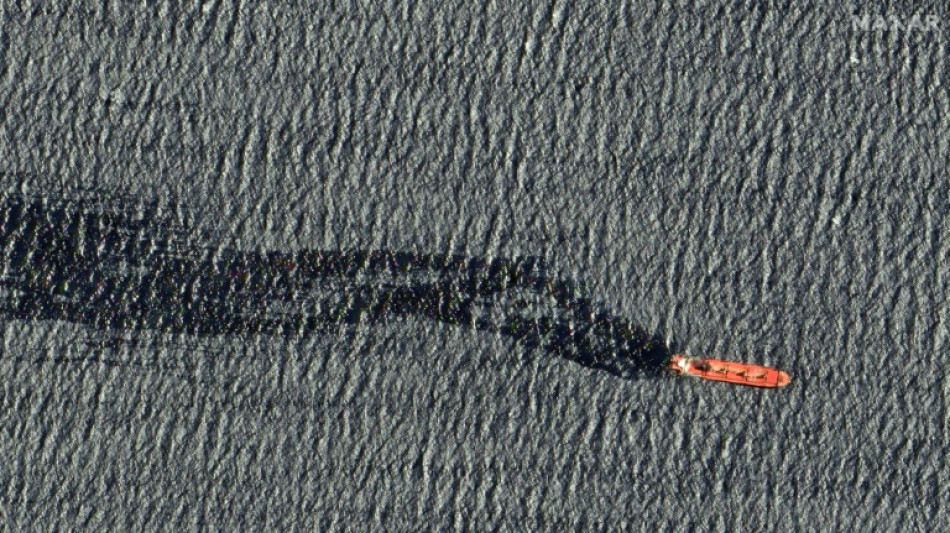
Yemen faces 'environmental disaster' as sunken ship threatens Red Sea / Photo: - - Satellite image ©2024 Maxar Technologies/AFP

The sinking of a bulk carrier off Yemen after a Huthi missile attack poses grave environmental risks as thousands of tonnes of fertiliser threaten to spill into the Red Sea, officials and experts warn.
Leaking fuel and the chemical pollutant could harm marine life, including coral reefs, and impact coastal communities that rely on fishing for their livelihoods, they said.
The Belize-flagged, Lebanese-operated Rubymar sank on Saturday with 21,000 metric tonnes of ammonium phosphate sulfate fertiliser on board, according to US Central Command.
It had been taking in water since a Huthi missile strike on February 18 damaged its hull, marking the most significant impact on a commercial ship since the rebels started targeting vessels in November.
After already leaving a slick from leaking fuel while it was still afloat, the Rubymar now poses a new set of environmental threats under water.
Abdulsalam al-Jaabi of the Yemeni government's environmental protection agency warned of "double pollution" that could impact 78,000 fishermen and their families -- up to half a million people.
"The first pollution is oil pollution resulting from the large amount of fuel oil on board," he said, estimating the quantity to be over 200 tonnes.
The second risk is posed by the fertiliser, which is highly soluble and could harm "fish and living organisms such as coral reefs and seaweed" if released into the sea, Jaabi added.
The overall contamination could incur "significant economic costs", especially on coastal communities that depend on fishing for survival, the official warned.
- 'Cascading effects' -
Yemen's Iran-backed Huthi rebels seized the capital Sanaa in 2014, pushing the internationally recognised government south to Aden and prompting Saudi Arabia to lead a military coalition to help prop it up the following year.
A ceasefire since April 2022 has largely held.
The Rubymar is the first ship to sink since the Huthis started their Red Sea campaign which they say is in solidarity with Palestinians in Gaza amid the Israel-Hamas war.
Plans to tow the vessel failed after port authorities in Aden, Djibouti and Saudi Arabia refused to receive the ship, according to Roy Khoury, the chief executive of Blue Fleet Group, the ship's Lebanese operator.
The Yemeni government's transport minister, Abdulsalam Humaid, said Aden's "refusal comes out of fear of an environmental disaster".
Djibouti also refused the ship over "environmental risks", said an official close to the country's presidency.
Saudi authorities were not immediately available for comment.
"Without immediate action, this situation could escalate into a major environmental crisis," warned Julien Jreissati, Middle East and North Africa programme director at Greenpeace.
"The sinking of the vessel could further breach the hull, allowing water to contact with the thousands of tonnes of fertiliser," he added.
This would "disrupt the balance of the marine ecosystems, triggering cascading effects throughout the food web," Jreissati said.
UN Special Envoy Hans Grundberg said five experts from the United Nations Environment Programme are due in Yemen this week to conduct an assessment in coordination with the Yemeni environment ministry.
- 'Worst-case scenario' -
George Wikoff, the head of the US Navy's Bahrain-based Fifth Fleet, warned that the "tonnes of chemicals carried on the sinking vessel Rubymar presents environmental risk to the Red Sea in the form of algae blooms and damaged coral".
Speaking during a conference in Doha on Tuesday, Wikoff said the ship also poses a threat to Red Sea navigation as it "presents a subsurface impact risk" to other ships transiting the critical waterway which normally carries around 12 percent of global trade.
It remains unclear who is ultimately responsible for the Rubymar, which was sailing from the United Arab Emirates to Bulgaria.
CENTCOM and maritime security firm Ambrey said the vessel is registered in Britain but its Lebanese operator said the ship is registered in the Marshall Islands.
Yemeni official Faisal al-Thalabi, a member of a crisis cell tasked with dealing with the Rubymar, said Yemen has been in contact with both the owner and operator but noted that the outreach "made no difference".
They owner "is part of the problem... as he did not respond to official messages issued from Yemen," Thalabi told AFP, without disclosing the owner's identity.
To contain a potential environmental crisis, Yemeni authorities will dispatch teams to collect water samples and survey beaches for pollution, Thalabi said.
Water sources and seawater desalination plants in coastal communities may also be affected, he cautioned.
"We have special containment booms and we are ready to place them in environmentally sensitive areas such as damaged islands" if they are contaminated, he said.
The "worst-case scenario is contamination," Thalabi said.
S.Ogawa--JT