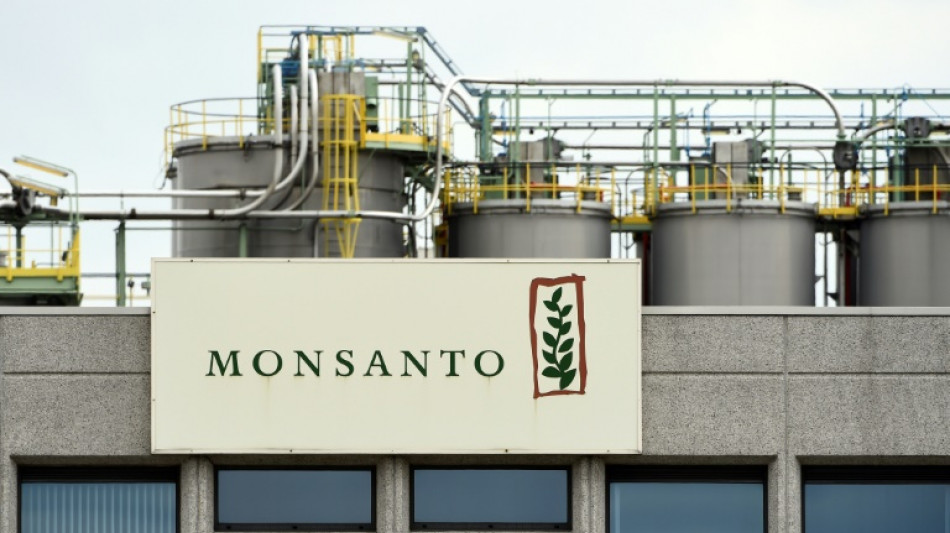
Monsanto: object of Bayer desire despite GMO fears

German pharmaceutical giant Bayer sees in agroindustry giant Monsanto a gem worth at least $62 million for its dominant global position selling seeds sought by farmers of corn, soybeans, cotton and other commodity crops.
But for the Green movement, especially in Europe, Monsanto turns stomachs for unstinting promotion of genetically modified crops and its widely used herbicide Roundup, often feared as a possible carcinogen.
The merger is still under discussion -- Monsanto rejected the price as too low on Tuesday, but said it is willing to keep talking.
But it raises questions across an industry that is pushing the frontiers of biochemistry amid great nervousness, and consolidating into just a handful of very powerful firms.
- What is Monsanto? -
St. Louis, Missouri-based Monsanto was established by pharmacist John Queeny in 1901 to produce saccharine. Queeny named the company after his wife Olga Monsanto Queeny.
By the 1940s, the company was producing farm-oriented chemicals, particularly the widely used herbicide 2,4-D, and slowly became a US household name.
Combined with another dangerous chemical, 2,4-D was used to make the notorious Vietnam War-era defoliant Agent Orange.
In 1976, it launched probably its most famous product, Roundup, the world's most widely used herbicide. Its active chemical is glyphosate.
The company began in the 1970s looking at the crops that the herbicides were protected, building cell and molecular biology units. In 1982, its scientists were the first to genetically modify a plant cell.
Monsanto then started buying other seed companies and withing five years began field trials of genetically modified seeds.
It eventually developed soybean, corn, cotton, canola and other crops that were genetically engineered to be tolerant of Roundup.
In 1994, Monsanto also became the first to begin selling the biotechnology-based hormone for dairy cows, rBST and rBGH, which was used across the United States to boost milk production. The two have been banned by many other major dairy producers.
- Why is Monsanto so valuable to Bayer? -
Monsanto is by far the world's leading producer of genetically modified crop seeds, and in many of its seed lines it has a dominant market position.
According to Farm Journal, it had 35.5 percent of the market for corn in the United States in 2014. It had a 28 percent share for soybeans, behind DuPont.
The company owns around 1,700 patents. In 1991, it lost its patent on glyphosate herbicide, but retains a huge market share in part by having marketed its "Roundup-Ready" genetically modified seeds.
Monsanto also owns one of the leading data analytics firms for farmers, Climate Corp.
- What makes Monsanto so controversial? -
Many people and countries, especially in Europe, have not accepted the use of genetically modified organisms -- which they label "frankenfoods."
They say GMO seeds are dangerous to introduce to the farm and food system generally, and foods produced from GMO crops could turn out unsafe to eat.
In addition, Monsanto's strong market position, critics say, can leave farmers dependent on it because they cannot reproduce Monsanto crops with their own seeds due to the company's patents.
In addition, critics say the herbicides the company sells are dangerous to human health, and some have been banned in certain countries.
A merger with Bayer thus could give the combined company even more power in the market, with farmers already facing consolidation among suppliers.
In December, DuPont and Dow Chemical announce plans to merge, and in China National Chemical Corp. or ChemChina, made a $43 billion offer for Syngenta.
S.Yamada--JT