Senegal not giving up on oil and gas / Photo: SEYLLOU - AFP

The new offshore gas terminal appears through the morning mist cloaking the Atlantic Ocean near Saint Louis, where Senegal meets Mauritania.
It has been hailed as a new economic beginning in developing Africa, and condemned as a new source of pollution in a world suffocating from global warming.
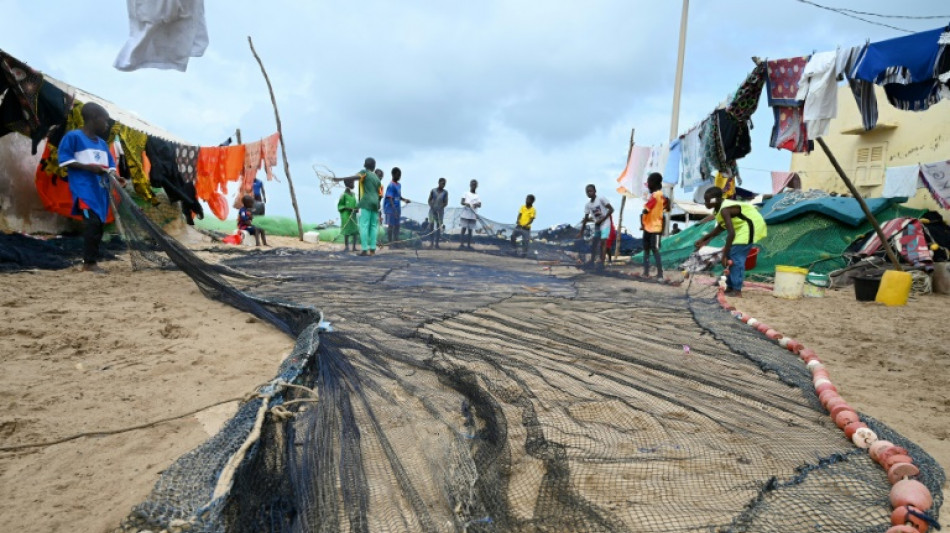
On the beach, a dugout canoe is hauled up the wet sand after a night's fishing.
"Not a lot of fish," scowls El Hadji Gaye, his eye catching the giant structure nearly 10 kilometres (six miles) out at sea.
Senegal, like the Democratic Republic of Congo, has discovered oil and gas reserves, raising hopes of future riches and industrialisation.
They have no intention of yielding to appeals to leave lucrative oil and gas in the ground in the name of fighting climate change.
Senegalese President Macky Sall says it would be "an injustice" and he has launched a diplomatic counter-offensive to justify extracting the resources, starting next year.
"Not being the greatest polluters since we are not industrialised, it would be unfair in the search for a solution (to global warming) to ban Africa from using the natural resources which are underground," Sall told visiting German Chancellor Olaf Scholz in May.
And the message seems even more likely to be heard now that Europeans, facing a major energy crisis following Russia's invasion of Ukraine, are looking to diversify their oil and gas supplies.
- 'Exacerbate' global warming -
Niger, the world's poorest country according to the UN's Human Development Index, is also building Africa's longest oil pipeline -- a nearly 2,000-kilometre (1,250-mile) link to Benin that will enable it to export crude from as early as next year.
Greenpeace Africa's ocean campaign manager Aliou Ba stressed that exploiting fossil fuel deposits will further "exacerbate" the climate crisis, with efforts to limit the temperature rise to 1.5 degrees Celsius looking increasingly forlorn.
Francois Gemenne, an expert with the Intergovernmental Panel on Climate Change, said: "When you are poor it is very difficult to give up on treasure, so something more interesting has to be on offer.
"What's at stake is that these countries can and do choose a decarbonised economy.
"And that requires the transfer of technology and investment in renewables, which is still generally lacking."
The pre-COP27 talks held in Kinshasa at the start of October heard calls for alternative technologies and major financing to sustain a green transition.
But the government of the vast, rainforest-covered DRC is standing by its right to exploit petrol and gas, despite criticism from environmental groups warning against the release of huge quantities of carbon.
At the pre-COP gathering, Congolese Prime Minister Jean-Michel Sama Lukonde pointed out that some European nations have returned to burning highly polluting coal due to gas shortages triggered by the Russian invasion.
He warned against "discrimination", "with certain states free to carry on or even increase their emissions, and others prevented from exploiting their natural resources".
DRC senior climate negotiator Tosi Mpanu Mpanu sees a positive outcome. "Paradoxically, it's the oil money that is seen as dirty which will allow us to have sufficient means to take back our environmental sovereignty and reduce emissions caused by deforestation," he said.
- 'Radical change' -
Senegal's oil and gas discoveries account for only 0.07 percent and 0.5 respectively of world reserves.
But Energy and Oil Minister Sophie Gladima said "they are important enough to radically change the economy and industrial fabric of our country and thereby its future prospects."
"Just exploiting our hydrocarbons will enable us to accelerate public access to electricity and above all to lower the cost of production and encourage industrialisation."
She underlined the legal framework needed to bring thousands of Senegalese jobs into the sector, and the setting up of the National Institute of Oil and Gas to turn out a highly qualified workforce.
But fishermen say they are being excluded from the future planned out by the state.
As the launch of gas production draws closer, the authorities are stepping up their control over the offshore platform.
A security perimeter has been set up and a boat patrols the coastline to block any seafarer tempted to cross an invisible barrier.
"This place was where we found most fish," says El Hadji.
"Now we are caught in a trap because we can no longer go there or further north into Mauritanian waters," the 39-year-old fisherman adds.
Behind him more than a dozen of his comrades chant rhythmically as they push their multicoloured canoe over the sand, following centuries-old traditions on a narrow strip of land separating the Senegal river from the Atlantic Ocean.
"I only know how to fish. My parents fished, my grandparents also. What will I become? What will my children do?" El Hadji asks.
He turns and looks at his friends, the waves crashing. In the distance, the gas platform looms above the ocean.
K.Hashimoto--JT