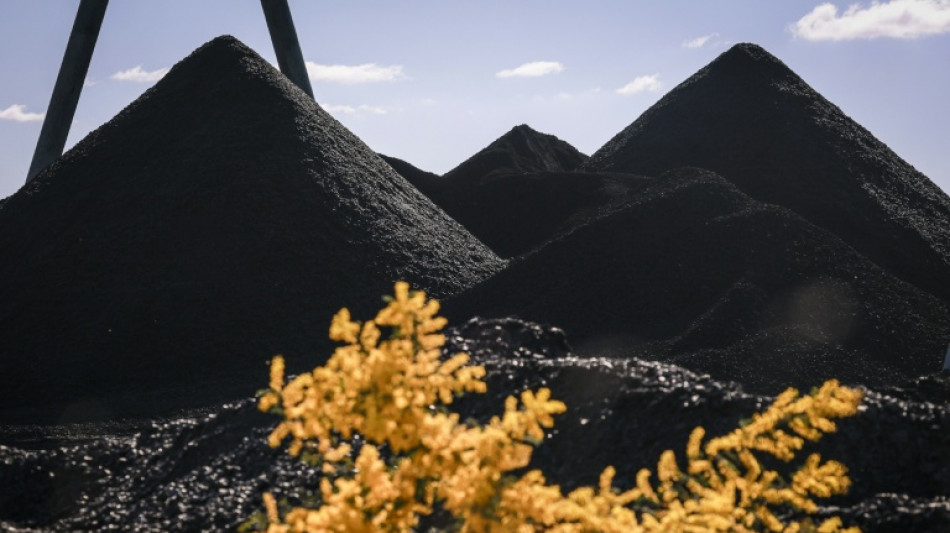
Climate champion Australia digging more coal / Photo: DAVID GRAY - AFP/File

Australia's coal mines are expanding as exports boom, awkward timing for a nation preparing to champion clean energy as lead negotiator for the UN's climate summit.
The Strait of Hormuz closure has forced Asian countries to buy more coal as an alternative to disrupted gas supplies, analysts and miners said.
Instead of falling, as predicted by the International Energy Agency in December, global coal demand will rise 1.2 percent to a record 8.94 billion tonnes in 2026, the agency's mid-year report forecast.
The second-biggest exporter of coal, Australia is best placed to fill demand caused by the Middle East conflict, it added.
Australia is president of negotiations for the UN Conference of the Parties, or COP31, to be held in Turkey in November, where it will seek to highlight the peril of climate change to low-lying Pacific Islands, accelerate clean energy and mobilise investment.
Australia's government said it has delivered Aus$3.9 billion ($2.7 billion) in climate finance from 2020 to 2025.
It is also shifting the population to renewable electricity, with a 2035 target to reduce emissions to 62-70 percent below 2005 levels. A third of households already use rooftop solar.
But environmental campaigners are unhappy at the nation's export of fossil fuels. Coal is the biggest source of greenhouse gas emissions.
A 19-year coal mine extension approved by New South Wales state last week will create 809 million tonnes of emissions -- 98 per cent when the coal is combusted overseas, authorities said.
"Climate harm does not stop at the border, and neither does the responsibility for it," the state's former fire commissioner turned climate activist, Greg Mullins, said.
An industry outlook shows Australia's annual thermal coal exports rose by 8 million tonnes to 213 million tonnes in 2025-2026.
COP31 president of negotiations, Climate Change and Energy Minister Chris Bowen, said Australia is building more renewable energy at home and abroad to create energy security less exposed to global conflict.
"Short-term increases in demand for coal as a result of an international supply shock should not be seen as a reversal of this direction," he told AFP.
"The exposure to volatile fossil fuel prices and vulnerable supply routes reinforces the need to move faster on renewable energy, storage and electrification," he said.
- Energy security -
The coal transition in Asia has been set back by the Middle East war "in many ways", said Emi Gui, a member of the UN-supported Council of Engineers for Energy Transition.
"Countries are prioritising energy security over decarbonisation goals," Gui, a Monash University associate professor, told AFP.
Japan and South Korea are using more coal to replace scarce and expensive oil and gas.
Increasing electrification of transport, to cut reliance on oil, will also increase coal demand, she said.
"Worsened fiscal positions delay the retirement or decarbonisation of coal plants, and there is less financial support for cleaner infrastructure such as solar and wind," she said.
- Climate change will 'bite everybody' -
In the rural NSW town of Mudgee, resident Bev Smiles says three nearby coal mines are seeking to expand.
Koalas, microbats and honeyeater birds are among the 23 threatened species living in a nature reserve she says is under threat from Yancoal's Moolarben mine, which wants to add another 30 million tonnes of coal.
There are 37 coal mines in NSW, and although new mines are banned, the state is allowing mine extensions.
NSW coal generated Aus$23.4 billion in exports last year, with most shipped for electricity generation to South Korea, Japan, China and Taiwan.
Whether coal exports slow is "highly dependent on the implementation of other countries' energy policies", NSW said.
Chinese-backed Yancoal has eight coal mines across Australia and told investors it set a production record digging up 19.8 million tonnes of saleable coal in the first half of 2026, a four percent lift.
Yancoal's Hunter Valley mine expansion was approved by NSW with the condition it only sells coal to nations that have signed the Paris Agreement.
The expanding mines have generated heated public debate, with opponents citing the Nepal glacier disaster and other impacts of climate change, while locals plead for jobs.
"The industry is not going to slow down. Climate change is going to come back and bite everybody," said Smiles, who has lived in the area for three decades, noticing worsening floods and bushfires.
"If the Asian countries turn around and start burning more coal then I think climate change itself is going to be the biggest impact on the industry's viability," she told AFP.
T.Sasaki--JT