Gambian businesses struggle under prolonged blackouts / Photo: MUHAMADOU BITTAYE - AFP

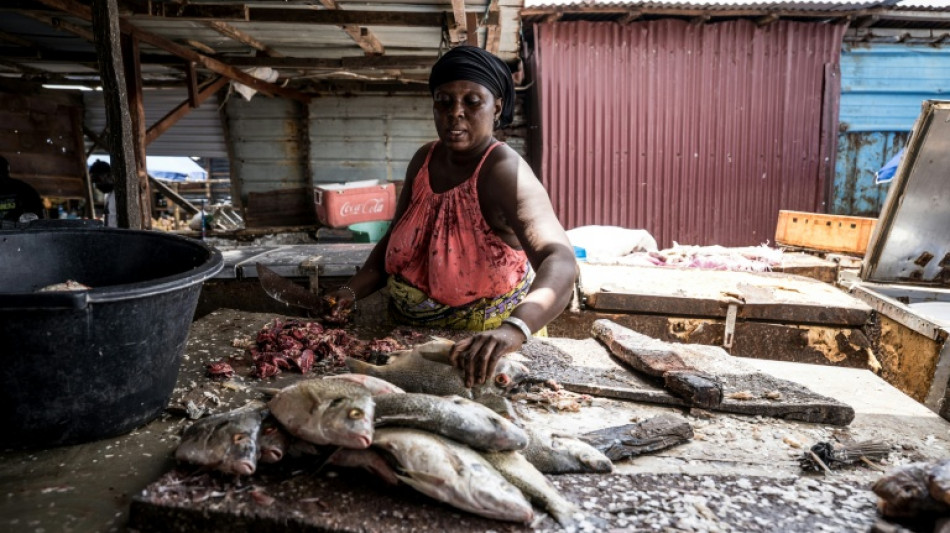
In the coastal Gambian town of Tanji, Sirah Darboe-Manneh cleans fish next to a row of ice boxes laying empty because of relentless power cuts. With limited supplies of ice, storing the daily catch has become almost impossible.
Since June the tiny west African nation has been hobbled by prolonged blackouts, which have reached a fever pitch in recent weeks, right at the peak of the hot season.
Two nights of chaotic, spontaneous protests broke out last week with demonstrators blocking roads and calling for President Adama Barrow to step down, just months before the Gambian leader runs for a third term.
The outages which have sometimes lasted 12 to 48 hours have plunged those living in the deeply impoverished country into steaming darkness at night.
Businesses have shuttered, hospitals have had to turn to generators that have occasionally faltered, and residents have been scrambling to charge phones and refrigerate food. In some locations, water supply has been cut for up to 24 hours.
In Tanji, home to The Gambia's largest fish landing, the stench of rotting catch is becoming an issue.
"The customers are not forthcoming. They are not buying fish anymore because they don't have a place to keep it", Darboe-Manneh, who works as a monger, told AFP while she cleaned the scales from a local species known as sompato.
That in turn means the 31-year-old mother of six has not had money for her children's school supplies as the new academic year begins.
The cost of ice has more than doubled, Darboe-Manneh told AFP, since the ice vendors -- who often make it in home freezers -- do not have electricity.
In the sweltering heat, fellow fish vendor Faraba Fatty stated bluntly that "without electricity, we have a very bad life".
The 58-year-old has 13 children but said he might "sit the whole day without selling anything".
The outages come just months ahead of The Gambia's December 5 elections.
As anger mounts, Barrow has promised the electricity situation will improve by the end of October.
His vice president, Muhammed Jallow, said during a visit to a transmitter substation in the town of Bijilo on Saturday that Barrow has set up a taskforce that is "meeting literally on a daily basis".
In the short term, he said, The Gambia must make sure that "everything comes back normal" before implementing a "long-term sustainable strategy".
A 24-megawatt generation machine will be commissioned by the end of October in Brikama, not far from the capital Banjul, Barrow said in a TV address last week.
Meanwhile a contract for a 50-megawatt solar power plant in Soma has also been awarded, he said.
- Everything 'intertwined' -
People stop by Amadou Gaye's shack at the market in the western town of Sukuta to use his small electric mill to grind millet for cooking porridge or the local steamed grain dish called chere.
But he is unable to run the machine without power.
"People depend on millet for livelihood. We depend on electricity for livelihood", the 40-year-old told AFP.
In The Gambia, the money people use to feed their families is known colloquially as "fish money". It is used to purchase ingredients like meat, chicken or fish.
Pointing out that everything is "intertwined", Gaye is now less able to buy fish from mongers like Darboe-Manneh.
Gambia's energy provider, the National Water and Electricity Company (NAWEC), in mid-August said the blackouts were due to surges in demand, mainly because of high temperatures, combined with "constraints on electricity imports" and a technical incident.
In June, Barrow admitted that The Gambia owed money to Senegal's public electricity provider, Senelec, explaining that the financial strain has complicated efforts to stabilize the power supply.
"We cannot deny that NAWEC is indebted to Senelec, and this is affecting our ability to deliver consistent electricity to Gambians", he said.
- 'Very painful' -
That has meant that tailor Ebrima Camara, 31, has had to sew using a foot-pedal machine rather than his usual electric model, as he struggles to complete orders for school uniforms for the new year.
"Using foot-pedalling to sew uniforms is very hard because it is slow", he told AFP.
It is bad timing for Camara, but it is also bad timing for President Barrow.
Although many Gambians have chafed at his bid for a third term, he was seen as the country's most viable candidate until the recent electric problems.
Now his fate lies in the hands of those such as Camara, who is frenetically pedalling late into the night to make ends meet.
"It's very, very hard. It's very painful", Camara said. "But I don't have a choice".
S.Fujimoto--JT