In hydropowered Bhutan, solar starts to rise / Photo: Niharika KULKARNI - AFP

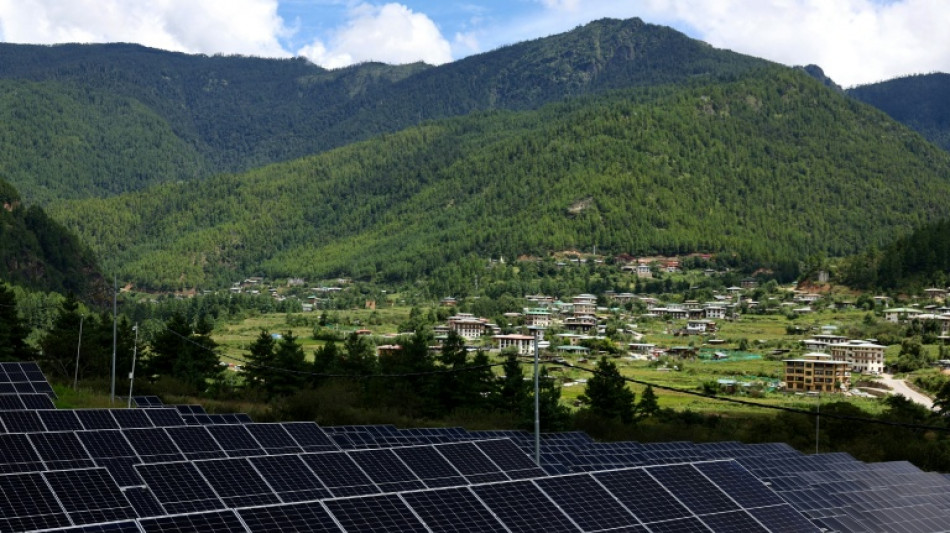
Engineer Rinzin Galley stands on a platform overlooking a former military shooting range on the edge of Bhutan's capital Thimphu, now home to a gleaming field of solar panels.
With abundant waterways, Bhutan has long relied on hydroelectric power to meet its electricity needs and stay carbon negative -- absorbing more planet-warming gases than it emits.
But demand is growing, and in winter, when rivers run low before the mountain melt arrives, Bhutan already relies on imported Indian electricity.
Climate change is also threatening the future of the glaciers that feed those rivers, adding impetus to a push for energy diversification.
"Solar projects are booming," said Rinzin, senior engineer at Norion Renewable Energy.
The company's biggest project to date is the Dechencholing solar farm on former military land, with an installed capacity of 4.45 megawatts (MW).
Dechencholing is one of several solar fields developed in recent years, including the country's first mega project -- Sephu, with over 22 MW capacity.
That is relatively modest, especially compared to the vast solar fields installed in neighbouring China.
But it represents a new direction for Bhutan, where hydropower exports account for up to 15 percent of GDP, according to the World Bank.
"Our plans are to develop about 5,000 megawatts," said Chhewang Rinzin, managing director of Druk Green Power Corporation, the country's generation utility.
Bhutan can currently produce around 3,700 MW from hydro, but that capacity falls around 80 percent during the winter, he said.
Winter demand has increased to 1,500 MW from 400 MW creating a significant shortfall currently being met by electricity imports from India.
Rising demand has created a significant shortfall in winter that is currently met by electricity imports from India.
- Finding space -
Officials attribute part of the growing demand to a construction boom, but Bhutan has also bet on bitcoin mining to boost revenue. A planned special economic zone known as the Gelephu Mindfulness City is expected to host energy-hungry data centres.
The problem was already clear back in 2008, when a goal of generating 10,000 MW from hydropower by 2020 was agreed. But the plan ran into a series of obstacles, including financing.
"When you're looking at constructing 10,000 megawatts in hydropower capacity and each megawatt probably costs you about $1.5 million... for a small economy like ourselves, that's quite difficult," said Chhewang.
Solutions have included liberalising foreign investment rules and increasing solar targets in the energy mix.
The country now aims for 25,000 MW by 2040, with solar accounting for a fifth of that.
But finding sufficient space for projects is challenging given Bhutan's largely mountainous terrain.
"When we do solar projects on the ground mount, it takes a huge amount of area to get certain capacity," Norion's Rinzin said.
The country's high altitudes, circuitous routes and roads frequently damaged by landslides pose further problems.
Part of the push has involved training up a corps of solar engineers, including through the De-suung royal skilling initiative.
Norion has trained around 450 De-suung volunteers "to build in-house capacity in the country," Rinzin said.
Several dozen now work at Norion, which has a goal of installing 30 MW of solar by 2027, much of it on rooftops.
Rooftop solar is now a common sight in Thimphu on government buildings and businesses, but the incentives for individual consumers are still slim.
Electricity is comparatively cheap in Bhutan, and installing solar remains expensive.
- Rooftop solar -
Om Pradhan, a former minister and ambassador, had long advocated for solar in Bhutan, and was keen to install panels at home.
"I thought that firstly it would benefit me personally, in the sense that my electricity bills would go down," the 79-year-old former minister for trade and industries told AFP.
"The second thing is that I've always been an advocate for solar power," he said.
But the 600,000 ngultrums ($6,300) it cost him to install the system remains far out of reach for most Bhutanese.
"Many people calculate that if you put that money in the bank, the interest would pay your electricity bills," he said.
For now, Bhutan's solar targets do not depend on rooftop installation.
Energy demand is not the only driving factor.
"We are quite aware that climate change will affect us, that the glaciers will keep receding," said Chhewang of Druk Green Power.
"So I think in the long-term, you will have to keep yourself open to other options."
K.Nakajima--JT