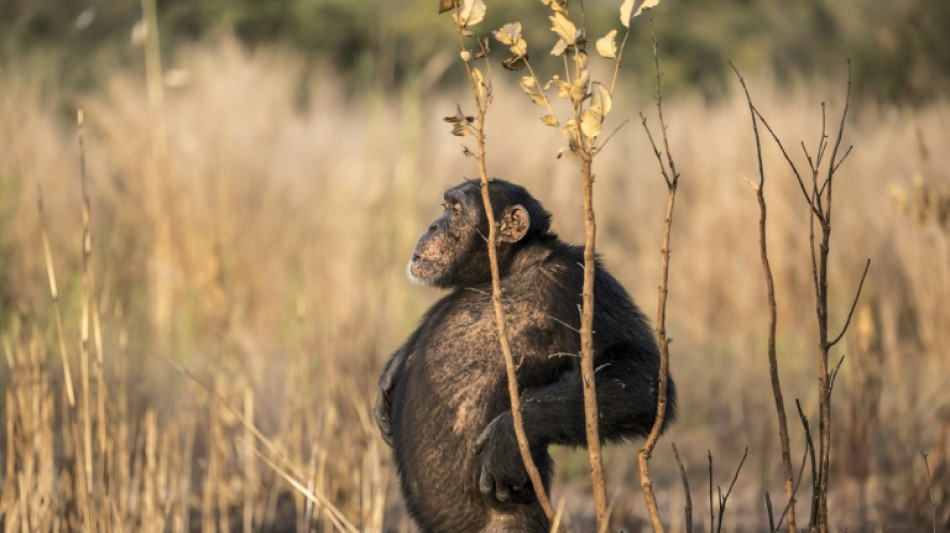
Senegal's spear-wielding savannah chimps yield clues on humanity's past / Photo: PATRICK MEINHARDT - AFP

A shriek broke the dawn on the savannah, followed by more screeches and the rustle of branches: The wild Fongoli chimps were bidding each other good morning in the dry, scraggly Sahel.
The rare chimpanzees -- who live in the bush of hot, southeast Senegal rather than the forest as is more common -- exist on the extreme edge of what is possible for their species.
Their unusual way of living offers clues into humans' own evolutionary past, while their adaptations to the heat appear timely in a world where temperatures are on the rise.
Soaking in pools, cooling off in caves and even wielding spears: The 35 wild chimps of the Fongoli community have adapted to the environment with behaviours that defy their species' conventional norms.
Now, 25 years after starting her pioneering research on savannah chimps, which had never before been habituated to observers, primatologist Jill Pruetz has a wealth of data.
The study's longevity allows for a deeper dive into the Fongoli community's behaviours, relationships and how they learn from one generation to the next.
"Until they were habituated to observers so we could follow them around and take data, we only knew chimpanzees from forested areas," Pruetz told AFP reporters, who spent two days following her and her team as they tracked the primates in the bush.
The Fongoli chimps, who live on a 100-square-kilometre (40-square-mile) home range, are only one group of savannah chimps in the region but for years the only one to be studied.
On a recent morning, A.J., Raffy, Diouf and ambitious young Pistache sat at the top of a baobab, plucking a breakfast of fruit that they cracked open with a whack-whack-whack against the branches.
Screeching, or "pant-hooting" as their vocalisations are known, they communicated with other members nearby.
Pruetz and her team of Senegalese researchers follow the group's adult males, which currently number 10, choosing one each day to track from dawn to dusk. The females, however, are not followed in order to keep them more wary of poachers.
The males' strict hierarchy spans from Cy, the alpha, down to Siberut, the oldest and lowest ranking despite his superb hunting skills.
Since the social apes spend much of their time together, Pruetz is still able to observe the females and their young.
It is the females who have proven the most groundbreaking members of the clan: They are the only non-human animal to systematically use tools to hunt.
It is a behaviour Pruetz and her researchers have observed almost 600 times.
- 'Hottest area' -
After whittling sticks into spears, usually with their teeth, the females hunt bush babies during the rainy season, impaling the small primates as they shelter in tree holes.
With the heat index reaching 49 degrees Celsius (120 degrees Fahrenheit) in the hot season, life on the savannah can be gruelling.
The Fongoli chimps "have to deal with the hottest area that we've studied chimps in" Pruetz said, and must "minimise energy expenditure" during the dry season.
They are the only wild chimps in the world known to soak, taking dips in natural pools. They additionally "use caves to rest in, because the caves are cooler", Pruetz told AFP.
The savannah woodlands that are the Fongoli chimps' habitat are similar to those that human ancestors lived in some six or seven million years ago.
By looking at chimps, which along with bonobos are humans' closest living relatives, perhaps we "can help confirm some of the hypotheses about how those really early hominins, or bipedal apes, behaved", Pruetz said.
While the Fongoli chimps' many adaptations mean they are able to deal with "high heat stress", Pruetz said, "we're not sure that with climate change they can continue to do that".
- Gold rush -
The Fongoli apes are members of the critically endangered subspecies of West African chimpanzees.
While they have traditionally co-existed alongside humans on their home range, a new threat has emerged: a gold rush which has ushered an increase in both artisanal and industrial mines.
In the morning, the rumble of rock-grinding machines, which crush through buckets of substrate, could be heard before the savannah's fauna began its daily chorus.
Fires burned at artisanal mine sites, where night guards watched over equipment.
Mines can mean water pollution, greater resource extraction and the spread of human disease to chimps.
Papa Ibnou Ndiaye, a wildlife researcher and professor at Cheikh Anta Diop University in Dakar, said studying the Fongoli chimpanzees allows "the local administration to have accurate information to make informed decisions for the conservation of Senegal's biodiversity".
Pruetz spends part of the year teaching at Texas State University, while her four research assistants and project manager, who are originally from nearby villages, continue to track the apes.
They keep count as Raffy whacks a baobab fruit eight times or note which arm he uses to do so -- although chimps are normally left-handed.
But they also meticulously track the chimps' friendships and social plights.
"When someone gets home from being out with the chimps all day, you sit around the supper table and you talk about, what drama? What did Cy do today? What did Pistache do today?" said Pruetz, who has images of three of the chimp group's deceased or disappeared members tattooed on her arm.
Chimpanzees can live up to 50 years in the wild and how their "relationships change" is just one of the many interests for Pruetz.
T.Sasaki--JT