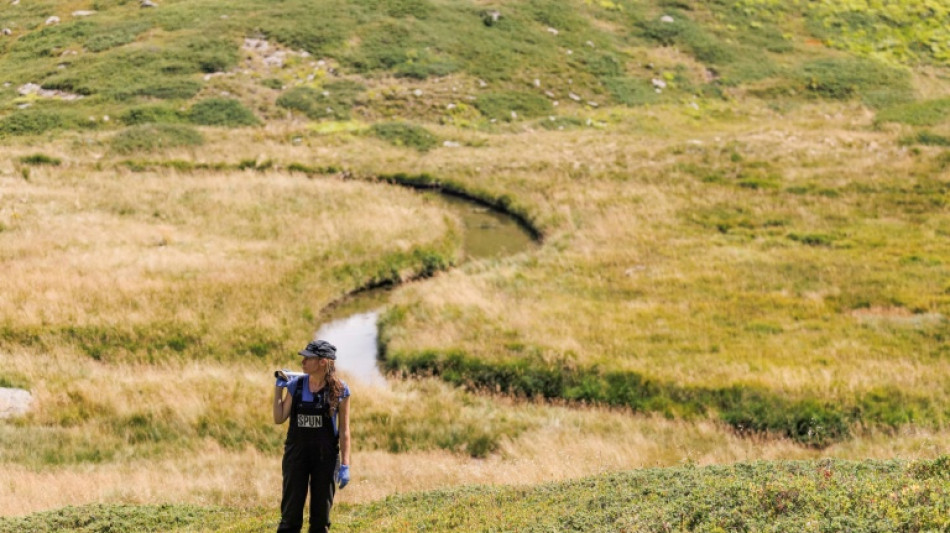
Scientist wins 'Environment Nobel' for shedding light on hidden fungal networks / Photo: Seth Carnill - Society for the Protection of Underground Networks/AFP/File

Beneath the surface of forests, grasslands and farms across the world, vast fungal webs form underground trading systems to exchange nutrients with plant roots, acting as critical climate regulators as they draw down 13 billion tons of carbon annually.
Yet until recently, these "mycorrhizal networks" were greatly underestimated: seen as merely helpful companions to plants rather than one of Earth's vital circulatory systems.
American evolutionary biologist Toby Kiers has now been awarded the Tyler Prize for Environmental Achievement -- sometimes called the "Nobel for the environment" -- for her work bringing this underground world into focus.
By charting the global distribution of mycorrhizal fungi in a worldwide Underground Atlas launched last year, Kiers and her colleagues have helped illuminate below-ground biodiversity — insights that can guide conservation efforts to protect these vast carbon stores.
Plants send their excess carbon below ground where mycorrhizal fungi draw down 13.12 billion tons of carbon dioxide -- around a third of total emissions from fossil fuels.
"I just think about all the ways that soil is used in a negative way -- you know, terms like 'dirtbag,'" the 49-year-old University Research Chair at Vrije Universiteit Amsterdam told AFP in an interview. "Whereas a bag of dirt contains a galaxy!"
- Biological marketplace -
Kiers began studying fungi at 19, after writing a grant proposal that won her a place on a scientific expedition to Panama’s rainforests, "and I started asking questions about what was happening under these massive trees in this very diverse jungle."
She still vividly recalls the first time she peered through a microscope and saw an arbuscule -- the mycorrhizal fungi's tiny tree-like structure that penetrates plant cells and serves as the site of nutrient exchange -- which she described as "so beautiful."
In 2011, Kiers published a landmark paper in Science showing that mycorrhizal fungi behave like shrewd traders in a "biological marketplace," making decisions based on supply and demand.
With filaments thinner than hair, fungi deliver phosphorus and nitrogen to plants in exchange for sugars and fats derived from carbon.
Using lab experiments her team demonstrated that fungi actively move phosphorus from areas of abundance to areas of scarcity -- and secure more carbon in return by exploiting those imbalances. Plants, in other words, are willing to pay a higher "price" for what they lack.
The fungi can even hoard resources to drive up demand, displaying behavior that echoes the tactics of Wall Street traders.
The fact that all this happens without a brain or central nervous system raises a deeper question: how fungi process information at all -- and whether electrical signals moving through their networks hold the answer.
- Debt of gratitude -
More recently, Kiers and her colleagues have pushed the field further with two Nature papers that make this hidden world newly visible.
One unveiled a robotic imaging system that lets scientists watch fungal networks grow, branch and redirect resources in real time; the other mapped where different species are found across the globe.
That global analysis delivered a sobering result: most hotspots of underground fungal diversity lie outside ecologically protected areas.
With fungi largely overlooked by conservation frameworks, Kiers co-founded the Society for the Protection of Underground Networks (SPUN) to map fungal biodiversity -- and argue for its protection.
To coincide with the prize, which comes with a $250,000 award, SPUN is this week launching an "Underground Advocates" program to train scientists in the legal tools they need to protect fungal biodiversity.
Her aim, she says, is to get people to flip how people think about life on Earth -- from the surface down.
"Life as we know it exists because of fungi," she said, explaining that the algal ancestors of modern land plants lacked complex roots, and that a partnership with fungi enabled them to colonize terrestrial environments.
T.Maeda--JT