The Japan Times - Iraqis cover soil with clay to curb sandstorms

EUR -
AED 4.324133
AFN 78.157457
ALL 96.380399
AMD 449.156435
ANG 2.108082
AOA 1079.707922
ARS 1708.376893
AUD 1.755008
AWG 2.119677
AZN 2.006313
BAM 1.95298
BBD 2.371775
BDT 143.902177
BGN 1.955017
BHD 0.444256
BIF 3482.570496
BMD 1.177435
BND 1.511917
BOB 8.155188
BRL 6.527745
BSD 1.177599
BTN 105.800204
BWP 15.479579
BYN 3.437236
BYR 23077.71732
BZD 2.36837
CAD 1.61079
CDF 2590.356452
CHF 0.928148
CLF 0.02719
CLP 1066.642572
CNY 8.275604
CNH 8.246852
COP 4352.975558
CRC 588.150597
CUC 1.177435
CUP 31.202016
CVE 110.105986
CZK 24.242911
DJF 209.254133
DKK 7.471298
DOP 73.813399
DZD 152.710027
EGP 55.99151
ERN 17.661518
ETB 183.214625
FJD 2.671839
FKP 0.872958
GBP 0.871174
GEL 3.161459
GGP 0.872958
GHS 13.101024
GIP 0.872958
GMD 87.723409
GNF 10292.136168
GTQ 9.021971
GYD 246.363158
HKD 9.150728
HNL 31.040172
HRK 7.536646
HTG 154.187324
HUF 386.909506
IDR 19748.285623
ILS 3.759113
IMP 0.872958
INR 105.739868
IQD 1542.672084
IRR 49599.431135
ISK 148.039301
JEP 0.872958
JMD 187.838725
JOD 0.834848
JPY 184.345088
KES 151.830639
KGS 102.937263
KHR 4720.163129
KMF 492.168057
KPW 1059.65744
KRW 1698.249636
KWD 0.361661
KYD 0.981379
KZT 605.235922
LAK 25485.086391
LBP 105452.458482
LKR 364.533543
LRD 208.428104
LSL 19.598596
LTL 3.476659
LVL 0.712219
LYD 6.372796
MAD 10.743984
MDL 19.754387
MGA 5385.199863
MKD 61.559944
MMK 2472.378569
MNT 4189.322215
MOP 9.432538
MRU 46.631655
MUR 54.150661
MVR 18.191809
MWK 2041.94237
MXN 21.0888
MYR 4.766848
MZN 75.250287
NAD 19.598596
NGN 1708.563955
NIO 43.337412
NOK 11.785418
NPR 169.280526
NZD 2.01357
OMR 0.452856
PAB 1.177594
PEN 3.962577
PGK 5.085655
PHP 69.127624
PKR 329.871502
PLN 4.215275
PYG 7980.474654
QAR 4.292301
RON 5.088288
RSD 117.375492
RUB 93.026079
RWF 1715.115758
SAR 4.416208
SBD 9.600085
SCR 17.02833
SDG 708.231214
SEK 10.782833
SGD 1.511948
SHP 0.883381
SLE 28.346782
SLL 24690.218261
SOS 671.826899
SRD 45.137547
STD 24370.518102
STN 24.464668
SVC 10.304119
SYP 13018.629636
SZL 19.582719
THB 36.583326
TJS 10.822025
TMT 4.132795
TND 3.425952
TOP 2.83498
TRY 50.421325
TTD 8.010397
TWD 36.965602
TZS 2908.263751
UAH 49.678255
UGX 4250.860936
USD 1.177435
UYU 46.023533
UZS 14192.503285
VES 339.20575
VND 30955.931942
VUV 142.088798
WST 3.262495
XAF 655.00826
XAG 0.014845
XAU 0.00026
XCD 3.182076
XCG 2.122335
XDR 0.81572
XOF 655.011038
XPF 119.331742
YER 280.759698
ZAR 19.625523
ZMK 10598.328156
ZMW 26.583495
ZWL 379.133447
  • SCS

    0.0200

    16.14

    +0.12%

  • BCE

    0.0400

    23.05

    +0.17%

  • BCC

    0.4200

    75.13

    +0.56%

  • NGG

    0.1500

    77.64

    +0.19%

  • RBGPF

    -0.5500

    80.71

    -0.68%

  • BTI

    0.0300

    57.27

    +0.05%

  • VOD

    0.0200

    13.12

    +0.15%

  • RYCEF

    0.0300

    15.56

    +0.19%

  • CMSC

    0.0700

    23.09

    +0.3%

  • RIO

    1.3500

    82.24

    +1.64%

  • JRI

    0.0000

    13.47

    0%

  • CMSD

    -0.0300

    23.11

    -0.13%

  • RELX

    0.0200

    41.11

    +0.05%

  • GSK

    0.1200

    49.08

    +0.24%

  • AZN

    0.4500

    92.9

    +0.48%

  • BP

    -0.0400

    34.27

    -0.12%

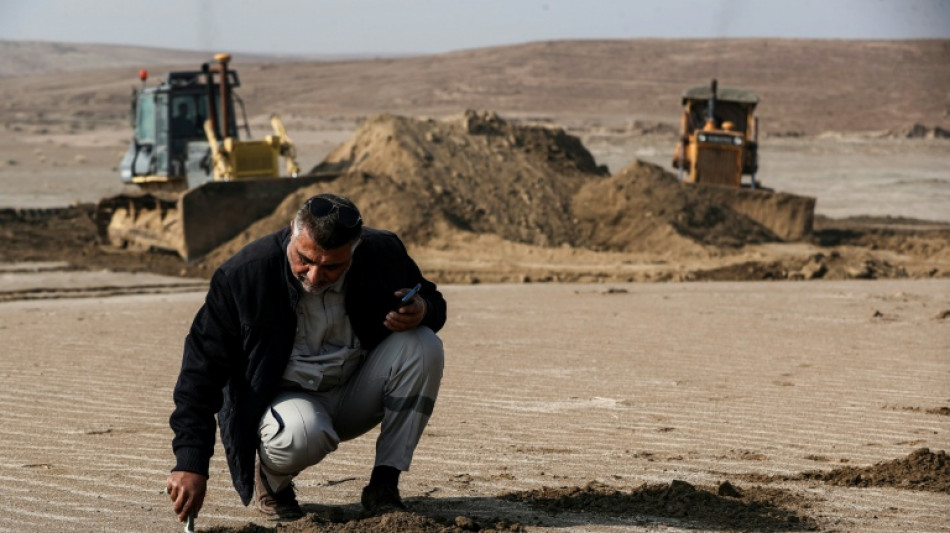
Iraqis cover soil with clay to curb sandstorms
Iraqis cover soil with clay to curb sandstorms / Photo: AHMAD AL-RUBAYE - AFP

Iraqis cover soil with clay to curb sandstorms

Deep in Iraq's southern desert, bulldozers and earthmovers spread layers of moist clay over sand dunes as part of a broader effort to fight increasingly frequent sandstorms.

Text size:

Iraq has long suffered from sand and dust storms, but in recent years they have become more frequent and intense as the country falls prey to the effects of climate change.

Sand and dust storms -- driven by severe drought, rising temperatures and deforestation -- have cloaked cities and villages in an endless ochre haze, grounded flights and filled hospitals with patients suffering from breathing difficulties.

Iraqi authorities have warned that these suffocating storms will intensify further, adding urgency to address the root of the problem.

In a relatively small area between the cities of Nasiriyah and Samawah, not far from ancient Sumerian ruins, labourers are working hard to stabilise the soil by applying a layer of moist clay 20–25 centimetres thick.

The project also includes planting heat-tolerant seedlings like Prosopis and Conocarpus to further stabilise the soil.

"The main goal is to reduce the impact of transboundary dust storms, which may reach Kuwait, Saudi Arabia and Qatar," said Udai Taha Lafta from UN-Habitat, which is leading the project to combat sandstorms with Iraqi expertise.

"It is a vital area despite its small size, and will hopefully help reduce dust storms next summer," Lafta said.

A short-term objective is to shield a southern highway where many traffic accidents have occurred due to poor visibility during dust storms.

- 'Slow but steady' -

The Ministry of Environment estimates that Iraq now faces about 243 storms per year, and the frequency is expected to increase to 300 "dust days" by 2050 unless drastic mitigation measures are adopted.

In 2023, Iraqi authorities teamed up with the UN-Habitat and the Kuwait Fund for Arab Economic Development in areas that have been identified as major sources of sandstorms.

The project has been implementing several methods in three southern areas, including digging water canals and supplying electricity to pump water from the Euphrates river, preparing barren lands for vegetation.

One of the project's ultimate goals is to increase green spaces and for farmers to eventually sustain the lands after droughts and chronic water shortages have drastically reduced agricultural areas.

Qahtan al-Mhana, from the agriculture ministry, said that stabilising the soil gives agricultural efforts in sandy areas a chance to endure.

He added that Iraq has extensive "successful" experience in combating desertification and dust storms by stabilising sand dunes.

Since the 1970s, the country has implemented such projects, but after decades of turmoil, environmental challenges have largely fallen by the wayside.

With the severe recent impact of climate change, "work has resumed," said Najm Abed Taresh from Dhi Qar University.

"We are making slow but steady progress," Taresh said.

K.Yoshida--JT