Who is setting fire to the Amazon? / Photo: Nelson ALMEIDA - AFP

"Red John" is an old acquaintance of landowners and ranchers in the Brazilian Amazon.
He helps clears pastures cheaply, but also leaves blackened earth and charred trees in his wake -- threatening the planet's largest tropical forest.
In northern Brazil's cowboy country, fire is so entrenched in ranching that locals nicknamed it "Joao Vermelho" (Red John).
Abandoning it is almost unthinkable.
"Fire is a cheap way to maintain pasture. Labor is expensive, pesticides are expensive. Here we don't have any public funding," Antonio Carlos Batista, who owns 900 head of cattle in the municipality of Sao Felix do Xingu, told AFP.
During dry season, a bit of gasoline and a match are enough to get the job done.
When someone goes to light a fire, they say, "I'm going to hire the worker Red John!" said Batista, 62.
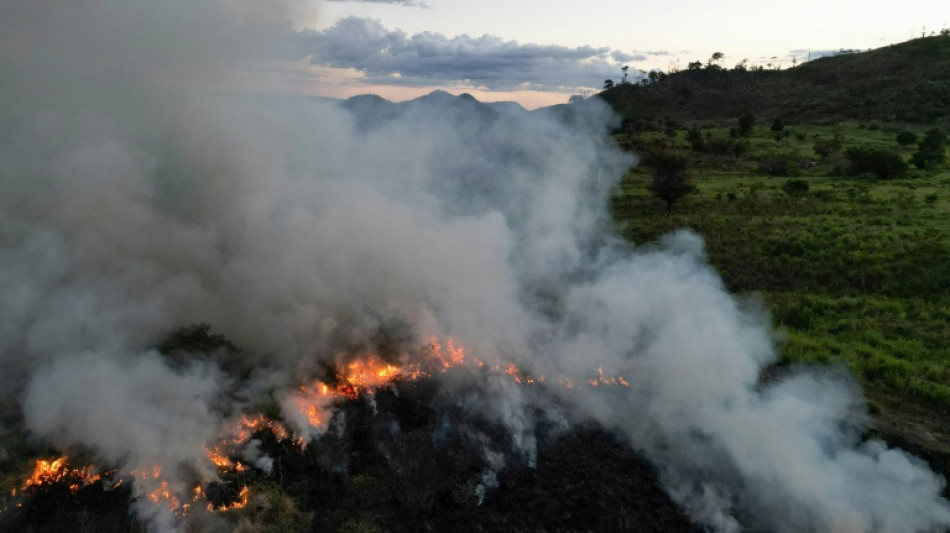
But Red John is a worker who cannot be controlled -- and an unprecedented drought in 2024 linked to climate change sent fires blazing out of control, scorching nearly 18 million hectares (44.5 million acres) of the Brazilian Amazon.
The resulting loss of trees caused deforestation to rise four percent in the 12 months to July, reversing a 30-percent decline achieved the previous year.
This was a setback for President Luiz Inacio Lula da Silva, who has pledged to eradicate deforestation by 2030.
For the first time, more tropical forest burned than grassland. Most of the fires began on cattle ranches and spread through dry vegetation to forested areas.
Sao Felix do Xingu recorded the highest number of fire outbreaks in Brazil -- more than 7,000.
In the Amazon, today "the big challenge is deforestation caused by fires," Environment Minister Marina Silva told AFP.
Experts say solving it will require firefighters, stricter sanctions, and, above all, a cultural shift.
- Fire 'devoured everything' -
Sao Felix is in Para state, which will host the COP30 UN climate conference in November -- the first to take place in the Amazon -- in its capital Belem.
Para is almost the size of Portugal, with 65,000 inhabitants and the largest herd of cattle in Brazil, with 2.5 million head, partly for export.
The municipality is also responsible for Brazil's worst carbon dioxide emissions due to deforestation, according to 2023 data.
In 2019, Sao Felix took center stage on the so-called "Fire Day," when landowners deliberately set blazes to support the climate-skeptical policies of then-president Jair Bolsonaro, sparking international outrage.
Here, miles of dusty roads stretch past vast, deforested expanses.
Many of the biggest ranches, their headquarters in distant cities like Sao Paulo, do not identify themselves.
Some -- like the Bom Jardim ranch, home to 12,000 cattle -- are identified only by a wooden fence.
Bom Jardim's young foreman Gleyson Carvalho, seated in the shade outside the stable in a black cowboy hat, with a silver buckle glinting on his belt, admits that using fire is increasingly risky.
"On the one hand, it's good," he said, because the burned vegetation acts as a natural fertilizer, enriching soil and stimulating growth of more nutritious grass for cattle to eat.
However, last year, the fires -- which Carvalho insists came from outside the ranch -- "devoured everything."
"There was no food, the cattle lost weight. We had to fight hard to prevent any animals from dying," he said.
According to satellite data from the Mapbiomas monitoring network analyzed by AFP, more than two-thirds of the ranch burned.
The property belongs to the former mayor of Sao Felix, Joao Cleber, who has been repeatedly fined for deforestation and other environmental crimes.
Located on the banks of the Xingu River, it borders a Kayapo Indigenous village, whose families suffered from the clouds of toxic smoke from the fires.
"There were days when you couldn't even breathe," said Maria de Fatima Barbosa, a teacher at the village school.
"During the night, it was difficult to sleep because the sheets, the bed, everything smelled of smoke."
A 2021 Greenpeace report notes that the ranch has indirectly sold cattle to Brazilian meatpacking giants Frigol and JBS, which export some of the meat abroad, especially to China in the case of Frigol.
- 'They alert you' -
Flying over Sao Felix during the dry season, clouds of smoke can be seen rising over patches of scorched pasture.
"It's very sad because you arrive in a region where everything is green, and then the fire comes and destroys everything," said Jose Juliao do Nascimento, a 64-year-old small-scale rancher in the rural neighborhood of Casa de Tabua, north of the Bom Jardim ranch.
He was like many farmers in the region, who arrived in the Amazon from the south of the country from the 1960s and 1970s onwards, encouraged by the military regime to clear the land, exploit it and enrich themselves.
"A land without men for men without land," read the slogan of the time.
Last year, the out-of-control flames reached his pasture, as did terrified cows from other properties that had traveled for kilometers in search of food.
The lush forest visible from his small wooden house was burned to the ground.
Although Para state completely banned pasture maintenance fires last year to avoid a major catastrophe, enforcement is weak.
"Everyone has WhatsApp, a phone. When a police car or a car from (environmental watchdog) Ibama shows up, they alert you. That way, even if someone is working with a tractor, they can hide the machine and flee," he told AFP.
Government representatives are scarce in the region.
Ibama president Rodrigo Agostinho told AFP that when officials from the watchdog are called to issue fines, they receive "threats."
- 'No one helps us' -
Small farmers say they feel powerless while large agricultural corporations thrive.
"They call us criminals of the Amazon, responsible for the fires and deforestation, but no one helps us," said Dalmi Pereira, a 51-year-old small-scale farmer living in Casa de Tabua.
"Here we have no rights. When the police come, we have to hide."
Facing some of the small farmers is Agro SB, an agricultural giant in the region.
The company bought land in 2008 to build its Lagoa do Triunfo complex, a ranch the size of a large city.
The ranch has received six environmental fines since 2013, and has yet to pay any of them.
The property recorded more than 300 fires in 2024, according to data analyzed by AFP.
That same year, it received the "More Green Integrity" seal from Brazil's ministry of agriculture and livestock for "its social responsibility and environmental sustainability practices."
Pereira complains that Agro SB receives preferential treatment when dealing with the government, while "we remain at the door."
He and other ranchers are engaged in a standoff with Agro SB over land titles, claiming right of ownership of some of the company's land by usucapion, a legal process that allows people to claim land they have occupied and used for a certain period.
Agro SB told AFP the ranchers are "invaders" who it is suing for allegedly starting all the fires recorded on its farm.
- No fire brigade -
In the Amazon, traditional communities and small producers use fire culturally.
However, the main offenders in razing trees are large farms, followed by illegal miners, said Cristiane Mazzetti, forest coordinator for Greenpeace Brazil.
The mayor of Sao Felix do Xingu, Fabricio Batista, emphasized that most people do not have titles for their land.
"The first thing we must do is document the people," he told AFP at a parade of cowboys on horseback.
"People who are documented will be careful with their heritage, because when they don't have documents, they sometimes do illegal things."
Batista also owns a ranch and was himself fined for deforestation in 2014.
He appealed, and the fine was canceled.
He said Sao Felix needs more federal support to fight fires.
"There isn't a single fire brigade here. When there's a fire, who puts it out? We need infrastructure," he said.
Regino Soares, a 65-year-old farmer and president of the Agricatu small-scale livestock association, lost a fifth of his animals in a fire last year.
He called for controlled burning to be done in a better way.
"You have to light the fire at the right time, make firebreaks" by removing dry vegetation around the pasture, "let neighbors know when something's going to burn," he said.
- 'Back turned to the Amazon' -
This year, the Amazon is experiencing a reprieve, with fires at their lowest level since records began in 1998.
Ane Alencar, scientific director of the Amazon Environmental Research Institute, attributes this to a combination of the climate and human factors.
"The drought persists in some areas, but rainfall has been more evenly distributed this year because the Amazon is in a neutral phase, unaffected by either El Nino or La Nina," she said.
"There was also greater oversight by authorities and the effect of trauma on some producers, who were more cautious after what happened in 2024."
The Ibama president, Agostinho, said the state has intensified surveillance in the Amazon since Lula's return to office, which followed years of a hands-off approach under Bolsonaro.
Despite deploying record numbers of firefighters, vehicles and aircraft, the effort still looks small against the immensity of a territory spanning five million square kilometers (1.9 million square miles).
Finding and punishing the person who lights the match is also an uphill battle for authorities.
"You have to conduct an expert report, find someone responsible and consult satellite images," said Agostinho, adding that Ibama is making progress thanks to artificial intelligence.
Enforcing fines remains a challenge.
Greenpeace showed in 2024 that five years after "Fire Day," the large majority of fines imposed were not paid.
During Lula's first two terms (2003-2010), monitoring and control policies led to a 70 percent drop in deforestation in the Amazon.
"The solution always starts with good public policy," journalist and filmmaker Joao Moreira Salles, author of an investigative book on the Amazon, "Arrabalde," told AFP.
But he warns that no public policy will succeed without popular support.
"What matters most is not that the world sees what's being done, but that Brazil and Brazilians see it," he said.
"The problem is that Brazil has its back turned to the Amazon."
M.Sugiyama--JT