The Japan Times - UN's Guterres issues 'global SOS' over fast-rising Pacific ocean

EUR -
AED 4.244974
AFN 72.820821
ALL 95.679468
AMD 435.069847
ANG 2.069125
AOA 1059.943556
ARS 1608.41038
AUD 1.649033
AWG 2.083477
AZN 1.960828
BAM 1.950286
BBD 2.324029
BDT 141.589657
BGN 1.975759
BHD 0.435868
BIF 3415.542608
BMD 1.155882
BND 1.475727
BOB 7.973455
BRL 6.141665
BSD 1.153937
BTN 107.875982
BWP 15.734511
BYN 3.500901
BYR 22655.282549
BZD 2.320738
CAD 1.585043
CDF 2629.631372
CHF 0.910875
CLF 0.027167
CLP 1072.7165
CNY 7.959867
CNH 7.977497
COP 4241.407488
CRC 538.976054
CUC 1.155882
CUP 30.630867
CVE 109.954107
CZK 24.487528
DJF 205.479011
DKK 7.47136
DOP 68.496328
DZD 152.86307
EGP 59.999466
ERN 17.338226
ETB 181.855905
FJD 2.559642
FKP 0.866441
GBP 0.867079
GEL 3.138222
GGP 0.866441
GHS 12.578435
GIP 0.866441
GMD 84.954116
GNF 10114.40169
GTQ 8.839008
GYD 241.417396
HKD 9.05505
HNL 30.542641
HRK 7.533347
HTG 151.38197
HUF 393.178948
IDR 19599.362345
ILS 3.593781
IMP 0.866441
INR 108.66508
IQD 1511.625902
IRR 1520706.944273
ISK 143.64086
JEP 0.866441
JMD 181.287413
JOD 0.819536
JPY 183.919854
KES 149.487327
KGS 101.07943
KHR 4610.962577
KMF 493.56122
KPW 1040.327809
KRW 1739.960935
KWD 0.354359
KYD 0.961581
KZT 554.761421
LAK 24778.937947
LBP 103341.603261
LKR 359.962213
LRD 211.16294
LSL 19.465661
LTL 3.413019
LVL 0.699181
LYD 7.387113
MAD 10.782612
MDL 20.095181
MGA 4811.395855
MKD 61.466205
MMK 2425.983079
MNT 4124.393548
MOP 9.314164
MRU 46.190397
MUR 53.760182
MVR 17.870088
MWK 2000.942367
MXN 20.733739
MYR 4.552987
MZN 73.846768
NAD 19.465661
NGN 1567.66451
NIO 42.459945
NOK 11.070054
NPR 172.601971
NZD 1.98137
OMR 0.444436
PAB 1.153937
PEN 3.98942
PGK 4.980917
PHP 69.526124
PKR 322.168873
PLN 4.275387
PYG 7536.690129
QAR 4.219569
RON 5.087616
RSD 117.118848
RUB 96.006653
RWF 1678.952788
SAR 4.339939
SBD 9.306767
SCR 15.832933
SDG 694.685214
SEK 10.812147
SGD 1.481684
SHP 0.867211
SLE 28.405845
SLL 24238.275136
SOS 659.435457
SRD 43.331121
STD 23924.418772
STN 24.430922
SVC 10.096452
SYP 127.969146
SZL 19.471943
THB 38.037761
TJS 11.083163
TMT 4.057145
TND 3.407964
TOP 2.783085
TRY 51.2244
TTD 7.828864
TWD 37.030636
TZS 3000.117216
UAH 50.55027
UGX 4361.667455
USD 1.155882
UYU 46.498526
UZS 14068.222325
VES 525.568607
VND 30413.56094
VUV 137.376492
WST 3.153027
XAF 654.107521
XAG 0.017125
XAU 0.00026
XCD 3.123828
XCG 2.07962
XDR 0.8135
XOF 654.107521
XPF 119.331742
YER 275.797228
ZAR 19.734312
ZMK 10404.320537
ZMW 22.530296
ZWL 372.193456
  • RBGPF

    -13.5000

    69

    -19.57%

  • BCE

    0.0600

    25.79

    +0.23%

  • BCC

    -1.5600

    68.3

    -2.28%

  • GSK

    -0.5300

    51.84

    -1.02%

  • NGG

    -3.5400

    81.99

    -4.32%

  • RIO

    -2.5000

    83.15

    -3.01%

  • CMSD

    -0.2420

    22.658

    -1.07%

  • JRI

    -0.3900

    11.77

    -3.31%

  • RELX

    -0.4600

    33.36

    -1.38%

  • CMSC

    -0.2000

    22.65

    -0.88%

  • RYCEF

    -1.2600

    15.34

    -8.21%

  • VOD

    -0.0900

    14.33

    -0.63%

  • AZN

    -5.3300

    183.6

    -2.9%

  • BTI

    -1.3500

    57.37

    -2.35%

  • BP

    -1.0800

    44.78

    -2.41%

UN's Guterres issues 'global SOS' over fast-rising Pacific ocean
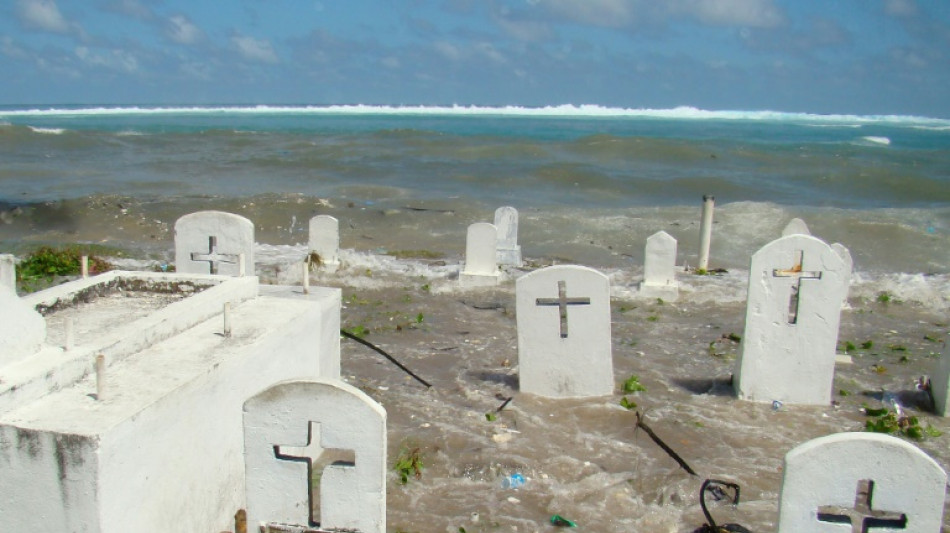
UN's Guterres issues 'global SOS' over fast-rising Pacific ocean / Photo: GIFF JOHNSON - AFP/File

UN's Guterres issues 'global SOS' over fast-rising Pacific ocean

United Nations Secretary-General Antonio Guterres voiced a global climate "SOS" at a Pacific islands summit on Tuesday, unveiling research that shows the region's seas rising much more swiftly than global averages.

Text size:

"I am in Tonga to issue a global SOS -- Save Our Seas -- on rising sea levels. A worldwide catastrophe is putting this Pacific paradise in peril" he said.

Sparsely populated and with few heavy industries, the Pacific islands collectively pump out less than 0.02 percent of global emissions every year.

But this vast arc of volcanic islands and low-lying coral atolls also inhabits a tropical corridor that is rapidly threatened by encroaching oceans.

The World Meterological Organisation has been monitoring tide gauges installed on the Pacific's famed beaches since the early 1990s.

A new report released by the top UN climate monitoring body showed seas had risen by around 15 centimetres in some parts of the Pacific in the last 30 years.

The global average was 9.4 centimetres, according to the report.

"It is increasingly evident that we are fast running out of time to turn the tide," said the forecasting agency's top official Celeste Saulo.

Some sites, particularly in Kiribati and Cook Islands, measured a rise that matched or was just under the global average.

But other sites, such as the capital cities of Samoa and Fiji, were rising almost three times higher.

In low-lying Pacific nation Tuvalu, land is already so scarce that throngs of children use the tarmac at the international airport as their own makeshift playground.

Scientists have warned that, even under some moderate scenarios, Tuvalu could be almost entirely wiped off the map within the next 30 years.

"It's disaster after disaster, and we are losing the capacity to rebuild, to withstand another cyclone or another flood," Tuvalu Climate Minister Maina Talia told AFP on the summit's sidelines.

"For low-lying island states, it's a matter of survival for us."

The plight of Pacific islands has been easily overlooked in the past, given their relative isolation and lack of economic might.

But the region is increasingly seen by scientists as a climate canary in the coal mine, hinting at the troubles possibly facing other parts of the planet.

"This new report confirms what Pacific leaders have been saying for years," Australian climate researcher Wes Morgan told AFP.

"Climate change is their top security threat. Pacific nations are in a fight for survival, and cutting climate pollution is key to their future."

Surrounded by millions of square miles of tropical ocean, the South Pacific is uniquely threatened by sea-level rise.

The vast majority of people live within five kilometres of the coast, according to the United Nations.

Rising seas are swallowing up scarce land and tainting vital food and water sources.

Warmer waters are also fuelling more intense natural disasters, while ocean acidification slowly kills the reefs that nourish key marine food chains.

Y.Kimura--JT