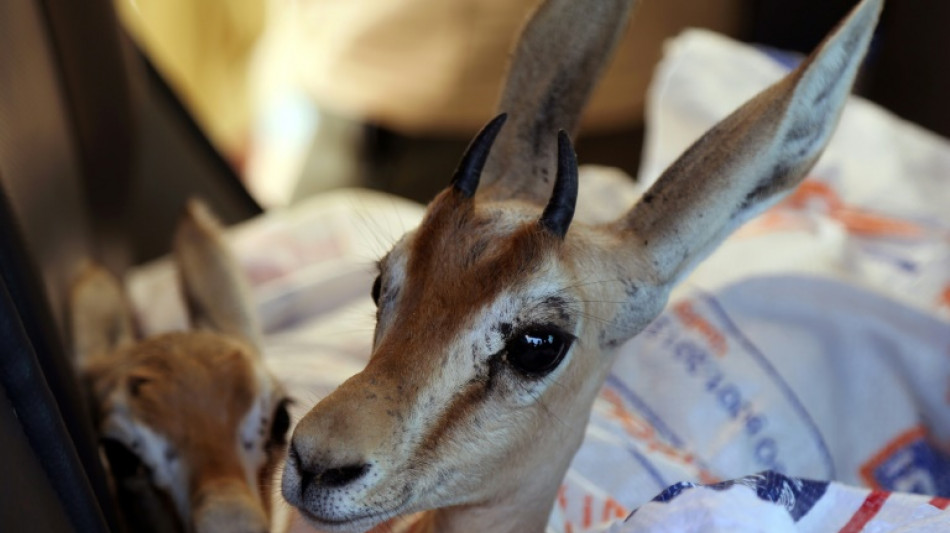
Endangered gazelles find Libyan 'safe haven' / Photo: Mahmud Turkia - AFP

Cocooned in white bags and nestled in the arms of volunteers, eight young rhim gazelles -- an endangered species native to North Africa -- have been transferred to an uninhabited Libyan island.
Environmentalist hope their new home on Farwa island, near Tunisia, will be a haven for the vulnerable animal.
Also known as Gazella leptoceros, or simply rhim, the slender-horned gazelle lives in desert areas in Algeria, Tunisia, Libya and Egypt.
But its population has declined significantly as it is a prized target for hunters.
According to an International Union for Conservation of Nature (IUCN) assessment in 2016, there were only between 300 to 600 mature rhims in the North African wild.
Environmentalists "wanted to relocate the wild animals in Farwa", a 13-kilometre-long (eight-mile) sandbar, as part of the gazelles' conservation efforts, Mohamed al-Rabti, one of the volunteers, told AFP.
A first group of rhims was released a few weeks ago, "followed by eight individuals, including one male and seven females" on July 18, Rabti added.
As soon as they were released, the young gazelles took off frolicking before promptly disappearing behind the island's wild bushes.
The animal with long slender horns is small, nimble, and well adapted to desert life with a pale coat that enables better survival by blending into sandy landscapes.
The colouring is less effective against hunters, which for a while have been the gazelles' major predator.
Equipped with binoculars, automatic rifles and powerful four-wheel drive vehicles, some go after the animals merely as a hobby.
Others hunt them for a price going as high as 5,000 Libyan dinars ($1,000) per carcass.
Gazella leptoceros has been classified in the IUCN's "Red List of Threatened Species" since 2016.
With no official census from Libya, a country plagued by chaos and instability since the fall of longtime dictator Moamer Kadhafi in 2011, little has been done to preserve their lives.
But with the work of numerous NGOs and activists, that could be set to change.
Farwa, though not their natural habitat, seems to have suited the first group of gazelles released on the island, Youssef Gandouz, an environmental activist, told AFP.
They have been "monitored with binoculars and drones and are doing very well," said Gandouz.
The island is also home to the loggerhead sea turtle (Caretta caretta), which has become its symbol, and is a staging post for flamingos and other migratory birds travelling over Africa to rest before flying across the Mediterranean to Europe.
- Climate threats -
While it remains uninhabited today, Farwa was once home to Amazigh tribes before they left for neighbouring areas inland.
The island appears picture-postcard idyllic, with scattered date palms on white sandy beaches and ringed by the sparkling Mediterranean.
Kadhafi dreamed of building a luxury seaside resort there, complete with "floating" villas and a golf course.
Once famed for its exceptional wildlife, today it faces a long list of threats including illegal fishing and pollution.
"Many associations and universities... are making significant efforts to protect the biodiversity and plant cover" of Farwa, said Jamal Ftess, a reserve manager for the island.
Besides wildlife, environmentalists have also been working to preserve the island's scarce flora.
Local associations like Bessida have been planting vegetation that is resistant to wind and sea sprays and requires little water. This can help provide food for the animals, and protect against erosion, they say.
Gandouz, helping volunteers to move some of the plants, said it was the second transplantation effort of its kind on Farwa.
"The vegetation on Farwa is sufficient" for the survival of rhim gazelles, said Ftess, and Gandouz added the narrow island "is now a safe haven where turtles and migratory birds can nest and feed".
But activists have long warned that coastal erosion and rising water levels are among climate-driven threats the island faces.
Ftess said a study conducted by a Libyan university found that "between 1961 and 2006, Farwa's coastline lost 1.6 metres (5.2 feet) per year, and between 2006 and 2020 erosion reached two metres per year."
"We need the help of the authorities to preserve it," he said.
T.Shimizu--JT