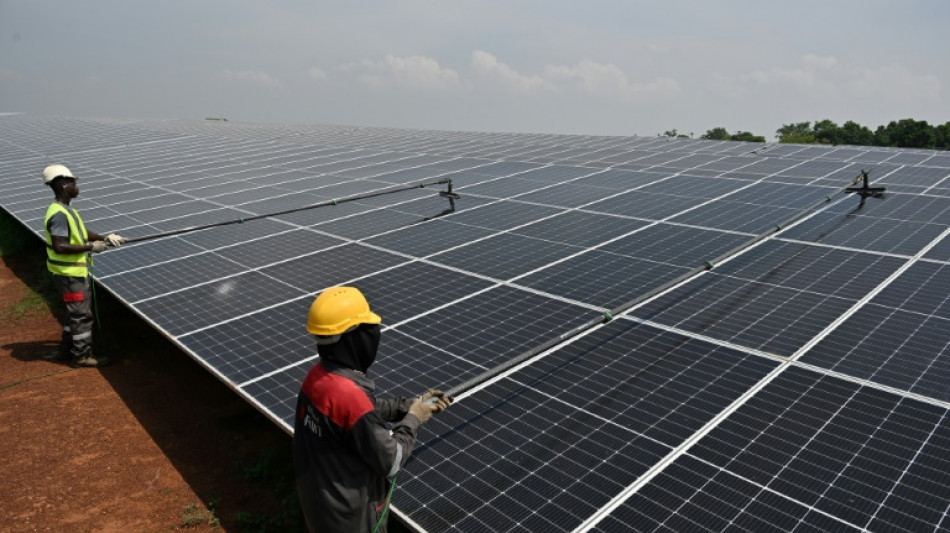
Ivory Coast bets on solar in clean energy drive / Photo: Sia KAMBOU - AFP

The sun beats down from a cloudless sky on the town of Boundiali, where Ivory Coast's first solar power plant embodies the drive to embrace clean energy without abandoning fossil fuels.
Unlike the wetter, cloudier south, the climate in northern Ivory Coast bordering Burkina Faso and Mali is hot and dry for around eight months of the year.
"Irradiance is very high" in the region, plant engineer Franck Alain Yayo told AFP, referring to the intensity of the Sun's energy.
The Boundiali plant, which opened in June 2023, aims to improve the electricity supply to more than 430,000 households, the energy ministry said.
Although Ivory Coast has about 10 smaller solar power plants serving villages at a local level, Boundiali is the first on the national grid.
The country, which already exports about 10 percent of its electricity to neighbours, aims to generate nearly half of its energy from renewable sources by 2030.
The International Energy Agency (IEA) estimates that half the population of sub-Saharan Africa has no access to electricity.
And yet, it added in a recent report: "Africa is home to 60 percent of the best solar resources globally, yet only one percent of installed solar PV (photovoltaic) capacity."
While the continent has doubled its capacity to produce clean energy in the last 10 years, African renewables still account for just two percent of global capacity.
- Call for private funding -
The northern Ivorian town has some 68,000 solar panels bought from China laid out in rows across 36 hectares (89 acres).
The panels convert sunlight, not heat, into electricity.
By the end of next year, the aim is to have twice as many panels to reach a production capacity of 80 MWp (Megawatt peak, a measure of the maximum potential output).
That would save some 60,000 tonnes of CO2 equivalent per year, say the authorities.
The 75.6-million-euro ($82.1-million) cost of building the solar power station was financed by Ivory Coast, a German loan and a European Union grant.
"This is the result of the EU's long-standing commitment to the renewable energy sector, with almost 140 million euros since 2017," EU ambassador to Ivory Coast Francesca Di Mauro told AFP.
However, international public funding to support sub-Saharan Africa's transition towards clean energy will not be enough.
Last year, the IEA called for private investment to be stepped up to account for 60 percent of financing.
Solar power is currently a small part of the Ivorian energy mix -- the Boundiali plant contributes just one percent of national production.
Nearly 70 percent of the country's electricity comes from gas-fired thermal power plants, while hydroelectric power stations account for the rest, all located in the south.
By 2030, Ivory Coast has pledged to increase its share of renewable energy to 45 percent, including nine percent solar, and to reduce its greenhouse gas emissions by 30 percent.
Fossil fuels however still play a key role.
- New oil, gas discoveries -
The West African nation recently discovered two huge oil and natural gas deposits.
One of them, the Calao field, "will eventually meet the country's electricity production needs", said Energy Minister Sangafowa Coulibaly.
It may also help reduce electricity bills, which would be a welcome relief to householders after prices rose by 10 percent in January.
"Every day the sun shines on our heads" the cost of production is "very low", plant engineer Yayo said.
Yayo, who learned his skills in Burkina Faso, regretted that his country had neither the technology nor the expertise to train people.
Ivory Coast's state-run company CI-Energies, which handles Boundiali plant's infrastructure, temporarily subcontracts to French civil engineering firm Eiffage.
It is Eiffage which is training many of the employees, most of them local people.
In this region of around 92,000 people, some 350 have been hired since construction of the plant began.
Most were taken on with short-term contracts to install solar panels or carry out maintenance.
Among them was Oumar Konate, who previously worked in farming as well as doing odd jobs in town.
Employment in the rural area was hard to come by, he said. "I prefer to work here. The pay is better. I can feed my family."
H.Takahashi--JT