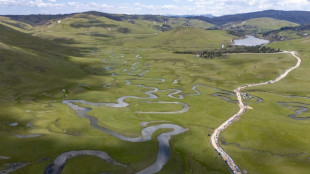
From polar bears to groundwater, nature is riddled with 'forever chemicals' / Photo: Romeo GACAD - AFP/File

They didn't exist a century ago but today PFAS "forever chemicals" contaminate the environment from groundwater to Antarctic snow to turtle eggs, and concern over their possible toxicity is growing.
Lawsuits and regulations targeting per- and polyfluoroalkyl substances (PFAS) are multiplying, with France becoming the latest jurisdiction to consider tough new curbs on these long-life substances.
On Thursday, a French legislator will introduce a bill to address what he calls the health "emergency" posed by exposure to PFAS in the environment.
Widely used in everyday items, highly durable, and very slow to break down, PFAS have been detected in water, air, fish and soil in the remotest corners of the globe.
"No ecosystem has escaped," said Yann Aminot, a specialist in environmental contamination at the French Research Institute for Ocean Science (IFREMER).
He spent six years examining tuna from the Indian and Pacific Oceans, dolphin livers from the Bay of Biscay, and samples from French oyster farms.
"I don't think I have ever seen a single sample free of perfluorinated contaminants," the researcher told AFP.
- Marine contamination -
These molecules -- the best known of which gave birth to non-stick Teflon -- were developed after World War II to give packaging, paints and coatings exceptional resistance to water or heat.
This very quality turned out to be a particular problem for oceans, said Aminot.
"Being persistent compounds -- which do not degrade and are mobile -- they end up in the marine environment, which always ultimately is the receptacle for contamination," he said.
A study published in January by the American Chemical Society, a nonprofit scientific organisation, said that PFAS had been detected in the Arctic Ocean at a depth of 3,000 feet (914 metres).
IFREMER recently examined the diets of two fish -- sea bass and sole -- in the Seine estuary of France and discovered PFAS riddled throughout the food chain.
From the tiny zooplankton eaten by shellfish, which are consumed by smaller fish and ultimately larger predators, PFAS lurked at every step along the way.
A 2022 study in Australia established the transmission of PFAS from female turtles to their unborn offspring, while other research found traces in polar bear livers and birds, seals and other animals.
A wealth of scientific research has demonstrated the pervasive reach of PFAS in nature, but possible harms to people and the planet have been harder to definitively establish.
More than 20 years ago, a study in the US concluded that once inside the body PFAS may be able to reach the brain of vertebrates and affect the nervous system.
- Chemical cocktail -
Studies have since shown that exposure to some PFAS -- there are at least 4,000 chemical compounds in the family -- may be linked to serious health effects in humans and animals.
It is a subject of growing concern, with French ecologist and MP Nicolas Thierry asking lawmakers to ban PFAS from 2025 if alternatives exist.
The European Union is considering a blanket Europe-wide ban on PFAS from as early as 2026 while New Zealand will outlaw their use in cosmetic products by 2027.
In April, a US court approved a litigation settlement in which the conglomerate 3M agreed to pay billions to test for and filter out PFAS in public water supply.
In February, US regulators said materials containing PFAS would no longer be used to package microwave popcorn or other greasy foods.
Establishing the possible long-term harms of PFAS exposure is difficult when considering such a kaleidoscope of chemicals, many of which are industry secrets, said Aminot.
Those known to scientists are "only the tip of the iceberg", he said.
Examining the full spectrum of chemicals is critical to better understanding their impact on nature, said Pierre Labadie, a researcher from the French National Centre for Scientific Research (CNRS).
"A wild organism is never exposed to a single PFAS, but to a cocktail of PFAS," he said.
Y.Ishikawa--JT