In 'project of the century', Swiss seek to bury radioactive waste

Storing radioactive waste above ground is a risky business, but the Swiss think they have found the solution: burying spent nuclear fuel deep underground in clay.
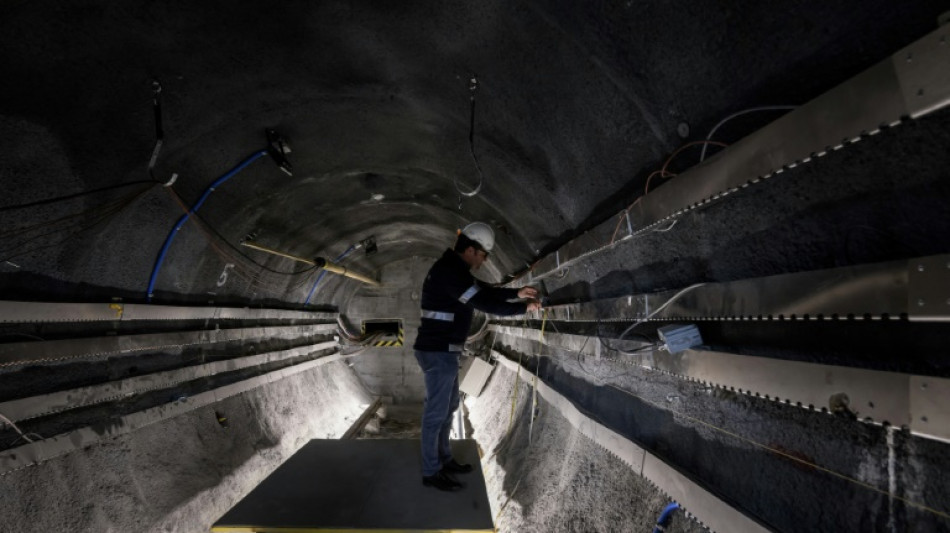
The Mont Terri international laboratory was built to study the effects of burying radioactive waste in clay which sits 300 metres (985 feet) below the surface near Saint-Ursanne in the northwestern Jura region.
The underground laboratory stretches across 1.2 kilometres (0.7 miles) of tunnels. Niches along the way, each around five metres high, are filled with various storage simulations, containing small quantities of radioactive material monitored by thousands of sensors.
More than 170 experiments have been carried out to simulate the different phases of the process -- positioning the waste, sealing off the tunnels, surveillance -- and to reproduce every imaginable physical and chemical effect.
According to experts, it takes 200,000 years for the radioactivity in the most toxic waste to return to natural levels.
Geologist Christophe Nussbaum, who heads the laboratory, said researchers wanted to determine what the possible effects could be "on storage that needs to last for nearly one million years."
That "is the duration that we need to ensure safe confinement," he said, adding that so far, "the results are positive."
- Potential sites identified -
Three prospective sites in the northeast, near the German border, have been identified to receive such radioactive waste.
Switzerland's nuclear plant operators are expected to choose their preferred option in September.
The Swiss government is not due to make the final decision until 2029, but that is unlikely to be the last word as the issue would probably go to a referendum under Switzerland's famous direct democracy system.
Despite the drawn-out process, environmental campaigners Greenpeace say Switzerland is moving too fast.
"There are a myriad of technical questions that have not been resolved," Florian Kasser, in charge of nuclear issues for the environmental activist group, told AFP.
For starters, he said, it remains to be seen if the systems in place can "guarantee there will be no radioactive leakage in 100, 1,000 or 100,000 years."
"We are putting the cart before the horse, because with numerous questions still unresolved, we are already looking for sites" to host the storage facilities, he said.
Kasser said Switzerland also needed to consider how it will signal where there sites are to ensure they are not forgotten, and that people many centuries from now remain aware of the dangers.
Swiss nuclear power plants have been pumping out radioactive waste for more than half a century.
Until now, it has been handled by the National Cooperative for the Disposal of Radioactive Waste, or NAGRA, founded in 1972 by the plant operators in conjunction with the state.
For now, the waste is being stored in an "intermediary depot" in Wurenlingen, some 15 kilometres from the German border.
- Horizon 2060 -
Switzerland hopes to join an elite club of countries closing in on deep geological storage.
So far, only Finland has built a site, in granite, and Sweden gave the green light in January to build its own site for burying spent nuclear fuel in granite.
Next up is France, whose Cigeo project, led by the National Agency for Radioactive Waste Management (ANDRA), plans to store radioactive waste underground in clay.
"We are awaiting the declaration of public utility but in the meantime we will submit a request for a construction permit," said ANDRA spokeswoman Emilie Grandidier during a visit to Mont Terri.
Following the 2011 nuclear accident at the Fukushima power station in Japan, Switzerland decided to phase out nuclear power gradually: its reactors can continue for as long as they remain safe.
A projected 83,000 cubic metres of radioactive waste, including some high activity waste, will have to be buried.
This volume corresponds to a 60-year operating life of the Beznau, Gosgen and Leibstadt nuclear power plants, and the 47 years that Muhleberg was in operation before closing in 2019.
Filling in the underground nuclear waste tombs should begin by 2060.
"It's the project of the century: we have carried out the scientific research for 50 years, and we now have 50 years for the authorisation and the realisation of the project," said Nagra spokesman Felix Glauser.
The monitoring period will span several decades before the site is sealed some time in the 22nd century.
Y.Ishikawa--JT