The Japan Times - Ecuadoran toad breaks its silence after 100 years

EUR -
AED 4.250766
AFN 72.908308
ALL 96.082221
AMD 436.873271
ANG 2.071606
AOA 1061.215153
ARS 1597.838385
AUD 1.645756
AWG 2.085976
AZN 1.97195
BAM 1.955467
BBD 2.330193
BDT 141.96215
BGN 1.978129
BHD 0.433607
BIF 3437.085868
BMD 1.157268
BND 1.479667
BOB 7.994742
BRL 6.149843
BSD 1.156998
BTN 108.163052
BWP 15.776518
BYN 3.510218
BYR 22682.452195
BZD 2.326894
CAD 1.587483
CDF 2632.785049
CHF 0.912279
CLF 0.0272
CLP 1074.002997
CNY 7.969415
CNH 7.992203
COP 4296.46149
CRC 540.405658
CUC 1.157268
CUP 30.667601
CVE 110.924591
CZK 24.475107
DJF 205.670119
DKK 7.473526
DOP 68.279225
DZD 152.783891
EGP 59.986564
ERN 17.35902
ETB 181.865115
FJD 2.562713
FKP 0.866861
GBP 0.867431
GEL 3.142029
GGP 0.866861
GHS 12.620054
GIP 0.866861
GMD 85.063652
GNF 10157.924053
GTQ 8.862453
GYD 242.061925
HKD 9.063434
HNL 30.737487
HRK 7.53787
HTG 151.782191
HUF 393.182241
IDR 19627.264756
ILS 3.598091
IMP 0.866861
INR 108.614171
IQD 1516.02104
IRR 1522530.672291
ISK 143.814137
JEP 0.866861
JMD 181.768268
JOD 0.820549
JPY 184.278148
KES 149.986328
KGS 101.200658
KHR 4640.644962
KMF 494.153828
KPW 1041.484287
KRW 1742.741851
KWD 0.354823
KYD 0.964148
KZT 556.232895
LAK 24863.90272
LBP 103633.347039
LKR 360.916993
LRD 212.214059
LSL 19.685569
LTL 3.417112
LVL 0.70002
LYD 7.38381
MAD 10.832611
MDL 20.148831
MGA 4825.807832
MKD 61.713417
MMK 2430.000094
MNT 4131.070323
MOP 9.33887
MRU 46.441602
MUR 53.81729
MVR 17.8918
MWK 2010.174862
MXN 20.713597
MYR 4.558523
MZN 73.953739
NAD 19.477256
NGN 1569.545119
NIO 42.495316
NOK 11.075049
NPR 173.060536
NZD 1.982642
OMR 0.441597
PAB 1.157018
PEN 4.02618
PGK 4.989851
PHP 69.404876
PKR 323.1135
PLN 4.275585
PYG 7556.680787
QAR 4.217668
RON 5.093719
RSD 117.69304
RUB 95.988502
RWF 1688.453967
SAR 4.345607
SBD 9.317929
SCR 16.627341
SDG 695.518442
SEK 10.812706
SGD 1.484085
SHP 0.868251
SLE 28.439904
SLL 24267.343207
SOS 661.382882
SRD 43.383087
STD 23953.110446
STN 24.89862
SVC 10.123276
SYP 128.185157
SZL 19.477247
THB 37.962609
TJS 11.112752
TMT 4.062011
TND 3.366536
TOP 2.786423
TRY 51.244872
TTD 7.84963
TWD 37.032963
TZS 2993.463438
UAH 50.684352
UGX 4373.236539
USD 1.157268
UYU 46.622062
UZS 14112.88327
VES 526.198902
VND 30450.034804
VUV 137.756939
WST 3.175735
XAF 655.853838
XAG 0.017004
XAU 0.000257
XCD 3.127575
XCG 2.085136
XDR 0.816864
XOF 660.225535
XPF 119.331742
YER 276.128291
ZAR 19.821112
ZMK 10416.804592
ZMW 22.590447
ZWL 372.639814
  • RBGPF

    -13.5000

    69

    -19.57%

  • CMSD

    -0.2420

    22.658

    -1.07%

  • CMSC

    -0.2000

    22.65

    -0.88%

  • RYCEF

    -0.6100

    15.99

    -3.81%

  • BCE

    0.0600

    25.79

    +0.23%

  • RIO

    -2.5000

    83.15

    -3.01%

  • VOD

    -0.0900

    14.33

    -0.63%

  • GSK

    -0.5300

    51.84

    -1.02%

  • BTI

    -1.3500

    57.37

    -2.35%

  • RELX

    -0.4600

    33.36

    -1.38%

  • JRI

    -0.3900

    11.77

    -3.31%

  • AZN

    -5.3300

    183.6

    -2.9%

  • BCC

    -1.5600

    68.3

    -2.28%

  • NGG

    -3.5400

    81.99

    -4.32%

  • BP

    -1.0800

    44.78

    -2.41%

Ecuadoran toad breaks its silence after 100 years


Ecuadoran toad breaks its silence after 100 years

Ecuadoran biologist Jorge Brito was trekking through the forest when he heard what he thought was the chirp of a cricket.

Text size:

What he found changed a century of scientific belief.

"At first I thought it was some sort of cricket out there vocalizing, but then I paid attention," said Brito, from Ecuador's national biodiversity institute.

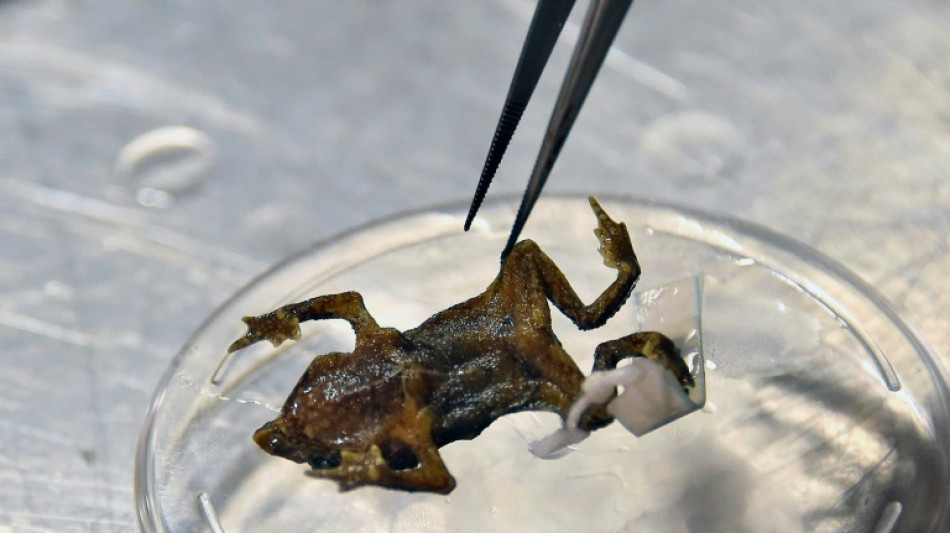
It was, in fact, a type of brown toad with rough skin called Rhinella festae that has a prominent nose and had been considered mute since it was first discovered 100 year ago.

"While it did not inflate its vocal sack, you could see a small flicker" on its chin, said Brito.

He caught it and took it to a laboratory to study with his colleague Diego Batallas.

"The first time I heard it, I said: Wow, that's not the sound of a toad, it's like a little bird," Batalla told AFP.

The toad, which measures between 45 and 68 centimeters in length, lives in the mountainous Ecuadoran regions of Cutucu and Condor, extending over the border into the Amazonian region of Peru.

The discovery was first reported in February in Neotropical Biodiversity magazine, where Brito and Batallas described the sound made by the toad.

"It is the first time this unique song of the Rhinella festae has been recorded and it's surprising because it shouldn't sing," Batallas told AFP.

The toad does not have the vocal sack that allows most amphibians to amplify their calls so that they can be heard up to one kilometer away.

"The fact that this species can sing (without the vocal sack) makes it unique," added Batallas, who used to sing in a choir.

Batallas said that the faint sound emitted by the Rhinella festae demonstrates that some species of amphibians could have evolved in such a way -- perhaps as an anti-predator measure -- as to "not need their song to be heard very far away."

In the case of the Rhinella festae, it emits a sound as a greeting, whereas other species of toad croak as part of a mating ritual or as a warning.

"It's a very subtle sound and very difficult to hear in nature."

Ecuador has registered 658 different species of amphibians, of which 623 are toads or frogs and almost 60 percent of those are at risk or in danger of disappearing.

Only Brazil and Colombia have more species of amphibians than Ecuador.

M.Saito--JT