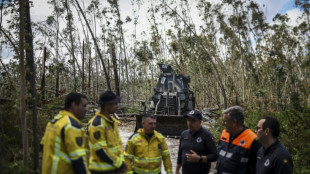
July hottest month on record: EU climate observatory / Photo: CRISTINA QUICLER - AFP

July was the hottest month ever recorded on Earth, the European Union's climate observatory confirmed Tuesday.
Marked by heatwaves and fires all around the world, the previous month was 0.33 degrees Celsius higher than the record set in July 2019 when the average temperature was 16.63C (32 Fahrenheit), it said.
"The month was 0.72C warmer than the 1991-2020 average for July," it said.
About 1.2 degrees Celsius of global warming since the late 1800s, driven by the burning of fossil fuels, has made heatwaves hotter, longer and more frequent, as well as intensifying other weather extremes like storms and floods.
"Heatwaves were experienced in multiple regions of the Northern Hemisphere, including southern Europe. Well-above average temperatures occurred over several South American countries and around much of Antarctica," the EU climate observatory Copernicus said.
"The global mean for 2023 is the third highest on record, at 0.43C relative to 1991-2020, compared with 0.49C for 2016 and 0.48C for 2020. The gap between 2023 and 2016 is expected to narrow in the coming months, as the latter months of 2016 were relatively cool... while the remainder of 2023 is expected to be relatively warm as the current El Nino event develops."
Scientists had warned that July could hit a new record.
The world's oceans also set a new temperature record, raising concerns about knock-on effects on the planet's climate, marine life and coastal communities.
The temperature of the oceans' surface rose to 20.96 degrees Celsius (69.7 degrees Fahrenheit) on July 30, according to European Union climate observatory data.
The previous record was 20.95C in March 2016, a spokeswoman for Copernicus Climate Change Service earlier told AFP.
The samples tested excluded polar regions.
- 'Dire consequences' -
"We just witnessed global air temperatures and global ocean surface temperatures set new all-time records in July. These records have dire consequences for both people and the planet exposed to ever more frequent and intense extreme events," said Samantha Burgess, Deputy Director of the EU's Copernicus Climate Change Service.
"2023 is currently the third warmest year to date at 0.43C above the recent average, with the average global temperature in July at 1.5C above pre-industrial levels.
"Even if this is only temporary, it shows the urgency for ambitious efforts to reduce global greenhouse gas emissions, which are the main driver behind these records," she said.
Forest fires have ravaged swathes of Greece and burnt 30 million acres (12 million hectares) in Canada, while southern Europe, parts of North Africa, southern United States and pockets of China have been reeling under a punishing heatwave.
Deadly rains that pummelled China's capital Beijing in recent days were the heaviest since records began 140 years ago.
Carlo Buontempo, Director of Copernicus, had earlier said the temperatures in the period had been "remarkable".
Beyond these official records, he said proxy data for the climate going back further -- like tree rings or ice cores -- suggests the temperatures seen in the period could be "unprecedented in our history in the last few thousand years".
Possibly even longer "on the order of 100,000 years" he said.
UN chief Antonio Guterres recently put out an SOS call.
"Climate change is here. It is terrifying. And it is just the beginning," said Guterres, urging immediate and bold action to cut planet-heating emissions.
"The era of global warming has ended; the era of global boiling has arrived."
Y.Ishikawa--JT