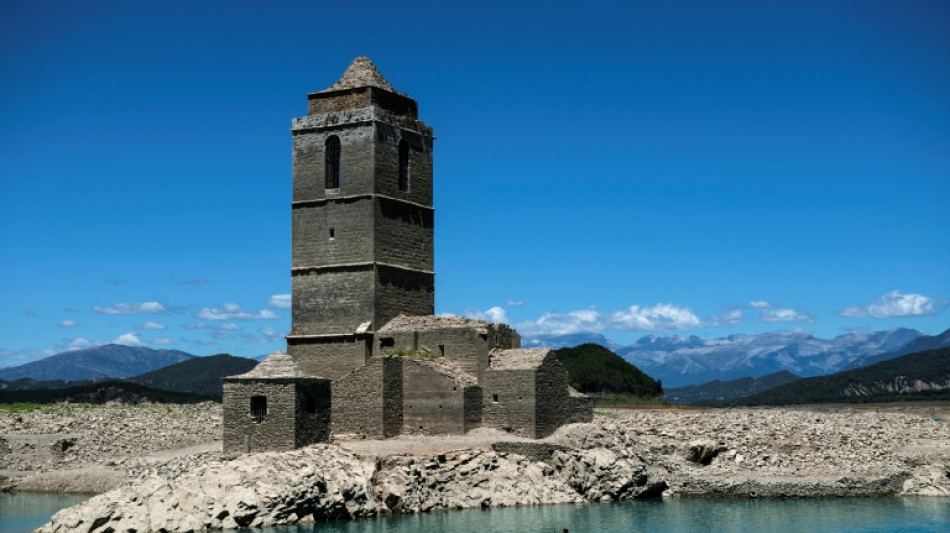
Spain worries over 'lifeless land' amid creeping desertification / Photo: ANDER GILLENEA - AFP

Ongoing droughts and an over-exploitation of land for both agriculture and industry have stoked fears in Spain over the creeping spread of "sterile soil" which could devastate Europe's kitchen garden.
"There used to be a holm oak forest here.. but now the land is barren," says Gabriel del Barrio, pointing to a hill where only stunted shrubs remain.
Wearing dusty trainers and with a canvas hat on his head, this specialist in desertification has been worriedly monitoring the daily degradation of the landscape in Almeria, in the southern Andalusia region.
"Spain is not going to be a desert with dunes like in the Sahara, that's morphologically impossible," explains del Barrio, a researcher at EEZA, the experimental centre for research into arid zones.
But desertification, which is characterised by a severe "degradation of the soil" causing it to lose its productive capacity, "is worrying", he says.
In the dock are the usual suspects: global warming, which is driving rising temperatures leading to water evaporation that causes more wildfires, but also human activity, which is the biggest culprit, notably due to intensive farming.
Despite its very dry climate, Almeria has transformed itself into Europe's vegetable garden through its 40,000 hectares of greenhouses -- its "Sea of Plastic" -- which produce thousands of tonnes of tomatoes, peppers, courgettes and cucumbers all year round.
But these vast crop-producing areas are exacerbating the problem by using groundwater and "depleting the aquifers," says del Barrio.
- 'Complicated position' -
Although the situation is extreme, it's not only happening in Almeria.
According to the UN Convention to Combat Desertification, 75 percent of Spain's land is battling climatic conditions that could lead to desertification, making it the European nation most threatened by the problem.
"This puts us in a complicated position in which the combination of extreme temperatures, droughts and other factors aggravate the risk of erosion and the loss of soil quality," Spain's Ecology Minister Teresa Ribera warned in June.
According to the Spanish National Research Council (CSIC), to which EEZA reports, soil degradation has tripled over the last 10 years, creating a problem which is "irreversible on a human scale".
And that means soils which are unable to retain water or organic matter, that cannot support crops or nourish livestock -- which is a matter of huge concern in a country where agriculture accounts for annual exports of some 60 billion euros ($66 billion).
"Soil erosion is now the main problem for most farmers in Spain," said UPA, which represents small farmers and stockbreeders, warning the situation was "serious" and could have a significant "economic cost".
- Seven years for soil regeneration -
In Andalusia, the situation has prompted some to roll up their sleeves and get down to work.
"We have to act on our own wherever possible... and not give in to fate," says Juan Antonio Merlos, 40, who owns a 100-hectare almond farm in the hills above Velez-Blanco.
Together with a handful of farmers from an association called AlVelAl, Merlos has introduced new "regenerative" practices since taking over his parents' farm three years ago, which has now been certified as organic, in a bid to "halt the soil erosion" in the region.
These farmers now use manure instead of chemical fertilisers, don't use pesticides "which kill insects," limit use of ploughing "which damages the soil" and use plant matter to cover the soil in order to conserve moisture on the rare occasions when it rains.
"This is long-term work" using techniques that have been around for years, says Merlos as he examines a few barley stalks planted under his almond trees.
But that doesn't stop him from being optimistic.
"In theory, you need seven years to see results from regenerative agriculture. But I have already started to notice the difference in the soil and the insects," he told AFP.
As well as urging farmers to adopt new practices, environmental associations are pushing for new ways of farming, by reducing irrigated areas and using crops that consume less water.
"We need to adjust our needs in light of the available water resources to reduce the risk exposure of both people and our productive sectors in a period of scarcity," said the World Wildlife Fund.
By and large, del Barrio agrees.
"We have to find a balance" to ensure food needs without endangering the soil, he said.
"We need to manage the soil in a way that makes it as sustainable as possible" to avoid the spectre of "lifeless" land.
S.Suzuki--JT