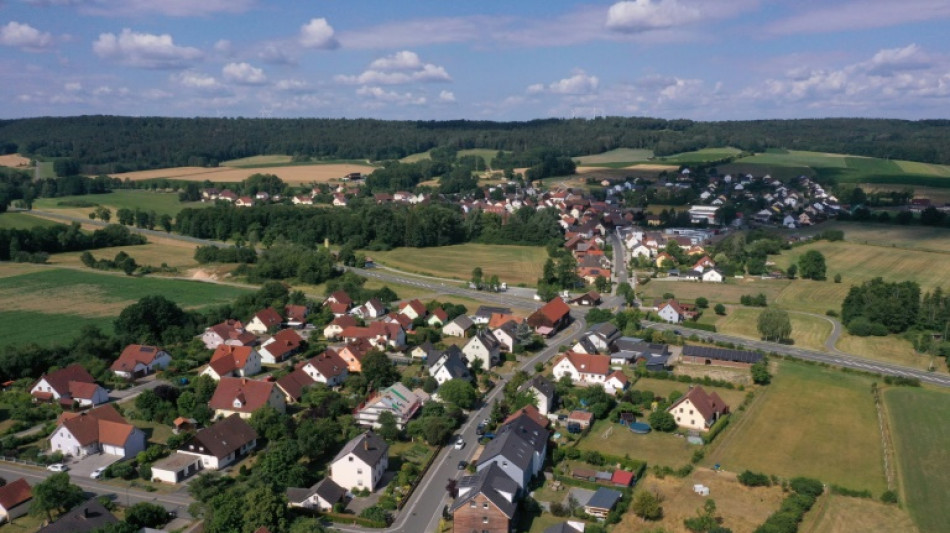
Wind of change picks up for German region's energy sector / Photo: Christof STACHE - AFP

Residents of the rural Bavarian village of Schnabelwaid have said "yes" to the installation of wind turbines on the hillside next to their community in a rare win for an energy source unloved in Germany's biggest region.
Economically prosperous and hungry for power, Bavaria has dragged its feet on the expansion of wind energy capacity, vitally needed for Germany to hit its goal to be carbon neutral by 2045.
Since January, the southern region has installed just five turbines and signed off on another two new projects, putting it close to the bottom of the league table among Germany's 16 federal states.
But a new wind seems to be blowing, as the government in Berlin looks to speed construction of new wind projects.
The roughly 900 residents of Schnabelwaid approved the new project to install about 10 turbines by a whisker at the end of a public consultation in April.
More than 80 percent of them rejected the idea 13 years ago when the idea was first put forward to place 18 turbines in the same location in Kitschenrain forest next to the village.
- 'For our children' -
The change of heart can be traced back not only to a growing awareness of climate change and the concern caused by Germany's exit from nuclear energy in April, but the village's own precarious finances.
The district is "heavily indebted", said mayor Hans-Walter Hofmann, while the wind park "will generate revenues".
Hofmann estimated that at a rate of 0.2 cents per kilowatt-hour, the area could bank two million euros ($2.2 million) over 20 years.
Schnabelwaid resident Guenther Angerer supported the turbine project to secure "the supply of energy for our children", the pensioner told AFP on his way to pick up his granddaughter from daycare.
On the other side of the debate, Karin Bauer said that clearing forest to make way for wind turbines "completely goes against" climate preservation principles.
The area's rich groundwater would be "at risk if 10 wind turbines are built" there, Bauer's neighbour Rosemarie Ballwieser added.
The prospective wind park's impact on local resources will be examined as part of the final approval process, which is set to last until 2024.
Thereafter, the blades of the 200-metre-tall (656-feet-tall) turbines "could start turning in the autumn of 2026", said Maximilian Weiss, the head of the project.
The energy produced by the wind park could produce enough electricity for 30,000 homes, according to his company Uhl Windkraft.
- Turbine target -
By setting a target to cover 1.4 percent of Germany's land surface with wind turbines by 2027 -- rising to two percent by 2032 -- Olaf Scholz's coalition government is hoping to send a signal to Germany's regional governments to get a move on.
The message is particularly directed at Bavaria, currently led by Markus Soeder from the conservative opposition CSU.
Not upsetting residents unhappy at the sight of new turbines in their backyard has often guided policymakers in the region.
In Bavaria, installing wind energy capacity is made more difficult by a rule that means any new mast has to be at a distance of 10 times its own height from the nearest house.
In northern Bavaria, there is a "real spirit of optimism", said regional MP Martin Stuempfig from the Green party.
But in the south of the region, closer to the Alps, only a few isolated places are willing to push forward with new wind parks, Stuempfig regretted.
With regional elections approaching in October, the CSU will "only want to talk about national issues to divert attention" from its poor record on wind energy, he said.
T.Ueda--JT