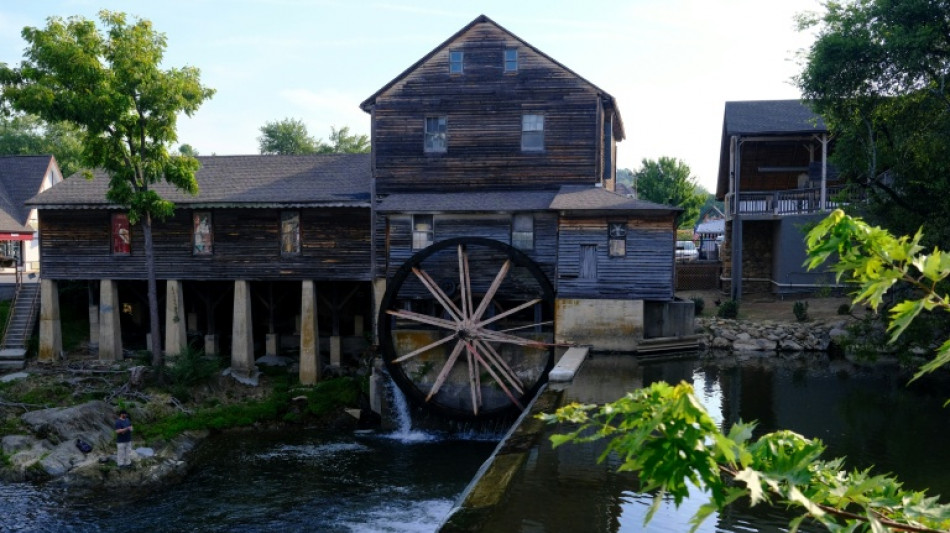
Grinding away: in remote Appalachia, old mills fuel US clean food dreams / Photo: Michael Mathes - AFP

In a country better known for industrial farming, highly processed food and suspiciously long-lasting bread, Chuck Childers rises before dawn and trudges off to operate one of America's oldest functioning gristmills.
East Tennessee's water-powered Old Mill first began grinding cornmeal back in 1830 in the deep Appalachian region along the Little Pigeon River.
It still does today.
And Childers, 68, isn't just keeping up tradition and showcasing heritage.
He and other optimists believe the old ways will fuel a return to healthier, smaller-scale, more sustainable food production across the US.
"There's been a resurgence" of interest in "clean food," he told AFP at the mill in Pigeon Forge.
In a nation that invented the likes of the frozen TV dinner, Childers is winding back the clock with technology that would be recognizable to farmers two millenia ago.
The corn ground at the Old Mill is Tennessee-grown, never genetically modified, and no harsh chemicals or additives are added to the cornmeal and grits.
The stones doing the grinding at the mill -- where the father of late country music legend Dolly Parton once took his corn -- each weigh 2,000 pounds (907-kg).
"I think people... want foods that are whole foods, the way we used to do them, the foods that their grandmother or great-grandmother made," Childers said.
- Traditional vs industrial -
Traditional millers say stone-ground products are healthier than ones from industrial roller mills.
Heavily processed milling strips away bran, germ and other nutrients, and while federal law requires such flour to be enriched, the end product still lacks key vitamins, minerals and anti-oxidants.
"A lot of the fiber is taken off" in the industrial process, said Danielle Nierenberg, president of the not-for-profit Food Tank which seeks to build sustainable and equitable food systems.
"Revitalizing" traditional gristmills, thousands of which once operated in Appalachia -- a swath of mountains and valleys across 13 states, from Alabama, Tennessee and West Virginia up to southern New York -- is key to America's clean-food puzzle, Nierenberg said.
The economics, however, are going the other direction, with local mills unable to compete with facilities boasting output hundreds of times greater.
Retired miller John Lovett estimates that fewer than 100 traditional gristmills nationwide still operate at commercial viability.
- Appalachia: poverty, poor health -
Appalachia is known for its struggles with nutrition, health disparities, diminished access to fresh food, and poverty.
Getting locals to eat differently is a challenge.
"It's like pushing a rope," Lovett sighed. A vocal minority is in favor, "but then the mass majority is, I think, not as concerned."
Even if they want to ditch the industrial food products, healthier alternatives cost more -- and in poverty stricken areas of East Tennessee, that's a non-starter.
Clive Valentine, who built a traditional gristmill in Dandridge, in the foothills of the Smoky Mountains, sees hope.
The Covid pandemic "opened people's eyes about what they're putting in their bodies," the 77-year-old told AFP.
A few years ago, 10 couples might stop by the mill and its general store each weekend. Today, that number has soared tenfold.
"People want clean, organic, non-GMO foods," he said.
- Rural America 'hit hard' -
In Dolly Parton's hometown of Sevierville, chef Derek Green is on a mission to promote the farm-to-table movement and healthier grains.
"If I know what you're feeding my meat, my veg, my everything, it's going to come out as a better product," said Green, who runs the kitchen at The Appalachian restaurant.
Green recognizes organic foods and stone-ground grains are too expensive for many Americans, but says the movement "has a real-life feel to it right now."
Food Tank's Nierenberg argues that traditional mills should be getting some of the money poured by the US government into agro-industry subsidies.
"Rural America is being hit hard by everything. Farmers are going out of business everyday," she said.
S.Yamada--JT