Dutch students unveil 'world-first' solar-powered ambulance / Photo: Robin Utrecht - ANP/AFP

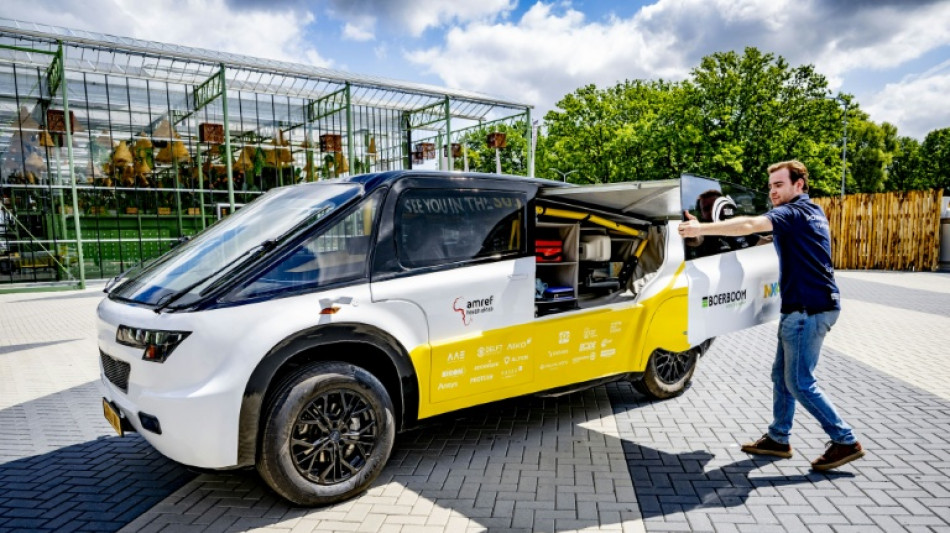
A Dutch student team Tuesday unveiled what they believe to be the world's first solar-powered ambulance, which they hope can bring much-needed medical care to the remotest parts of the globe.
The sleek, futuristic-looking, white and yellow vehicle boasts solar panels on the roof that power its engine but also medical devices from x-ray machines to defibrillators.
The two-seater ambulance, named Stella Juva, can reach a top speed of 120 kilometres per hour (75 miles per hour) and is designed for inaccessible off-road terrain.
With a range of 715 kilometres on a sunny day, the car has a solar power-charged battery to ensure the vehicle and equipment works at night or when it is cloudy.
"Stella Juva is fully equipped to deliver medical healthcare in hard-to-reach areas," said project leader Mathijs van Gerven, a 21-year-old student of biomedical engineering at Eindhoven University of Technology.
The vehicle is designed to bring healthcare to the patient, rather than transport them to hospitals. It contains testing kits for tuberculosis, cooled storage for vaccines, and ultrasound for pregnant women.
The team plans to travel to Kenya next month to put the car through its paces.
The innovation responds to a pressing real-world need, said Femke Maurits, Partnerships Manager at Amref Health Africa, a humanitarian organisation providing health services in African countries.
"The issue that many African countries have is that the distance between very remote villages and healthcare facilities is really big," Maurits, 34, told AFP.
"There's little public transportation, fuel is very expensive, electricity networks are unreliable. So a really cool innovation like the Stella Juva can help us solve such big challenges in healthcare delivery," she said.
- 'Really large distances' -
Many of the team have put their studies on hold to work on the project, which has taken a year to complete.
The front of the vehicle features a dashboard showing current speed and battery power, and the medical equipment is packed into the rear.
When AFP visited for the unveiling, riding in the vehicle was a smooth experience on the flat concrete roads of the test centre at Barneveld, central Netherlands.
But Van Gerven and his team are aware the challenges will be very different in remote areas of Kenya.
"There is a robustness that we need to take into account if we want to drive off-road... where the healthcare really needs to be delivered," he told AFP, showing the spare tyres and shovels in case the car needs to be dug out.
Stella Juva is a prototype and Van Gerven said there was a need to scale up to make a real impact.
"I mean, we are 23 students and we built this within just one year. The technical industry should be able to do this way better and way faster," he said.
"So, we would like to invite any technical company and industry partner, come talk to us. We would like to scale this up with you."
One of the key advantages of a solar-powered car for providing healthcare in somewhere like Kenya is its adaptability, said Maurits from the Amref NGO.
"It's really designed to reach large distances. It's powered by the sun, so even when it reaches a destination, it doesn't have to go back to a central point," she said.
"It can go on and on and on."
Isabella Wanningen, 22, a computer science student who worked on the energy functions of the car, said the vehicle's name encapsulated the team's hopes for the impact.
"Stella is our family name. Our first car was called Stella and we've taken it to each car," she told AFP.
"And of course, we want to make a societal impact and Juva in Latin means 'to help'. So we really wanted to express that in the name as well."
M.Matsumoto--JT