'Global Dream' turns into nightmare for German port town

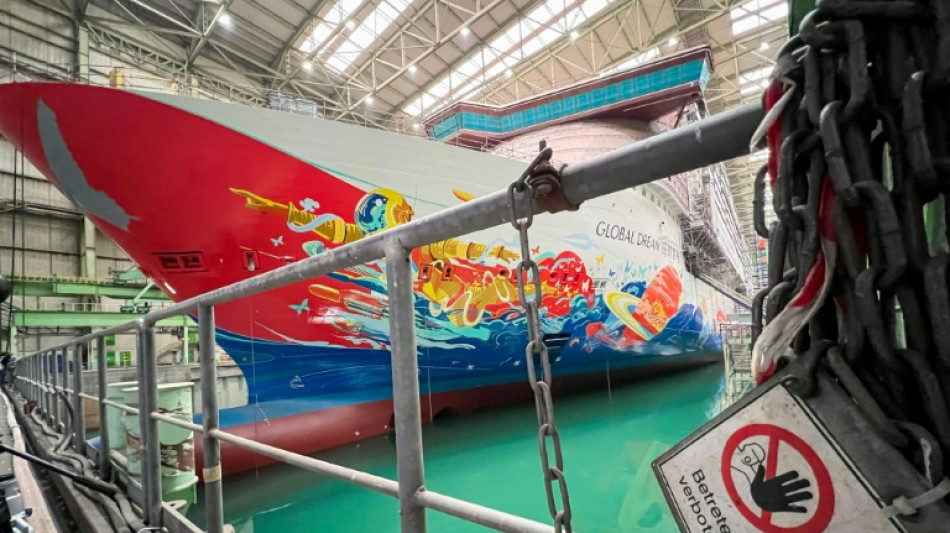
The unfinished "Global Dream" rests quietly in a dock as the Covid-19 pandemic has turned the cruise ship into a nightmare for the shipyard in Wismar along Germany's windswept Baltic coast.
Destined to have become one of the world's largest liners, the "Global Dream" will be lucky to ever set sail after the Asian-owned MV Werften shipyard filed for bankruptcy last month.
With no buyer having stepped forward, thousands of jobs at the shipyard are at risk and the local economy stands to take a huge hit.
"We are the classic victims of coronavirus," said Carsten Haake, MV Werften's chief executive.
The bankruptcy filing meant that construction work on the vessel, which would have become one of the first ships capable of hosting up to 10,000 passengers and crew, was halted.
MV Werften's fate was decided thousands of kilometres away in Asia, in the offices of Genting HK, the owner of the shipyard and the Dream Cruises operator.
Specialised in tourism and casinos, the company collapsed from the disruption to travel caused by the pandemic and the decision made by its Malaysian parent company Genting to abandon it.
Without sufficient financial guarantees, the German state, which had agreed to support the shipyard, withdrew.
Since then, the 342-metre-long cruise ship -- a little taller than the Eiffel Tower and adorned with a lurid cartoon fresco of astronauts and mermaids -- has been waiting for a saviour.
The project with an estimated cost of 1.5 billion euros ($1.7 billion), is "75 percent" complete, according to the shipyard's management. But it requires 600 million euros to keep going.
While the ship waits, uncertainty grips the 2,000 employees at MV Werften's docks in Stralsund, Rostock and Wismar, across the coast of Mecklenburg-West Pomerania in what used to be East Germany.
- Countdown -
Christoph Morgen was appointed to be the legal administrator for the company with one goal: "find a buyer for the Global Dream".
The ship was conceived when the cruise business was booming but demand for ocean-borne holidays has been hurt by the pandemic.
Even if "some investors have expressed an interest", Morgen said, securing a good offer for such a giant ship is difficult, not least while the coronavirus is still around.
Administrators are on the clock for March 1, their deadline for finding a viable solution.
The situation is also being monitored closely by local government figures for whom the collapse was a "shock, as it was for the whole city", the Social Democrat mayor of Wismar Thomas Beyer told AFP.
"Many families depend on the facility, generations have worked there," he added.
The shipyards are closely linked to the history of the city. Built after the Second World War, they were first used to service Soviet ships, before branching out in the 1950s.
The fall of the Berlin Wall and the collapse of East German industry led to massive layoffs.
Privatised in the 1990s, the shipyards have since then had a series of owners from both Germany and abroad, but had survived the economic ups and downs until now.
- Wismar no more -
On Wismar's central square, hemmed by the colourful buildings typical of Hanseatic cities, Heike Reimann, 67, worried what impact the disappearance of the flagship industry might have on the town.
"Wismar, without its naval yard, it's not Wismar," said Reimann, whose husband, Siegfried, worked for 10 years in the docks.
If no buyer comes forward, the yards will have to be converted to offshore wind or hydrogen production sites, symbols of the country's energy transition, the administrator Morgen said.
The idea appeals to some residents.
"Is it really a good idea to still be building big boats what with global warming?" said Christian Buenge, 63.
But the pivot to green energy would be a disaster for local workers, unions said.
"For a different project, different employees with different skills will be needed," said Henning Groskreutz from the IG Metall union.
The mayor's office is equally cold on the idea.
"We have to keep our maritime industries, it is a part of who we are," said mayor Beyer.
M.Fujitav--JT