The Japan Times - US overdose deaths shot up for Black, Native people during pandemic

EUR -
AED 4.255569
AFN 73.569217
ALL 95.755613
AMD 437.008887
ANG 2.073921
AOA 1062.400492
ARS 1596.510973
AUD 1.662617
AWG 2.088017
AZN 1.968901
BAM 1.953568
BBD 2.334712
BDT 142.259279
BGN 1.980339
BHD 0.439124
BIF 3438.030034
BMD 1.158561
BND 1.481871
BOB 8.010227
BRL 6.057769
BSD 1.159165
BTN 109.038223
BWP 15.797698
BYN 3.435693
BYR 22707.797359
BZD 2.331587
CAD 1.598536
CDF 2638.628761
CHF 0.915906
CLF 0.026812
CLP 1058.588213
CNY 7.985615
CNH 7.995352
COP 4292.932262
CRC 539.005004
CUC 1.158561
CUP 30.701869
CVE 110.497782
CZK 24.450503
DJF 206.440134
DKK 7.472354
DOP 69.51338
DZD 153.265352
EGP 60.806419
ERN 17.378416
ETB 182.473596
FJD 2.601259
FKP 0.865707
GBP 0.865335
GEL 3.133915
GGP 0.865707
GHS 12.668845
GIP 0.865707
GMD 85.150373
GNF 10169.266904
GTQ 8.872091
GYD 242.541684
HKD 9.05755
HNL 30.725138
HRK 7.532503
HTG 152.011542
HUF 385.871527
IDR 19528.705728
ILS 3.60762
IMP 0.865707
INR 108.560417
IQD 1517.715028
IRR 1521219.675342
ISK 143.197193
JEP 0.865707
JMD 182.596072
JOD 0.821466
JPY 184.294578
KES 150.269031
KGS 101.315237
KHR 4645.830177
KMF 493.54763
KPW 1042.721602
KRW 1736.022326
KWD 0.354636
KYD 0.966042
KZT 559.322576
LAK 24995.955609
LBP 103749.145909
LKR 364.576538
LRD 212.76958
LSL 19.753733
LTL 3.42093
LVL 0.700802
LYD 7.379732
MAD 10.804718
MDL 20.2698
MGA 4819.613964
MKD 61.646764
MMK 2433.17245
MNT 4135.44684
MOP 9.335438
MRU 46.49301
MUR 53.873392
MVR 17.911178
MWK 2011.261646
MXN 20.551814
MYR 4.593669
MZN 74.043317
NAD 19.7532
NGN 1600.610517
NIO 42.542292
NOK 11.215879
NPR 174.464166
NZD 1.989644
OMR 0.445468
PAB 1.15923
PEN 4.006882
PGK 4.995141
PHP 69.446508
PKR 323.325465
PLN 4.273631
PYG 7542.446202
QAR 4.222375
RON 5.094658
RSD 117.44566
RUB 93.873663
RWF 1690.34063
SAR 4.346593
SBD 9.317119
SCR 15.810264
SDG 696.295134
SEK 10.785219
SGD 1.482188
SHP 0.869221
SLE 28.497915
SLL 24294.459313
SOS 662.119922
SRD 43.261249
STD 23979.875432
STN 24.874307
SVC 10.14354
SYP 128.540334
SZL 19.75347
THB 37.709977
TJS 11.100278
TMT 4.066549
TND 3.362145
TOP 2.789536
TRY 51.387863
TTD 7.882299
TWD 36.959244
TZS 2977.57035
UAH 50.895102
UGX 4289.209702
USD 1.158561
UYU 46.927388
UZS 14140.237955
VES 531.638381
VND 30528.084714
VUV 138.457402
WST 3.172374
XAF 655.236527
XAG 0.015925
XAU 0.000254
XCD 3.131069
XCG 2.089294
XDR 0.813879
XOF 654.010453
XPF 119.331742
YER 276.435289
ZAR 19.583271
ZMK 10428.435247
ZMW 21.707225
ZWL 373.056198
  • RBGPF

    -13.5000

    69

    -19.57%

  • CMSC

    0.0500

    22.92

    +0.22%

  • RYCEF

    0.3000

    15.9

    +1.89%

  • CMSD

    0.1250

    22.755

    +0.55%

  • VOD

    0.1250

    14.785

    +0.85%

  • RELX

    0.0100

    32.47

    +0.03%

  • RIO

    1.1100

    87.88

    +1.26%

  • BCE

    -0.1600

    25.67

    -0.62%

  • BTI

    0.6800

    58.44

    +1.16%

  • GSK

    1.9950

    54.945

    +3.63%

  • BCC

    1.0200

    74.59

    +1.37%

  • NGG

    2.3200

    84.65

    +2.74%

  • JRI

    0.3100

    12.17

    +2.55%

  • AZN

    2.9000

    188.68

    +1.54%

  • BP

    0.7350

    45.525

    +1.61%

US overdose deaths shot up for Black, Native people during pandemic
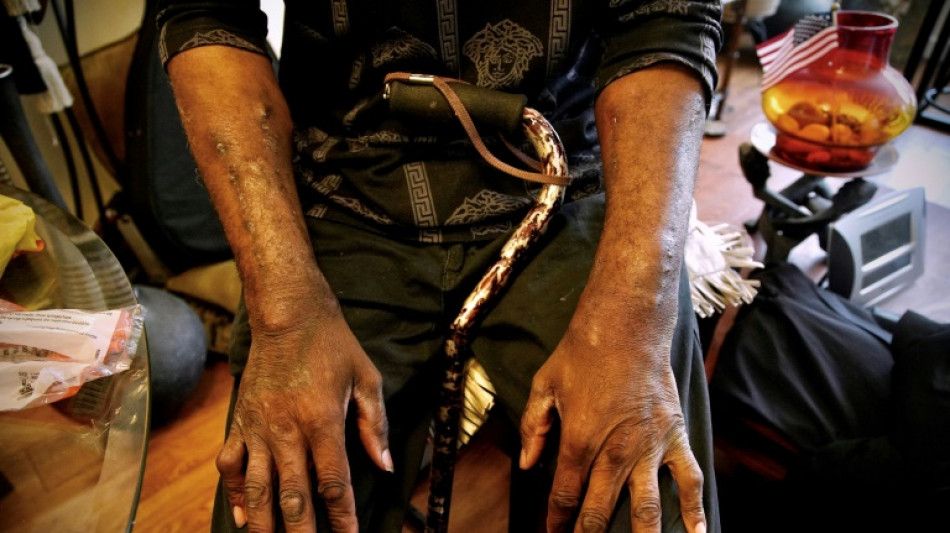
US overdose deaths shot up for Black, Native people during pandemic / Photo: Agnes BUN - AFP/File

US overdose deaths shot up for Black, Native people during pandemic

Overdose deaths increased 44 percent for Black people and 39 percent for American Indians in 2020 compared to 2019, as the Covid-19 pandemic disrupted access to care and exacerbated racial inequality, an official report showed Tuesday.

Text size:

"Racism, a root cause of health disparities, continues to be a serious public health threat that directly affects the well-being of millions of Americans," US Centers for Disease Control and Prevention (CDC) acting principal deputy director Debra Houry said in a briefing.

"The disproportionate increase in overdose death rates among Black and American Indian/Alaskan Native people may partly be due to health inequities, like unequal access to substance use treatment and treatment biases."

Recent increases in deaths were largely driven by illegally manufactured fentanyl and fentanyl analogs (IMFs), according to the report from the CDC.

Before the pandemic, the overdose death rate was similar for Black, Native and white people, at 27, 26 and 25 per 100,000 people in 2019.

But that changed dramatically in 2020, when the respective figures were 39, 36 and 31 per 100,000 people.

Though the increase among white people was not as great as for Black people and American Indians, the new rate is still a historic high.

Among key findings, the overdose death rate among Black males 65 years and older was nearly seven times that of their white counterparts.

Black people 15-24 years old experienced the largest rate increase, 86 percent, compared to changes seen in other groups.

"There was a substantially lower percentage of people in racial and ethnic minority groups showing evidence of ever receiving treatment for substance use, compared to white people," CDC health scientist Mbabazi Kariisa said during the briefing.

In fact, most people who died by overdose had no evidence of getting prior substance use treatment before their death.

Areas with a wider income gap between rich and poor had the highest death rates.

Being impoverished "can lead to lack of stable housing, reliable transportation and health insurance, making it even more difficult for people to access treatment, and other support services," said Kariisa.

In terms of recommendations, Houry said it was vital to raise awareness about the lethality of the illicit drug supply, particularly fentanyl -- and encouraging the public to carry the life-saving treatment Naloxone.

Improving access to treatment and offering structural support, such as transport assistance and child care, can improve care access.

"Combining culturally appropriate traditional practices, spirituality and religion with evidence based substance use disorder treatment also helps raise awareness and reduce stigma," she said.

"While we have made so much progress in treating substance use disorders as chronic conditions, rather than moral failings, there is still so much more work to do, including making sure that all people who need these services can get them," Houry concluded.

Y.Ishikawa--JT