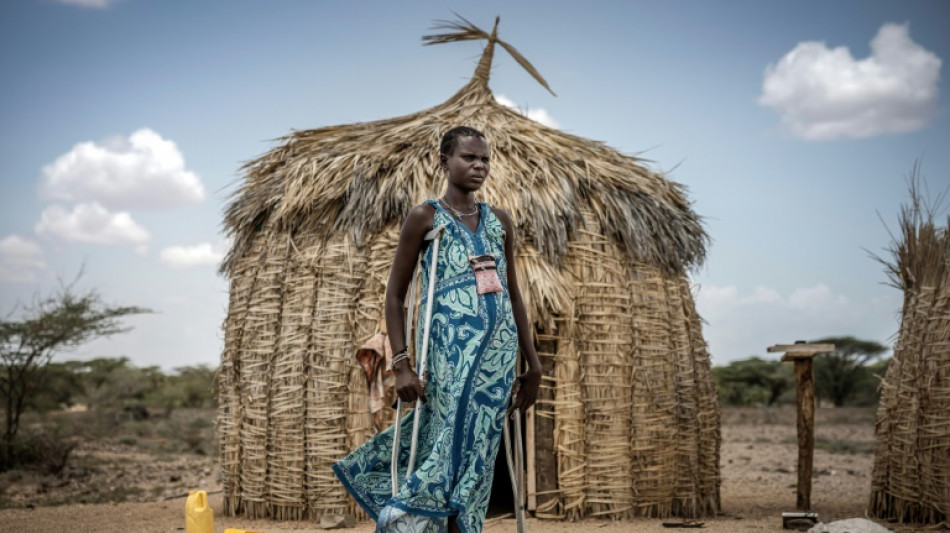
Rare bone-eroding disease ruining lives in Kenya's poorest county / Photo: Luis TATO - AFP

Joyce Lokonyi sits on an upturned bucket, fingers weaving palm fronds as the wind pulls her dress to expose the stump of her amputated foot, lost to a little-known disease ravaging Kenya's poorest county.
Mycetoma is a fungal or bacterial infection that enters the body through any open wound, often as tiny as a thorn prick.
Starting as tiny bumps under the skin, it gradually leads to the erosion of tissue, muscles and bone.
The fungal variety is endemic across the so-called "mycetoma belt" -- including Somalia, Sudan, Yemen and northern Kenya -- with funding and research desperately lacking.
Once the disease has reached the bone the only option is amputation.
"I was able to slightly walk, although the disease had eaten all my toes," Lokonyi, 28, told AFP.
She was shunned by the local community, she said.
"They used to say that when you go to someone's home, you will leave traces of the disease where you stand."
She was unable to afford medication despite her husband selling off his goats, and amputation became the only option.
"I accepted because I saw that it was going to kill me," she said, a pair of battered crutches lying on the sand beside her two-year-old daughter.
But she has struggled with the aftermath.
"I have become a good-for-nothing, I can't work, I can't burn charcoal, I can't do anything," she said.
- Neglected -
In Kenya's poorest county, Turkana, around 70 percent of the population lives beneath the poverty line, with healthcare limited and hard to reach.
Mycetoma disproportionately affects rural communities of farmers and herders, according to the Drugs for Neglected Diseases initiative (DNDi), a global NGO.
It was only recognised as a neglected disease by the World Health Organization in 2016. Ignorance and misdiagnosis remain widespread.
"Doctors are not aware of the disease," Borna Nyaoke-Anoke, DNDi's head of mycetoma research, told AFP.
"If you're used to donkeys, you don't start seeing zebras everywhere."
The scale of the problem is difficult to estimate, but Ekiru Kidalio, director of Lodwar Hospital in Turkana, said they "rarely go a week without finding a case".
He added that the local population, 80 percent of which is illiterate, often turns to traditional medicine.
By the time they come to hospital "the condition is already advanced such that it's not easy to reverse".
Medication is also expensive -- treatment takes up to a year and costs as much as $2,000 -- and comes with dizzying side effects.
Diagnosis and treatment are not free under Kenya's overwhelmed health system, leaving patients at the mercy of foreign donors or seeking sums that are unimaginable for subsistence farmers.
- 'Think about the worst' -
In Lodwar Hospital, lab technician John Ekai bends over his microscope and examines a suspected mycetoma sample.
"Mycetoma is a very neglected disease, no-one is giving it attention," he told AFP.
He has become the go-to man for suspected patients, handling his charges with a mischievous sense of humour that puts them at ease.
Ekai has treated more than 100 mycetoma patients in the past year, but has seen only five recoveries, with many simply vanishing back into Turkana's arid plains.
He worries for those who have disappeared: "The mycetoma will grow and grow and maybe... lead to amputation."
During AFP's visit, he examined young mother Jennifer Ekal, 19, who had lived with the disease since she was 11.
"I was in school but I decided to leave because of my foot," she said, showing her swollen and painful extremity, hidden beneath a red-and-white dishcloth.
Four doses of medication a day appeared to be helping, she said.
But as she gathered up her daughter, three-year-old Bianca, she admitted she was worried about the future.
"I do not want to think about the worst."
T.Maeda--JT