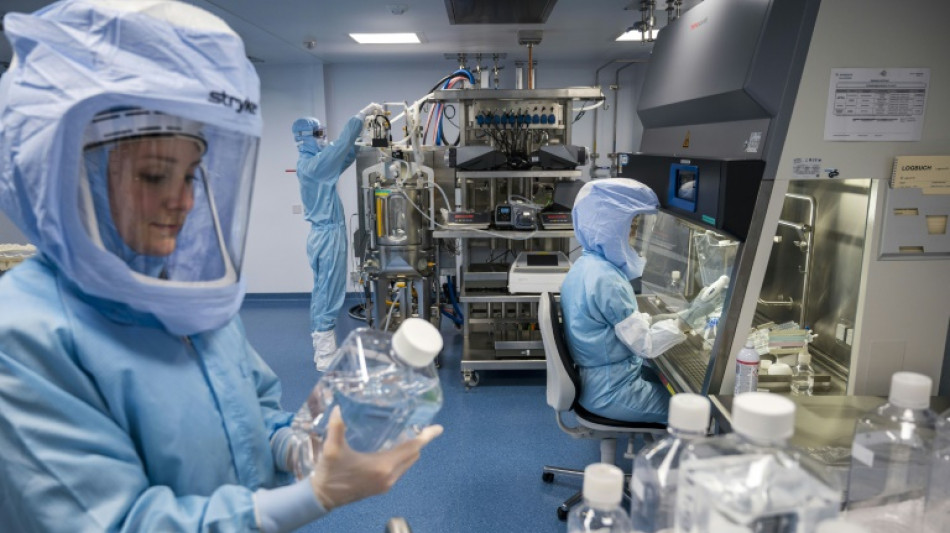
Moment of reckoning for pandemic agreement talks at WHO / Photo: Thomas Lohnes - AFP

Negotiations toward a global agreement on tackling future pandemics came down to the wire Friday, with observers voicing hope that a consensus could be found to seal a landmark deal.
The outcome of the years-long talks taking place at the World Health Organization headquarters remained unclear, but optimism appeared to be building as the scheduled cutoff approached.
"There is a high chance that a consensus will be reached in the coming hours," Michelle Childs, head of policy advocacy at the Drugs for Neglected Diseases Initiative (DNDi), an NGO, told AFP.
Five years after Covid-19 killed millions of people -- and with new health threats lurking, from H5N1 bird flu to measles, mpox and Ebola -- pressure is rising on world leaders to secure an agreement on pandemic prevention, preparedness and response.
"Having a framework that brings nations together and plans for the next pandemic will save thousands if not millions of lives," said WHO emergencies director Michael Ryan.
But President Donald Trump's decision to withdraw the United States from the WHO and his large-scale dismantling of US health institutes is a new threat to the global health risk surveillance system, experts say.
Adding to the sense of urgency are drastic US cuts to foreign aid, which could exacerbate health emergencies worldwide.
- 'Now or never' -
"It's now or never," said Suerie Moon, co-director of the Global Health Centre at the Geneva Graduate Institute.
In December 2021, WHO member states resolved to seek a deal to prevent and prepare for future pandemics, to avoid mistakes made during Covid.
Major disputes have slowed negotiations, including on how to share data on dangerous pathogens, and whether the transfer of the technology and know-how to produce vaccines, tests and treatments should be mandatory or voluntary.
After 13 rounds of discussions, countries have been meeting at the WHO headquarters in Geneva for final negotiations this week, with a Friday night deadline to iron out remaining problems.
The aim is to have a text ready for final approval during the WHO's annual assembly next month.
At the WHO headquarters, a sense of urgency has been building.
"The Covid-19 pandemic may now seem like a distant memory, overtaken by conflict and geopolitical and economic disruption," WHO chief Tedros Adhanom Ghebreyesus said as the latest round of talks began on Monday.
"But the next pandemic will not wait until things calm down. It could happen in 20 years or more, or it could happen tomorrow.
"But it will happen and either way we must be ready."
- 'Political will' -
The number of disputed issues in the negotiations has shrunk in recent months, with observers saying the main sticking point now is "political will".
The outcome is "unpredictable", a diplomatic source told AFP.
On Thursday, the Chinese mission in Geneva told AFP that "substantial progress" had been made on the draft text "but differences remain on some key articles", saying that parties should "display mutual understanding".
NGOs and experts urged countries to compromise and get the deal done, though some suggested a further extension of the talks until May was likely.
"It's very important to reach this agreement, even with a sub-optimal text," said Ellen 't Hoen, director of the Medicines Law and Policy NGO.
"That is much more preferable than having to negotiate such an agreement from scratch, because that will likely only happen after the next pandemic hits, and that would be an unacceptable situation," she said.
Childs agreed, saying "The pandemic agreement will not be perfect; it is a product of compromise, and not all ambitions will be met".
"But it will create a crucial new baseline to build on to save lives during the next global health emergency. It is a floor, not a ceiling."
- 'Too late' -
Among the stickier issues to resolve has been how a so-called Pathogen Access and Benefit-Sharing System (PABS) proposed in the text should work.
The latest draft calls for participating companies to provide the WHO with "rapid access" to "a target of 20 percent" of their production of pandemic-related health products, including "at least 10 percent" in the form of donations.
Some countries, especially ones where such products are produced, have balked at hard thresholds.
While the talks could in theory continue even after next month's assembly, there is widespread concern that if the process drags on, the political will to conclude a deal would dissipate.
If that happens, "it will probably be too late", Moon said. "The wind will go out of the sails."
M.Matsumoto--JT