Viruses that could save millions of lives

It may seem strange after a pandemic that has killed millions and turned the world upside down, but viruses could save just as many lives.
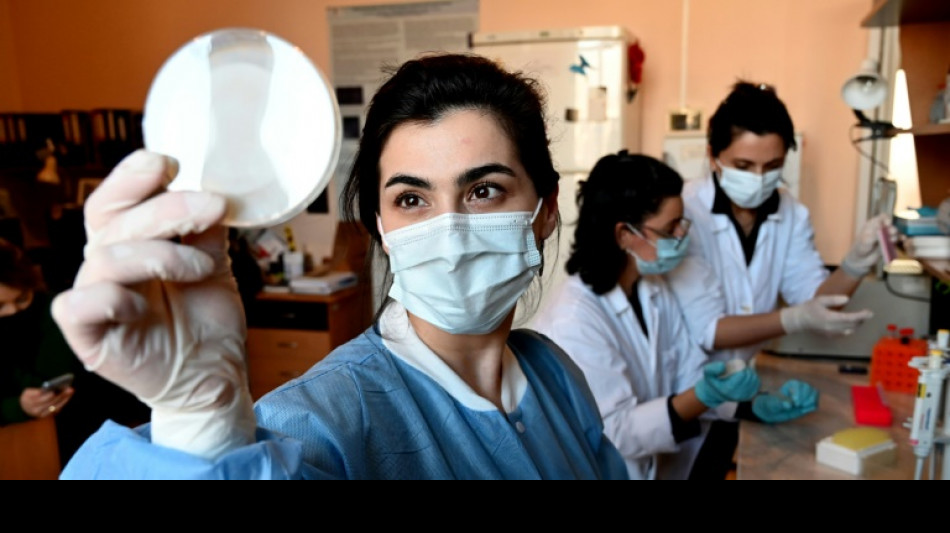
In a petri dish in a laboratory in the Georgian capital Tbilisi, a battle is going on between antibiotic resistant bacteria and "friendly" viruses.
This small nation in the Caucasus has pioneered research on a groundbreaking way to tackle the looming nightmare of bacteria becoming resistant to the antibiotics on which the world depends.
Long overlooked in the West, bacteriophages or bacteria-eating viruses are now being used on some of the most difficult medical cases, including a Belgian woman who developed a life-threatening infection after being injured in the 2016 Brussels airport bombing.
After two years of unsuccessful antibiotic treatment, bacteriophages sent from Tbilisi cured her infection in three months.
"We use those phages that kill harmful bacteria" to cure patients when antibiotics fail, Mzia Kutateladze of the Eliava Institute of Bacteriophages told AFP.
Even a banal infection can "kill a patient because the pathogen has developed resistance to antibiotics," Kutateladze said.
In such cases, phagotherapy "is one of the best alternatives", she added.
Phages have been known about for a century, but were largely forgotten and dismissed after antibiotics revolutionised medicine in the 1930s.
- Stalin's henchman -
It didn't help that the man who did most to develop them, Georgian scientist Giorgi Eliava, was executed in 1937 on the orders of another Georgian, Lavrentiy Beria, Stalin's most notorious henchman and the head of his secret police.
Eliava had worked in the Pasteur Institute in Paris with French-Canadian microbiologist Felix d'Herelle, one of the two men credited with discovering phages, and persuaded Stalin to invite him to Tbilisi in 1934.
But their collaboration was cut short when Beria had Eliava killed, although his motive still remains a mystery.
With the World Health Organization now declaring antimicrobial resistance a global health crisis, phages are making a comeback, especially as they can target bacteria while leaving human cells intact.
A recent study warned that superbugs could kill as many as 10 million people a year when antimicrobial resistance due to overuse of antibiotics reaches a tipping point. That could come within three decades.
- 'Training' viruses -
While phages-based medicines cannot completely replace antibiotics, researchers say they have major pluses in being cheap, not having side-effects nor damaging organs or gut flora.
"We produce six standard phages that are of wide spectrum and can heal multiple infectious diseases," said Eliava Institute physician Lia Nadareishvili.
In some 10 to 15 percent of patients, however, standard phages don't work and "we have to find ones capable of killing the particular bacterial strain," she added.
Tailored phages to target rare infections can be selected from the institute's massive collection -- the world's richest -- or be found in sewage or polluted water or soil, Kutateladze said.
The institute can even "train" phages so that "they can kill more and more different harmful bacteria."
"It is a cheap and easily accessible therapy," she added.
- Last-resort treatment -
A 34-year-old American mechanical engineer suffering from a chronic bacterial disease for six years told AFP he "already felt improvement" after two weeks at the Tbilisi institute.
"I've tried every possible treatment in the United States," said Andrew, who would only give his first name.
He is one of the hundreds of patients from around the globe who arrive in Georgia every year for last-resort treatment, said Nadareishvili.
With the traditional antimicrobial armoury depleting rapidly, more clinical studies are needed so that phagotherapy can be more widely approved, Kutateladze argued.
In 2019, the United States Food and Drug Administration (FDA) authorised a clinical study on the use of bacteriophages to cure secondary infections in Covid patients.
Beyond medicine, phages are already being used to stop food going off, and they "can be used in agriculture to protect crops and animals from harmful bacteria," Kutateladze said.
The institute has already conducted research on bacteria targeting cotton and rice.
Bacteriophages also have potential to counter biological weapons and combat bioterrorism, with Canadian researchers publishing a 2017 study on using them to counter an anthrax attack on crowded public places.
H.Takahashi--JT