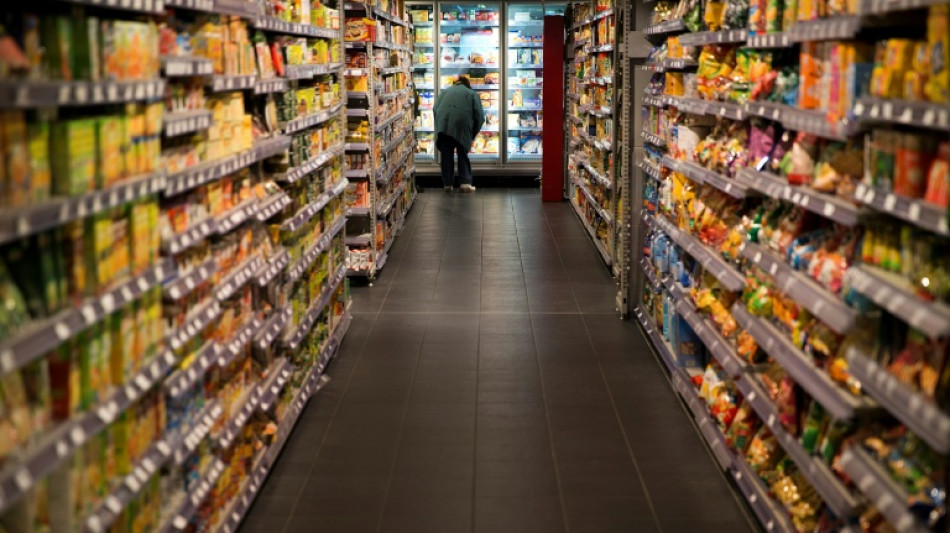
How unhealthy are ultra-processed foods? / Photo: JOEL SAGET - AFP/File

Ultra-processed foods are commonly portrayed as a modern health scourge: a threat lurking on the shelves of every supermarket linked to obesity, heart disease, cancer and early death.
Researchers warning of their dangers have called for taxation and even bans of products which make up a huge proportion of the food eaten worldwide.
However some nutrition experts have started to push back against such all-encompassing claims, saying the definition can be vague. They say more research is needed and that some ultra-processed foods, or UPFs, can actually be healthy.
The concept was first introduced in 2009 by Carlos Monteiro, a nutrition and health researcher at Brazil's University of Sao Paulo.
His NOVA classification system for UPFs was unusual in nutrition because it ignored the level of nutrients such as fat, salt, sugar and carbohydrates in food.
Instead, it splits food into four groups, ranked by the level of processing involved in their creation. Everything in the fourth group is considered ultra-processed.
Monteiro said that UPFs "aren't exactly foods".
"They're formulations of substances derived from foods," he told AFP.
"They contain little or no whole foods and are typically enhanced with colourings, flavourings, emulsifiers, and other cosmetic additives to make them palatable."
Examples include crisps, ice cream, soft drinks and frozen pizza. But items not traditionally considered junk food are also included, such as non-dairy milks, baby formula and supermarket bread.
According to the NOVA scale, nearly 60 percent of the calories eaten in the United States and UK are from UPFs.
- 'Confused' -
In recent years, dozens of studies have found that people who eat lots of UPFs have a higher risk of heart disease, cancer, asthma, depression and other illnesses.
But these studies have almost entirely been observational, which means they cannot show that UPFs directly cause these health problems.
Monteiro pointed to a US-based randomised-controlled trial, which is considered the gold standard of research.
For the 2019 trial, 20 people were fed either ultra-processed or unprocessed food for two weeks, then the opposite for the following two weeks.
The diets were matched for things like fat, sugar and overall calories. Those eating UPFs gained an average of nearly a kilo (2.2 pounds), while those on the unprocessed diet lost the same amount.
However, there was no limit on how much the trial participants ate, including snacks. Those on the UPF diet ate much more food, and their weight gain roughly matched how many more calories they consumed, the researchers said.
Monteiro said the study showed how big companies make food "hyperpalatable" in a way that "leads to overconsumption and even poses risks of addiction".
But one of the study's co-authors, Ciaran Forde of Wageningen University in the Netherlands, rejected the idea that there is something unique about UPFs that makes them irresistible.
Forde, a critic of NOVA who has disclosed he worked for food giant Nestle nearly a decade ago, said it was not just the public who was "confused".
In a French study published last year nearly 160 nutrition experts were asked to put 231 different foods into the four NOVA categories -- they only unanimously agreed about four.
- A healthy UPF diet? -
This potential for confusion was why US researchers brought in NOVA experts to help them develop a healthy diet in which 91 percent of calories were from UPFs.
Their week-long menu scored 86/100 on the US Healthy Eating Index -- far higher than the average American diet of 59/100.
Julie Hess, a nutritionist at the US Department of Agriculture who led the study, told AFP they sought out fruits and vegetables such as dried blueberries or canned beans deemed ultra-processed because of additives like preservatives.
"There may really be something here, but right now the scale puts gummy candies and sodas in the same category as oranges and raisins," she said.
Both Hess and Forde pointed out that many people do not have the time or money to cook every meal from fresh ingredients.
"Taxing processed foods in the middle of a cost-of-living crisis will be regressive and is likely to affect the most vulnerable groups," Forde said.
Robin May, the chief scientific adviser at the UK's Food Standards Agency, earlier this year warned against a "knee-jerk reaction" that treats all UPFs the same, "when we clearly know that everything is not the same".
Monteiro dismissed criticism of the NOVA scale.
"Those who profit from the sale of ultra-processed foods naturally dislike the NOVA classification and often sow doubts about its functioning," he said.
He called for ultra-processed foods to be treated like tobacco, praising a recent ban on UPFs in schools in Rio de Janeiro.
So where does this debate leave people who simply want to have a healthy diet?
Hess felt that most people already know what food is good for them: fruits, vegetables, whole grains, some lean protein and low-fat dairy.
Even "some delicious, full-fat cheeses" are allowed sometimes, she added.
T.Ueda--JT