The Japan Times - Double lung transplant saves US man with terminal cancer

EUR -
AED 4.195799
AFN 72.545262
ALL 94.373378
AMD 420.516584
ANG 2.04552
AOA 1047.664661
ARS 1669.737728
AUD 1.638439
AWG 2.056485
AZN 1.915954
BAM 1.951192
BBD 2.306888
BDT 140.408382
BGN 1.931817
BHD 0.431912
BIF 3415.632271
BMD 1.142492
BND 1.481278
BOB 7.897348
BRL 5.893655
BSD 1.145341
BTN 108.143585
BWP 15.544485
BYN 3.204703
BYR 22392.836377
BZD 2.303589
CAD 1.618819
CDF 2587.74347
CHF 0.924013
CLF 0.026309
CLP 1035.451024
CNY 7.740154
CNH 7.746636
COP 3930.319806
CRC 519.587055
CUC 1.142492
CUP 30.276029
CVE 110.678859
CZK 24.200773
DJF 203.963878
DKK 7.474495
DOP 66.955446
DZD 152.554686
EGP 56.834273
ERN 17.137375
ETB 181.827173
FJD 2.562437
FKP 0.863375
GBP 0.862895
GEL 3.021908
GGP 0.863375
GHS 12.830461
GIP 0.863375
GMD 83.401519
GNF 10035.686741
GTQ 8.715416
GYD 239.095302
HKD 8.956735
HNL 30.470429
HRK 7.532562
HTG 149.621405
HUF 352.498091
IDR 20415.183327
ILS 3.394743
IMP 0.863375
INR 108.117981
IQD 1496.664064
IRR 1570926.021079
ISK 143.94249
JEP 0.863375
JMD 180.980659
JOD 0.809973
JPY 184.591272
KES 147.836101
KGS 99.910684
KHR 4584.258768
KMF 492.413889
KPW 1028.242887
KRW 1757.180697
KWD 0.352642
KYD 0.954488
KZT 558.256206
LAK 25191.940644
LBP 102310.127428
LKR 382.985073
LRD 208.165004
LSL 18.819309
LTL 3.37348
LVL 0.691082
LYD 7.343339
MAD 10.682125
MDL 20.141622
MGA 4832.739286
MKD 61.615135
MMK 2399.138755
MNT 4089.242301
MOP 9.248709
MRU 45.779688
MUR 54.622615
MVR 17.663374
MWK 1986.06828
MXN 19.859978
MYR 4.729575
MZN 73.000192
NAD 18.819227
NGN 1563.054356
NIO 41.849596
NOK 11.099621
NPR 173.396514
NZD 2.004319
OMR 0.439295
PAB 1.142901
PEN 4.207825
PGK 4.985548
PHP 70.18666
PKR 317.784078
PLN 4.27669
PYG 6982.421087
QAR 4.165551
RON 5.236383
RSD 117.347575
RUB 84.836309
RWF 1673.179024
SAR 4.288561
SBD 9.214242
SCR 15.148116
SDG 686.068212
SEK 11.007165
SGD 1.478321
SHP 0.852985
SLE 28.276973
SLL 23957.48288
SOS 654.557716
SRD 42.764032
STD 23647.270512
STN 24.67782
SVC 10.021778
SYP 126.281999
SZL 18.747925
THB 37.723361
TJS 10.600763
TMT 4.010146
TND 3.326363
TOP 2.750846
TRY 53.098673
TTD 7.767244
TWD 36.134608
TZS 3002.733115
UAH 51.513002
UGX 4172.146184
USD 1.142492
UYU 45.70206
UZS 13704.187802
VES 704.763427
VND 30072.66526
VUV 135.216519
WST 3.143904
XAF 655.814443
XAG 0.01805
XAU 0.000276
XCD 3.087641
XCG 2.064242
XDR 0.815619
XOF 655.808704
XPF 119.331742
YER 272.655331
ZAR 18.772074
ZMK 10283.794611
ZMW 20.301498
ZWL 367.881846
  • CMSC

    -0.2100

    22.16

    -0.95%

  • RBGPF

    -0.2700

    60.34

    -0.45%

  • CMSD

    -0.2100

    22.08

    -0.95%

  • RYCEF

    0.2300

    18.63

    +1.23%

  • RIO

    -0.7200

    99.36

    -0.72%

  • AZN

    1.5000

    176.43

    +0.85%

  • BCE

    -0.6300

    22.65

    -2.78%

  • NGG

    1.5300

    80.97

    +1.89%

  • VOD

    -0.1800

    14.12

    -1.27%

  • GSK

    0.0700

    50.74

    +0.14%

  • BCC

    -2.1200

    72.54

    -2.92%

  • RELX

    -0.3500

    30.83

    -1.14%

  • BTI

    -0.0100

    58.9

    -0.02%

  • BP

    0.6800

    39.78

    +1.71%

  • JRI

    -0.0200

    12.65

    -0.16%

Double lung transplant saves US man with terminal cancer


Double lung transplant saves US man with terminal cancer

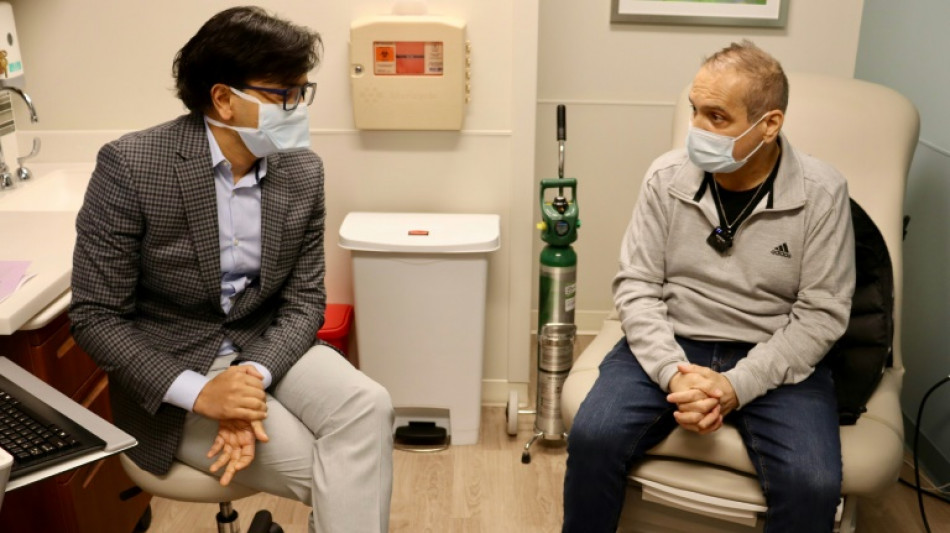
US doctors announced Thursday they had successfully performed a double lung transplant on a patient with terminal lung cancer, giving new hope to others who also have advanced stages of the deadly disease.

Text size:

Albert Khoury, a 54-year-old non-smoker, underwent a seven-hour surgery to receive his new lungs at Northwestern Medicine in Chicago on September 25, 2021.

Six months on, the lungs are working well and he has no signs of cancer in his body.

"Lung transplantation for lung cancer is extremely uncommon with few cases reported," Ankit Bharat, chief of thoracic surgery at Northwestern Medicine, said in a statement.

"For patients with stage 4 cancer, lung transplantation is considered a complete 'no-no,' but because Albert's cancer was confined only to his chest, we were confident we could clear all the cancer during surgery and save his life."

Surgeons are generally reluctant to proceed with such transplants because if there are even a few cancerous cells remaining, there is a strong chance they will regrow in a patient taking immune-suppressing medications to prevent organ rejection.

The few such procedures in the past have not been successful, but since then, advances have allowed doctors to better understand cancer's spread.

In early 2020, Khoury was working as a cement finisher for the city of Chicago, when he began to experience back pain, sneezing, chills, cough and mucus. At first he assumed it was Covid, but called his doctor when he coughed up blood.

"They discovered stage 1 lung cancer, but due to the Covid-19 surge, I couldn't begin treatment right away," he said in a statement.

By July 2020, his cancer progressed to stage 2, and, despite several rounds of chemotherapy, kept growing to stage 3 and stage 4.

He was told there was no chance of survival, but his sister told him about the pioneering lung transplants at Northwestern.

- 'Can't stop smiling' -

In 2020, Bharat led a team that performed the first double lung transplant on a woman in her twenties whose lungs had been decimated by Covid.

Khoury came under the care of oncologist Young Chae at Northwestern who wanted first to try other cancer-fighting treatments -- but his health kept declining, leaving him in an intensive care unit with pneumonia and sepsis.

It was determined that he was in fact a candidate for transplant since the cancer, despite being stage 4, had not spread to other organs, and he received his new lungs after a two-week wait.

The team had to remove "trillions" of cancer cells all over his lungs within a six hour time frame, all the while taking care not to spill material into his chest cavity or blood stream.

"It was an exciting night," said Bharat.

Khoury is now leading a normal life, and is able to work and go to the gym, without requiring breathing support.

"My life went from zero to 100 because of Northwestern Medicine," he said.

"You didn't see this smile on my face for over a year, but now I can't stop smiling."

Based on the success, Bharat and Chae are developing a new set of protocols to determine who else might be eligible for such treatment.

Lung cancer is by far the leading cause of cancer-related deaths in the United States making up almost 25 percent of all cancer mortalities.

H.Hayashi--JT